Tuesday, May 12, 2015

A Monster of Nature Comes to Ghosts of the Heart by John Bradford Branney


Follow Author John Bradford Branney on Facebook


Allow me to set the stage for this blog posting about Ghosts of the Heart, the second book in the Shadows on the Trail Trilogy by John Bradford Branney. Imagine that you are living almost 11,000 years ago in what would thousands of years later be called North America. You and your tribe of First American explorers are literally surviving hand to mouth. You have no possessions that you can not carry. You and your tribe follow the seasonal migration of the herds of Pleistocene mammals. You learned how to survive in this harsh and unforgiving land when you were just a child. You know nothing about science or weather or the physical phenomena of nature. Since you and your people are always one step away from annihilation, you do not have time to ponder anything except where your next meal is coming from and surviving for another sun. One day, you see the sun cloaked into darkness and after that, complete chaos. An unknown beast is coming alive!! You believe the gods are angry, but you don't know why. What is happening in front of your eyes is a horrific mystery that cannot be explained. 


The following text in blue is from my book Ghosts of the Heart, the second book in the Shadows on the Trail Trilogy. Nahuu was the leader of a hostile band of warriors who were tracking down the heroes of my prehistoric trilogy, the Folsom People. This was what happened.


Nahuu watched the billowing dark clouds to the north of the war party. The dangerous looking storm was crossing the trail the hunters had left to the north. Nahuu and the war party would wait the storm out before continuing their hunt. Iinii stood next to Nahuu, watching the black-tinged clouds swirling and bubbling in the sky. No one in the war party had ever seen a storm like this and the warriors stood there frozen, staring up into the clouds. On the west side of the storm, small swirling claw-shaped clouds descended out of the larger clouds. Each of the claws grasped the sky, like talons from a bird of prey. Then as quickly as the talons appeared, they disappeared back into the cloudbank.
While the large cloudbank slowly rotated through the sky, the talons lengthened and shortened, spiraling left and then right, until they disappeared into the clouds above. The warriors watched the dark clouds with both fear and awe.
While most of the warriors watched the talons in the northwest appear and disappear, Nahuu kept his eye on the furious thunderstorm to the north. The winds gusted when the two powerful storms collided. The sky erupted with lightning and thunder. Out of the storm clouds, five talons dropped down, swirling and twisting their way to the ground.

The five talons gently swayed in the sky, hypnotizing the warriors into believing there was less danger than there actually was. The five talons then touched each other and then quickly separated while ascending back up into the cloudbank. They suddenly reappeared as two larger talons. The two talons swirled and danced while a bolt of lightning struck a dead pine tree, showering the warriors with shards of wood. By the time the warriors looked back up in the sky, the two talons had become one.   

The pointed talon swirled in the sky, its shape weaving back and forth. The talon suddenly lunged towards the ground, colliding into the ground and the dead pine trees. The air erupted with the dust and dirt that climbed up the funnel cloud, turning its color from gray to brown. The Arid Plains lit up with lightning and shook from the thunder as the funnel cloud metamorphosed into a beast, a gigantic tornado that was ripping dead pine trees from the ground by the hundreds and tossing them across the Arid Plains. The war party stood there on the hill, too petrified to move as this monster of nature came towards them.
                                                                                                                                                   
Well, what do you think? What would you have done? Read Ghosts of the Heart to find out what Nahuu and his warriors did. Ghosts of the Heart is available at better booksellers everywhere. Click Here to Purchase John Bradford Branney Books.    


Monday, April 20, 2015

Bipointed Ultrathin Knife Forms

Figure One. 6.8-inch long bipointed knife form surface found in the 1950s on private
land near the town 
of Farson in the Eden Valley of Wyoming.
John Bradford Branney Collection.


My historical fiction book series titled the SHADOWS on the TRAIL Pentalogy is about the Folsom Paleoindian culture, a mysterious group of hunters and gatherers who lived over 12,000 years ago. In other articles, I have written about various components in the Folsom stone tool kit, but one tool I have not written about is the laurel leaf or bipointed knife form. That will be the focus of this article.  

What is a laurel leaf or bipointed knife form? In most cases, a descriptive name adds clarity to the description of something. In a few cases, a descriptive name causes confusion. In the case of laurel leaf or bipointed knife forms, the name adds clarity. Bipointed knife forms were named for prehistoric stone knives that have dual points, one on each end of the artifact. In the prehistoric record, bipointed knife forms have worldwide distribution and are currently the oldest continually made tool form in human prehistory. The oldest documented example of a bipointed knife form comes from Africa where investigators believe it is around 75,000 years old.

Figure Two. Cross-section of the bipointed ultrathin knife form in figure one.
John Bradford Branney Collection.

What does a bipointed knife form look like? Figure one is a photograph of an extremely rare bipointed knife form. This prehistoric knife form is not only a bipointed, it is an ultrathin bipointed knife form. This 6.8-inch-long, heavily patinated, bipointed knife form was found in the early 1950s on a private ranch near the town of Farson in the Eden Valley of Wyoming. The original material, before pedogenic carbonate took it over, appears to be a moderate brown jasper. You can barely see a touch of moderate brown jasper near the base of the knife form in the lower right-hand corner of the photograph. I told you; you can barely see it. 

How thin are ultrathin knife forms and how thin is the knife form in figure one? Very thin! Figure two is a photograph of the cross-section of the bipointed ultrathin knife form in Figure one.  The width of this bipointed ultrathin knife form is 58 millimeters and the thickness in the middle of the knife form is only 5 millimeters for a width to thickness ratio of 11.6, well within the ratio investigators use to define ultrathin knife forms.

Figure Three. CLICK for INFO

In my books from the SHADOWS on the TRAIL Pentalogy, the Folsom culture made some of the finest bipointed knife forms in existence. The ultrathin knife form in figure one exhibits another Paleoindian characteristic; thin, wide, and long flaking patterns resulting in overshot and over-the-face flaking patterns, I am confident that a Paleoindian made the knife form in figures one and since the Folsom culture specialized in ultrathin knife forms, it might have been a flintknapper from that culture who made the knife form sometime around 12,000 years ago. Since this bipointed ultrathin knife form was a surface find and not found in a dated and/or stratified archaeological context I will never know for sure who made it and when. 

What are some of the characteristics of bipointed knife forms? One of the best reference books on the subject of bipointed technology is titled Bipoints Before Clovis by William Jack Hranricky. This is the only book that I have found that explores bipointed technology in any detail. I encourage you to pick up this book if you are interested in A to Z on bipointed knife forms. I will be using the information from his book to go through the characteristics of bipointed knife forms below.  


Figure Four. CLICK to ORDER


Bipointed knife form technology has been in North America for a very long time and bipointed knife forms can be some of the oldest prehistoric tool forms in North America. A few investigators believe the technology arrived in North America via Europe around 20,000 years ago (evolved from Solutrean laurel leaf bifaces according to the book Across Atlantic Ice by Dennis Stanford and Bruce Bradley). That was a long time before the 13,000-year-old Clovis culture. The distribution of bipointed knife forms in North America appears to range from pre-Clovis sites to historical Indian sites. Therefore, it is virtually impossible to assign an age to a bipointed knife form with 100 percent assurance if the artifact was surface found and out of archaeological context.  

At the time Hranricky published Bipoints Before Clovis, there were no documented associations between bipointed technology and Clovis technology. Let me repeat that because I think it is an important observation. At the time Hranricky published his book, there were no known examples of bipointed technology found with Clovis cultural material. It appears that Clovis people preferred other knife forms, such as ovate or fluted knife forms. The Folsom culture was a different story. Investigators have tied some of the finest bipointed knife form examples in North America to the Folsom culture.

Figure Five. 4.6 inch long bipointed ultrathin knife form found by Keith Glasscock 
in Tom Green County, Texas in 1956. Ex Glasscock and Parrish Collections. 
John Bradford Branney Collection.     

How are bipointed knife forms made? They can start out as either a biface or a blade. 

What is a blade? A blade is a rock flake struck off the core rock. A blade is several times longer than its width. Prehistoric knappers produced bipointed knife forms from blades and finished them off as dual-pointed knife forms. Prehistoric people rarely used them as projectile points.   

Figure Six. 4.2-inch-long bipointed ultrathin knife form found by Bob Knowlton with
a grouping of other artifacts and bone material on a possible kill site in western Colorado. 
John Bradford Branney Collection 

Figure six is an example of how difficult it is to determine the age of a bipointed ultrathin knife form found on the surface of the ground and out of archaeological context. When I first saw this knife form my first opinion was that it was Paleoindian all the way. It has the wide, thin, and long flaking patterns that Paleoindians preferred, and the knife form was uber thin like an ultrathin knife form should be. I would have bet Paleoindian. 

Robert Knowlton surface found the bipointed ultrathin knife form in figure six on a private ranch in western Colorado near Grand Junction. Mr. Knowlton found this knife form with several other similar knife forms, two diagnostic projectile points, a pottery rim, and scattered and weathered deer bones. The finder believed he discovered a prehistoric deer kill site. As mentioned, Mr. Knowlton discovered a non-diagnostic pottery rim and two heavily serrated San Pedro dart points with the bipointed knife forms. He had no reason to believe they were unassociated. San Pedro projectile points were Late Archaic with an age somewhere between 2,500 and 1,800 years old, well after Paleoindian time. So much for my opinion that a Paleoindian made it.  

Unfortunately, Mr. Knowlton broke up the entire artifact suite and sold it piecemeal, artifact by artifact. It would have been much better if he had left all the artifacts together and sold them as the result of a single archaeological event.     

Bipointed knife forms have similar morphological characteristics (shape and form) that were consistent across a long span of prehistory. Therefore, unless the bipointed knife form is found within a dated context on an archaeological site or in a single cultural event such as figure six, it is difficult to tie a bipointed knife form with 100 percent certainty to any specific culture or chronology.

Figure Seven. CLICK to ORDER


One more example of a bipointed ultrathin knife form is shown in figure eight. This 7-inch long bipointed knife form was found on private land in Weston County, Wyoming. The knife form exhibits the wide, shallow percussion flakes favored by the Paleoindians, as well as fine pressure flaking along the edges. I would love to say this knife form was from the Folsom Paleoindian culture, but I cannot. It was not found with other Folsom materials and it was a surface find. Based on the prehistoric evidence of bipointed ultrathin knife forms, this bipointed knife form could have been made at any time during our country's prehistoric past.


Figure Eight. 7-inch long bipointed knife form was found on private land
in Weston County, Wyoming. John Bradford Branney Collection. 

    
I hope you enjoyed this article and learned something about bipointed knife form technology like I did when I researched the topic. If you get a chance please check out my SHADOWS on the TRAIL Pentalogy book series and join me on the adventure! Once you have read the series, please let me know what you think. 


John Bradford Branney holds a geology degree from the University of Wyoming and an MBA from the University of Colorado. He held various duties in the oil and gas industry for thirty-four years before taking up his writing. John has published eleven books and many magazine articles on prehistoric America and life in general. John lives in the Colorado mountains with his wife, Theresa, three German Shepherds, and a feral cat.


Wednesday, March 25, 2015

THE PREHISTORIC ART OF BLADEMAKING


Figure 2.1 - Dorsal side of a 4.9-inch-long unifacial blade,
surface recovered on private land in south-central Wyoming. 

John Bradford Branney Collection.

Figure 2.1 is a wonderful example of the dorsal side of a well-flaked side scraper on a unifacial blade that was surface recovered on private land in south-central Wyoming. After the knapper removed the blade from the core, he or she worked a scraping edge onto it. The ventral face of the blade is smooth with a slight bend and a small amount of linear retouch (figure 2.2). The ridge or aris running down the dorsal face of the blade is the scar from two previous blade removals from the blade core. Since this was a surface find out of archaeological context, I cannot say for sure that someone from the Clovis prehistoric culture made it. 
 
Figure 2.2 - Ventral side of the 4.9-inch-long unifacial blade in figure 2.1, surface recovered
on private land in south-central Wyoming. 
John Bradford Branney Collection.


My prehistoric adventure book series is called the SHADOWS on the TRAIL Hexalogy, and it is about prehistoric people who existed over 12,000 years ago, called the Folsom People. These people roamed North America in the Late Pleistocene from around 12,900 to 12,200 years ago. I have published several articles about the Folsom Paleoindian culture, so I won't be writing about them in this article. I am focusing my writing for this article on unifacial blades, but I will be comparing the toolmaking of the Clovis prehistoric culture with the Folsom prehistoric culture.

Figure 2.3 -  A Recent Book - CLICK to ORDER

In the archaeological record of the High Plains of North America, at least two distinct cultures or complexes preceded the Folsom complex, Clovis, and Goshen. Many people contend that the Clovis people were the ancestors of the Folsom people, but there is no archaeological evidence that defines the relationship between Clovis and Folsom. Since neither the Clovis nor the Folsom culture left behind any written transcripts, we must speculate as to their relationship with what these people left behind in recorded archaeological sites. This is insufficient at best when trying to establish the cultural relationships between two prehistoric peoples.  

We know from radiocarbon dating and geology the general time frames when the Clovis and Folsom cultures existed. We know from their campsites and kill sites what they ate and generally how they lived. We know that both cultures focused a good part of their sustenance efforts on big game. Based on the archaeological record, the Clovis culture was known as a mammoth-hunting culture, while the Folsom culture focused on bison and smaller game. However, based on archaeological data, both cultures were not too proud to eat almost any animal, no matter its size or taste.   

There were a few differences between Clovis and Folsom that investigators see in the archaeological record related to lithic or stone tool technologies. We know that both Clovis and Folsom fluted their projectile points and that the fluting process for Folsom was more involved and intricate than that of Clovis. On some of the Clovis points in my personal collection, fluting appeared to be an afterthought or not a significant part of the process at all, while fluting on Folsom was the critical deliverable that defined Folsom.  

Figure 2.4 - Probable Clovis blade surface recovered 
5/24/2003 in an arroyo in Weld County, Colorado.
John Bradford Branney Collection.   
Folsom flintknappers made very thin bifaces with biplanar or biconcave profiles, instead of the typical biconvex biface profile of Clovis flintknappers. We call these thin Folsom bifaces ultrathin knife forms. I have previously published articles on ultrathin knives, so I will not cover them here. 

We also saw an increase in the making and use of end scrapers from Clovis to Folsom. End scrapers appear to have been a much more prevalent part of the stone tool kit during Folsom times.

One of the most intriguing differences between Clovis and Folsom stone tool technologies was the heavy use of blades by the Clovis culture. After Clovis, the archaeological record showed a significant drop off in blade knapping and usage. Although investigators do find an occasional blade in Folsom and later tool assemblages, blades were more of an exception in the post-Clovis record.

Figure 2.4 is a probable 3.3-inch-long Clovis unifacial blade surface recovered by me in a small arroyo in Weld County, Colorado, on May 23, 2003, and made from a gem-quality, pale red Flat Top Chalcedony. The length-to-width ratio on his blade is 3.3 to 1. The blade demonstrates linear retouch along all its edges. Two other blades and two Clovis projectile points have been surface recovered by me in this same arroyo.


Figure 2.5 - A handful of stone tools on blades for cutting, drilling, gouging, and scraping. 
John Bradford Branney Collection.


Blades are one of the most misunderstood terms in North American archaeology. Some people refer to unnotched projectile points or any kind of stone knife as a blade. Or if a well-made knife form does not have a hafting notch component, it instantly becomes a blade. The above examples should be called bifaces, not blades! Over the past few years, there has been a concerted effort from professional and amateur archaeologists alike to call bifaces what they are: bifaces! And to call blades what they are; blades! I understand old habits are hard to break, but we should try to call them by the appropriate terminology.

According to Bradley, Collins, and Hemmings in their book Clovis Technology, blades are defined as specialized, elongated flakes intentionally detached from a core selected and prepared for that purpose. These flakes or blades are often twice as long as they are wide. 

Figure 2.6 - 3.4-inch-long unifacial blade surface found on private land on 5/5/2015 in central Wyoming. The Paleoindians who made this blade used it as a knife. The lower left-hand corner of the piece also has a graver tip. Material is a greyish-red Tiger Chert. John Bradford Branney Collection.    

How did the Clovis People make blades? 
Figure 2.7 is from another wonderful book titled Clovis Blademaking Technology, written by Michael Collins. A general overview of how we think Clovis People produced blades is as follows: the Clovis flintknapper found a suitable rock or cobble (2.7 a), which allowed the flintknapper to remove as many blades as possible from the blade core. The flintknapper started the process by knocking off one end of the cobble with a hammerstone (2.7 b). The resultant fractured surface on the end of the cobble then became the striking platform for subsequent blade removals.


Most cobbles selected by the flintknapper had at least one face that was pointed or convex enough for the flintknapper to remove the first blade. When the knapper removed this first blade, cortex or rock rind covered it. Cortex partially covered subsequent blades (2.7 i) until the cortex was completely gone from the blade core. If the cobble did not have a suitable pointed or convex face, the flintknapper created a ridge on the cobble through bifacial flaking (2.7 c and 2.7 d). This bifacial ridge is called the crest and the detached triangular blade that came from the crest is called a crested blade (2.7 e and 2.7 g). Once the flintknapper removed several blades from the blade core, it looked something like 2.7 f.

Figure 2.8 - High Plains blades, showing the variety of shapes and sizes.
Blades were used for cutting, scraping, gouging, drilling, and slicing. The longest
blade in the frame is 4.3 inches long. John Bradford Branney Collection


Even though we want to adhere to our definition of a blade twice as long as it is wide, blades come in all shapes and sizes. While some blades show very little modification by a human hand, other blades are well-worked. While some blades were purposely used for cutting only, other blades had drilling, scraping, cutting, engraving, and gouging functionality. Figure 2.8 shows a variety of shapes and sizes of unifacial blades from the author's collection. 

One of my big regrets is not learning about blades earlier in life. I wonder how many blades I walked over in the field without giving them a second glance because I thought they were just chipping debris. Having a real answer to that question might give me heartburn. That is why, when I artifact hunt now, I pick up and inspect every suspicious flake  

What makes my prehistoric artifact passion so fun is learning something new each and every day!


Figure 2.9 - CLICK for MORE INFORMATION


Wednesday, March 11, 2015

The Hell Gap Complex Along the SHADOWS on the TRAIL


Figure One - Flintknapping technology from Agate Basin to Hell Gap projectile points. 
The point on the far left is Agate Basin, while the other three points are Hell Gap. For  
 scale, the Agate Basin point is 2.45 inches long. 
John Bradford Branney Collection.   


In figure one, I photographed four high plains projectile points from my collection: on the far left is a 2.45-inch-long Agate Basin projectile point, and on the right are three Hell Gap projectile points. Bradley (1991:382) proposed that the manufacturing process for Hell Gap projectile points was an outgrowth of a well-developed Agate Basin projectile point technology. He postulated that the production sequence was the same for both projectile point types: first, there was percussion thinning and shaping, followed by pressure thinning and shaping. Bradley stated that the makers of Hell Gap projectile points just terminated their flintknapping process earlier than the makers of Agate Basin projectile points. 

Fortuitous circumstances led to the discovery of the Hell Gap archaeological site in southeastern Wyoming. Since its discovery over sixty-some years ago, Hell Gap has become one of the most important archaeological discoveries in North America and the type site for the Hell Gap projectile point. 

On May 22nd, 1958, James Duguid and his family were travelling north along a gravel road between Guernsey and Lusk, Wyoming, along the eastern flank of the Hartsville Uplift. Along came one of those afternoon rain showers that temporarily flooded a low spot in the road. The floodwaters forced the family to stop and allow the water on the road to drain. The family bided their time by walking and artifact hunting in the immediate area. Duguid discovered some interesting artifacts in an arroyo and promised himself that he would return the next day to finish the hunt (Duguid 2009:313-314).


Figure Two - A 2.55-inch-long Hell Gap projectile point/knife form surface found
on private land in Morgan County, Colorado, and made from a pretty
caramel-colored j
asper. John Bradford Branney Collection. 

Duguid and a friend returned to the site the next day, and Duguid found a complete Agate Basin point along with a lot of flintkapping debris. He returned to the site with his father and another friend the very next day, on May 24th. Duguid's father, Otto, discovered what appeared to be a Paleoindian projectile point eroding from a cutbank. That point was later determined to be a Hell Gap projectile point. Between his father's Hell Gap point and his Agate Basin point, Duguid recognized that they stumbled upon a very special place. However, he was hesitant to report the site to professional archaeologists because he knew that there were archaeologists who failed to report and document other excavated Paleoindian sites in the area. Duguid was worried that the same fate might befall his newly discovered secret.   

Figure Three - The Hell Gap Paleoindian site
in the late 1960s.


In the fall of 1958, James Duguid began working on his geology degree at the University of Wyoming. In the fall of 1959, Duguid reported the site to University of Wyoming anthropology professor George A. Agogino. The professor convinced Duguid to take him to the site to investigate it. Duguid and his father escorted Agogino to Hell Gap Valley, and the rest was history, or in that case, prehistory. 

Sixty-plus years later, archaeologists are still investigating the Hell Gap Site. Hell Gap remains one of the most important archaeological discoveries in the Western United States during the past one hundred years, and that came about because of an avocational archaeologist named James Duguid. 


Figure Four - A mixed hand of Agate Basin and Hell Gap projectile points collected
from the High Plains. Which points are Agate Basin and which are Hell Gap?
My answer is found in the last paragraph of the article. 


George Agogino (1961) defined the Hell Gap projectile point type from examples found in Hell Gap Valley and the archaeological site. Hell Gap projectile points were medium to large lanceolate-shaped points that were similar to Agate Basin points, except that the Hell Gap projectile points bore shoulders. Hell Gap stems were long and contracting. The blade edges from tip to base were either straight-to-concave or convex-to-straight-to-concave. The basal edges of the points were often ground and polished, which gave investigators an indication as to how far up the projectile point was hafted. The basal corners ranged from sharp to ground and polished smooth. 

 
Figure Five - Two examples of Hell Gap projectile points (o and p) found
in situ with Agate Basin projectile points at the Agate Basin site in 
eastern Wyoming.  Frison and Stanford (1982:101)


Based on excavated bison kill sites, it appears that Hell Gap Paleoindians participated in large, well-organized communal hunts for meat acquisition, much like their Paleoindian predecessors. Figure five is a photograph of a few projectile points excavated in a bison bonebed at the Agate Basin site in eastern Wyoming (Frison and Stanford 1982:101). In that photograph, two of the projectile points (o and p) were classic Hell Gap projectile points with shouldering. Those Hell Gap points were excavated from the same bonebed and stratigraphic level as Agate Basin projectile points. In addition to those two Hell Gap points, there were other examples of Hell Gap points excavated from the Agate Basin bonebed, which provided evidence of a relationship between the two point types. Based on the evidence, it seems likely that Paleoindians used Hell Gap points contemporaneously with Agate Basin points at the Agate Basin site. 
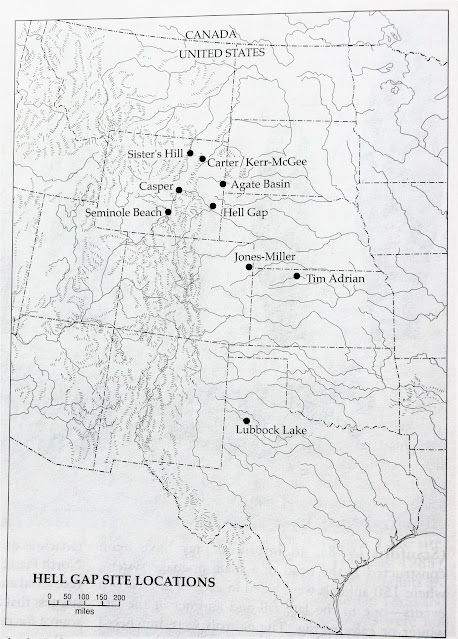

Figure Six - Select Hell Gap sites from Stanford (1999:318)


Stanford (1999:318) published the map in figure six of important Hell Gap sites along the High Plains. He noted that the number of Hell Gap sites was less than Cody and Folsom sites for the same area. Stanford made no assumptions or conclusions as to why there were fewer Hell Gap sites. 

The Casper Site was originally discovered by avocational archaeologists. George Frison (1974) investigated the Casper Site in central Wyoming and determined it was a late-autumn bison kill site where Hell Gap Paleoindians harvested around one hundred animals by immobilizing them in the deep and shifting sands of a parabolic dune.  

Using several Hell Gap point specimens from the Casper Site, Bradley (2010:487) proposed a special bifacial reduction process. He noted that Hell Gap flintknappers achieved the general shape and regularity of the biface by serial percussion thinning on one side with a hammerstone. In the world of flintknapping, serial percussion thinning usually results in the arrises, i.e. the high ridges at the flake margins, trending in the same direction. The Hell Gap flintknappers skillfully controlled the spacing and the thinning flakes that crossed the surface of the biface. Many of the thinning flakes reached or almost reached the other edge of the biface. 

Figure Seven - Clovis point and three 
Hell Gap projectile points from the
Casper site (Frison 1974:74). 
The Hell Gap flintknappers then turned the bifaces over and percussion thinned from the opposite edge, creating bifaces with cross-sections resembling a parallelogram. After serial percussion thinning, the Hell Gap flintknapper shaped and straightened the margins of the biface using direct percussion with an antler or hammerstone or by selective pressure flaking. Hell Gap flintknappers used platform isolation and moderate-to-heavy grinding to prepare the striking platforms for percussion flaking. Unlike Clovis striking platforms, Hell Gap flintknappers used smaller and more convex-shaped striking platforms. Bradley found in his study of the Hell Gap projectile points from the Casper site that a few flintknappers used percussion flaking exclusively, while others chose to retouch the margin edges with pressure flakes, particularly near the tips and bases of the bifaces. Ultimately, the finished bifaces ended up with lens-shaped cross-sections. Figure seven represents the forms and flaking patterns of one Clovis and three Hell Gap projectile points found at the Casper Site.    

Cassells (1997:79) reported that in the summer of 1972, rancher Robert Jones Jr. uncovered bones and artifacts while levelling a ridge near his home near Wray, Colorado. Jones contacted a local anthropologist named Jack Miller, who conducted a few test excavations in the bonebed. Miller recognized the significance of the site and contacted archaeologist Dennis Stanford at the Smithsonian Institute. Full-scale excavations at the Jones-Miller site occurred between 1973 and 1978. 


The Jones-Miller investigations uncovered the bones of approximately three hundred bison in a shallow arroyo above the Arikeree River floodplain. Based on bison tooth eruption patterns, the investigators determined that the animals were most likely killed during three episodes over one or more winters. The projectile points that the investigators found were mostly of the Hell Gap variety. Taylor (2006:207) reported and photographed what appeared to be Agate Basin points found with the Hell Gap points from a single kill episode at Jones-Miller. That either meant that Agate Basin and Hell Gap hunters were cooperating at that bison kill, or the mixture of point types represented the same complex using two different styles of points. In my opinion, the situation at Jones-Miller was most likely the latter. 

Stanford (1999:316-318) observed that during the refurbishment or resharpening of Hell Gap points, the flintknappers could narrow the blade edge enough to make the points indistinguishable from Agate Basin points. Peck (2011:55) lumped Agate Basin and Hell Gap into the same archaeological complex based on the overlapping projectile point technology and the association between the two-point types at several archaeological sites such as Agate Basin, Carter-Kerr McGee, and Jones-Miller. Peck reported an age of ca. 10,500 to 10,000 BP for Agate Basin materials and an age of ca. 10,000 to 9,500 BP for Hell Gap materials at the Hell Gap Site in Wyoming (Irwin-Williams et al. 1973:52). To obtain the age of the materials in calendar years, the radiocarbon ages must be corrected.         

Based on the archaeological evidence at Jones-Miller, the investigators proposed that Paleoindians trapped the bison in a topographical trough. The investigators found evidence that the Paleoindians might have used an enclosure or corral around the trough. Since the bison harvest took place in the wintertime, the investigators hypothesized that the entrance leading into the trough might have been slick with snow and ice, making it difficult for the beasts to escape. The hunters then trapped and dispatched the beasts with spears and possibly spearthrowers. Jones-Miller remains the only excavated Hell Gap site in Colorado. 

Figure Nine - From left to right: Two Hell Gap projectile points and two Alberta 
projectile points from my collection. Note the shouldering on the Hell Gap
projectile points and the stemming on the Alberta projectile points.  

What happened to the Hell Gap projectile point technology?     

Figure nine is a photograph of four projectile points from my collection. These projectile points represent a plausible technological transition from the shouldering on the first two Hell Gap points on the left to the stemming on the two Alberta points from the Cody Complex on the right. The notion that Hell Gap projectile point technology evolved into Alberta projectile point technology is also supported from a temporal perspective. Kornfeld et. al. (2010:237) reported that the Alberta component at the Hudson Meng bison kill site in Nebraska was approximately the same age as the Hell Gap component at the Casper bison kill site in central Wyoming. Both sites were dated to around 10,000 years BP (uncorrected radiocarbon date). While Hell Gap hunters were trapping bison in a parabolic sand dune in Wyoming, Alberta hunters were trapping bison in an ancient arroyo in Nebraska.    

I hope you enjoyed the article. I am currently writing the sixth book in my SHADOWS on the TRAIL Hexalogy. Check out the series if you enjoy adventures about Paleoindians living on the High Plains.

Oh, I almost forgot about the projectile point types in figure four above. From left to right, the point types are Agate Basin, Hell Gap, Agate Basin, Hell Gap, and Agate Basin.     

Until next time, HAPPY TRAILS!  


References Cited.  

Agogino, George A. 1961. A New Point Type from Hell Gap Valley, Eastern Wyoming. American Antiquity 26: 558-560, Salt Lake City.  

Bradley, Bruce A. 1974. The Lithic Technology of the Casper Site Materials in The Casper Site: A Hell Gap Bison Kill on the High Plains, edited by George A. Frison. Academic Press. New York.   

Bradley, Bruce A. 2009. Bifacial Technology and Paleoindian Projectile Points in Hell Gap: A Stratified Paleoindian Campsite at the Edge of the Rockies, edited by Mary Lou Larson, Marcel Kornfeld, and George C. Frison. 

Bradley, Bruce A. 2010. Paleoindian Flaked Stone Technology on the Plains and in the Rockies in Prehistoric Hunter-Gatherers of the High Plains and Rockies. Third Edition. Edited by Marcel Kornfeld, George C. Frison, and Mary Lou Larson. Left Coast Press. Walnut Creek.      

Cassell, E. Steve. 1997. The Archaeology of Colorado. Revised Edition. Johnson Books. Boulder.   

Duguid, James O. 2009. A Paleoindian Site Discovery in Hell Gap: A Stratified Paleoindian Campsite at the Edge of the Rockies, edited by Mary Lou Larson, Marcel Kornfeld, and George C. Frison.    

Frison, George A. 1974. The Casper Site: A Hell Gap Bison Kill on the High Plains. Academic Press. New York.   

Frison, George C., and Dennis J. Stanford. 1982. The Agate Basin Site. Academic Press. New York.

Irwin-Williams, Cynthia, Henry Williams, George Agogino, and C. Vance Haynes. 1973. Hell Gap: Paleo-Indian Occupation on the High Plains. Plains Anthropologist. 18(59):40-53.  

Peck, Trevor R. 2011. Light from Ancient Campfires. AU Press. Edmonton.  

Stanford, Dennis. 1999. Paleoindian Archaeology and Late Pleistocene Environments in the Plains and Southwestern United States in Ice Age People of North America, edited by Robson Bonnichsen and Karen L. Turnmire. Oregon State University Press. Corvallis.    

Taylor, Jeb. 2006. Projectile Points of the High Plains. Sheridan Books. Chelsea.   


About the Author. 

John Bradford Branney started collecting prehistoric artifacts in Wyoming with his family at the ripe old age of eight years old. He has amassed and documented a prehistoric artifact collection numbering in the thousands. He has written eleven historical fiction books and over ninety papers focused on Paleoindians, prehistoric artifacts, and geology. Branney holds a B.S. degree in geology from the University of Wyoming and an MBA in finance from the University of Colorado. He lives in the Colorado Mountains with his family.