Wednesday, September 30, 2015

Wild Horses - Living Artifacts from our Great Past!

CLICK TO VIEW ALL JOHN BRADFORD BRANNEY BOOKS


My latest book WHEN LEAVES CHANGE COLOR is about the introduction of horses to the Plains Indians in the late 17th Century. I dedicated the book to the wild horse herds in North America. When I wrote WHEN LEAVES CHANGE COLOR I wanted to portray the majesty and nobility of America's wild horse herds. Whenever I travel across the desert basins of southwestern Wyoming I always try to take a detour off the highways to see if I can capture a glimpse at the splendor and beauty of America's last wild horse herds. Even with the modern world encroaching on their environment from almost every direction, the wild horses maintain their nobility and desire to remain free. These proud creatures represent a living and breathing historical link to our country's past. When these wild horse herds are finally gone, America will lose yet another link to the country's greater past.
Wild horses in the Washakie Basin of Wyoming.
Photograph by John Bradford Branney. 

At the beginning of the 20th Century, there were approximately one million wild horses in the western United States. Over the last one hundred years plus, poachers, mustangers, developers, ranchers, energy companies and the federal government have cut deeply into the wild horse herds. Today, there are less than twenty-five thousand wild horses left and their environment and lifestyle continues to be attacked. The cattlemen and sheep ranchers want what is left of the meager desert rangeland while the oil men and miners want what is buried under the surface of the desert. Wild horses must also compete with antelope, deer, and elk. The ironic part is when newspaper articles blame wild horses for the destruction of the desert rangelands.
Wild horses along Powder Rim in Wyoming. Photograph by John Bradford Branney.  


What can we do about it? Write your congressman! Adopt a wild horse if you have the land! If we do nothing, within the next few decades, the wild horse herds will disappear from North America and the indomitable spirit of the wild horses will become only a memory.

Wild horses along the Wyoming - Colorado border north of Craig, Colorado.
Photo by John Bradford Branney.


Friday, July 31, 2015

From Clovis to Hell Gap - Overlapping Technologies?

Figure One - Paleoindian Projectile Point evolution from oldest on the left to old on the right.
From left to right, Clovis (northern Colorado), Goshen (Nebraska Panhandle), Folsom
(northern Colorado), Agate Basin (north-central Colorado), and Hell Gap  (eastern
Colorado). For scale, Hell Gap is 2.55 inches long. John Bradford Branney Collection. 

Using radiocarbon dating and geology, scientists are able to establish age ranges for different prehistoric cultures and the associated stone projectile point types. For example, scientists estimate that the Folsom prehistoric culture existed from around 10,900 to 10,200 RCYBP. This is based on a 10,900 RCYBP age from the Hanson site in northern Wyoming and a 10,200 RCYBP age from the Hell Gap site in southeastern Wyoming. This means that when I find a Folsom projectile point out on the surface of the prairie, I pretty much know how old it is and who made it. As more and more archaeological evidence is unearthed, scientists will fine-tune the Folsom prehistoric culture and age.

Without getting too far into the weeds, I want to explain the above dates, the 10,900 to 10,200 RCYBP. Those dates are uncalibrated or uncorrected radiocarbon dates, often referred to as Radiocarbon Years Before Present, with Before Present representing the year 1950. Archaeologists and scientists oftentimes publish uncalibrated or uncorrected radiocarbon ages like the above, even though uncalibrated radiocarbon dates can be misleading and do not tie up well to calendar years. For example, 10,000 RCYBP (uncalibrated radiocarbon years) corrects to approximately 11,695 to 11,336 calendar years from 1950, depending on the correction model used. And 11,000 RCYBP corrects to approximately 13,000 calendar years; two thousand years of correction going from uncalibrated to calibrated radiocarbon dates!  When you read an author quoting Clovis at 11,000 years bp that is an uncalibrated radiocarbon date. The Clovis prehistoric culture was really around 13,000 calendar years old. So be careful when you are looking at ages and dates. For more information, see my article on Reporting Radiocarbon Dates.  

Below is a scene from my prehistoric thriller book series the SHADOWS on the TRAIL Pentalogy. In this particular scene from the first edition of my first book SHADOWS on the TRAIL, the leaders of  a Paleoindian 
Figure TwoCLICK for ADVENTURE
tribe found a spear point near the remains of their burning village.  From the style and technology of the spear point, Avonaco identified the people and culture who made the spear point and destroyed his village. In my book series, I emphasize my belief that certain Paleoindian projectile point types overlapped chronologically and geographically, and that Paleoindian projectile point evolution was not a serial process but more like a parallel process.  

Avonaco held the spear in his hands. The spear shaft was the same wood that the River People used, but the stone spear point was different. The stone spear point was thinner and longer than any Avonaco had ever seen and made from a shiny, black rock material. Avonaco ran his thumb down the sharp edge of the spear point and quickly pulled his thumb away.

Éŝkos!–Sharp!” Avonaco exclaimed, looking down at his bleeding thumb.

He continued to examine the spear point, “I have only seen a spear point like this once made from this black rock. When I was a boy, I found a spear point much like this deep in the mountains. My father told me the black rock comes from the mountains.”

Avonaco then inspected the sinew wrap that connected the stone spear point to the wooden spear shaft. The River People used sinew from deer or bison to attach their spear points. Avonaco pointed to the sinew and said, “This is too thin, it is not from bison or deer.”

Avonaco ran his fingers down the smooth wood of the spear and noticed it had carvings in it. To see better, Avonaco moved the spear shaft closer to the light of the campfire. Carved into the
wood were five green-painted peaks next to two orange-painted suns : ҉  Ʌ Ʌ Ʌ Ʌ Ʌ  ҉   Waquini and Vipponah leaned over Avonaco’s shoulders to take a better look.

Vipponah asked, “Tipis?”

Avonaco thought about this and replied, “Mountains, maybe.”
The spear point that Avonaco inspected was a calling card for the people who made it. Just like Avonaco, scientists and collectors interpret and analyze prehistoric clues from projectile points. While Avonaco noted the differences in material and projectile point style, scientists and collectors recognize the differences in projectile point technologies and tie them back to specific prehistoric cultures. 

Figure Three - Paleoindians making their way. 

                                                                                                                                              Archaeological evidence and radiometric dating lean toward specific Paleoindian projectile point types overlapping with other Paleoindian projectile point types in both time and space. The High Plains Paleoindian projectile point types in figure one represent a chronological and technological continuum from the oldest stone projectile point on the left, a Clovis point made sometime around 13,000 years ago to the youngest projectile point on the right, a Hell Gap point made sometime around 11,500 years ago (calibrated radiocarbon ages). The Clovis prehistoric culture was gone by the time Paleoindians started making Hell Gap styled projectile points, but Hell Gap most likely overlapped in time with other prehistoric cultures such as Agate Basin and the Cody Complex.  

One way to illustrate this is with Table One below. It shows the statistical age ranges for each of the prehistoric cultures represented in Figure One above. As a reminder, B.P. in this table represents uncalibrated or uncorrected radiocarbon dates from the baseline year of 1950. I don't want to get hung up on the actual ages because as more archaeological data surfaces and technology improves, these age ranges will become better defined. My point is that these projectile point types statistically overlap in time, just as archeological sites indicate that these projectile point types overlapped in geographical space. 

The age ranges in Table One are from a single source, the book Projectile Points of the High Plains by Jeb Taylor. You will find that ages for prehistoric cultures vary from book to book and that ages are periodically updated as radiometric technology improves, but what stays the same is the overlapping projectile point technology concept. As a reminder, the ages in Table One are uncalibrated or uncorrected radiocarbon dates. For example, Clovis and Folsom 'calibrated years ago' are around 13,000 and 12,600 years ago, respectively.           

Prehistoric Culture

Earliest Date

Latest date

Clovis
11,300 B.P.
10,600 B.P.
Goshen
11,000 B.P.
10,700 B.P.
Folsom
10,900 B.P.
10,200 B.P.
Agate Basin
10,400 B.P
9,000 B.P.
Hell Gap
10,400 B.P.
9,500 B.P.

Table One. B.P. is uncalibrated radiocarbon age in years benchmarked from 1950.

It should be noted that in some cases the width of the age ranges in Table One might not be due to overlap but to the sampling and technology limitations of the radiometric measurements. 

If the overlap is legitimate between Paleoindian projectile point types, it opens up a number of mind-blowing questions, such as were the different projectile point types made by the same or different prehistoric cultures? Were the changes due to manufacturing process differences or changes in style? Did different prehistoric cultures make different projectile point types and just utilize the same sites or did the same culture make the different projectile point types? Were these projectile point types made by prehistoric cultures with different religions, beliefs, and languages?

Figure Four - Paleoindian artifacts from the Author's collection. 
From left to right: Clovis, Goshen, Hell Gap, Agate Basin, 
and Folsom. Agate Basin is 4.6 inches long.    

There is a high probability that we will never know the answers to these questions, we can only speculate, but it is fun to ponder these questions anyway. 
There is currently no archaeological evidence that defines the relationships between the people and cultures who made these different projectile point types. Scientists fill in these blanks with conjecture and theory. As an author of historical fiction novels about Prehistoric America, these blank spaces provide me some latitude in my stories, as well as food for thought.   

When I wrote the SHADOWS on the TRAIL Pentalogy, I extensively researched the archaeological evidence from Folsom Paleoindian sites. I wrote my stories based on archaeological data combined with my own fictional spin and plot. I invite you to read the SHADOWS on the TRAIL Pentalogy and join the adventure.    


Tuesday, July 14, 2015

A Return to the SHADOWS on the TRAIL Site


Figure one - The 1.6-inch-long Lookingbill dart point I found on July 9, 2015
at the SHADOWS on the TRAIL Site.   


On an overcast and rainy July 9, 2015, I returned to the SHADOWS on the TRAIL Site in northern Colorado for a visit. At the time we were living in Houston, Texas. A building contractor was constructing our new home in the Colorado mountains and we were in town to check on his progress. I took the day off and instead of bugging the building contractor, I went artifact hunting at one of my favorite sites. Following is my story about the SHADOWS on the TRAIL Site.   
In the early 1980s, I discovered a copy of a master's thesis written in the 1960s about northeastern Colorado archaeology. The anthropology student visited several dozen archaeological sites in northern Colorado and then wrote about them. If I remember right, the grad student never discovered any of the sites himself but relied on information from old documents from archaeologists like E.B. Renaud (1931) or from word of mouth with local collectors or landowners. The master's candidate mostly surface-hunted the sites, although I do remember that he dug a couple of test trenches on a site or two. I studied that thesis from beginning to end and based on the locations described, I investigated most of the sites myself. 
I was mostly disappointed with the results of my master's thesis project. Local collectors knew about most of the sites and were hunting them for decades. However, there was one site, a possible jewel off the beaten path. The thesis barely mentioned that site, devoting less than one page to it. Thirty years and some change later I named that site SHADOWS on the TRAIL.   
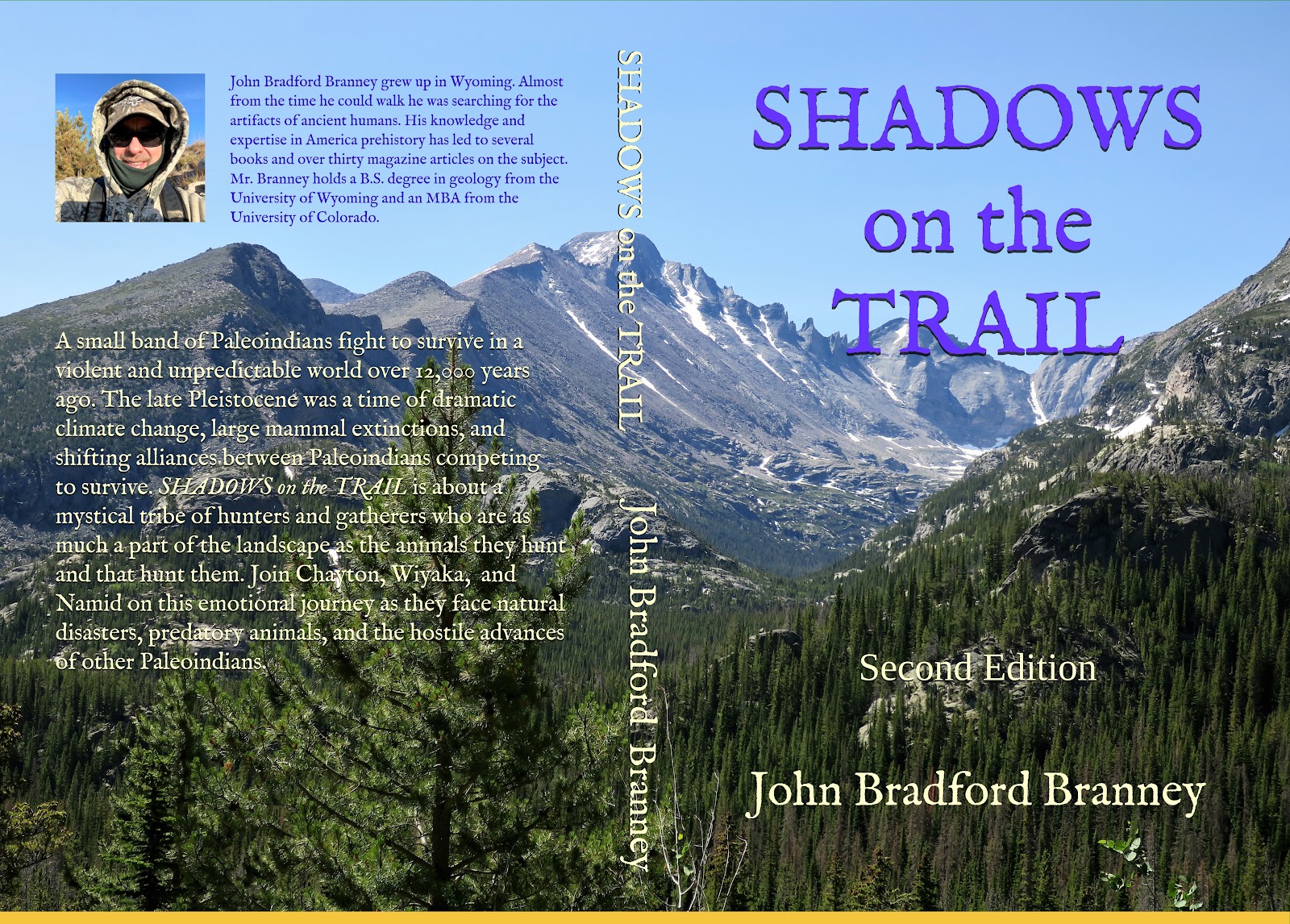
Figure Two - The first book in my historical fiction series 
about the Folsom People.  

On December 20, 1986, I made my first trip to the ranch where the site was. The road was not much better than a rutted Jeep trail. Back then, I was driving a front-wheel drive car with little ground clearance. I slowly drove on that glorified cow trail for about five miles never knowing when or where I might hit something hard enough to rip my car's oil pan off.  About two hundred yards away from the tiny ranch house, the road crossed a dry creek bed filled with sand. I punched the accelerator and the vehicle slid across the top of that sand like a toboggan on snow. I felt very fortunate that I made it through the sandy creek bottom without high-centering my low-slung vehicle in the sand. I concluded from the condition of the road that the ranchers didn't make it to town too often.
When I reached the ranch house, another surprise awaited me. The ranchers owned a humongous St. Bernard dog, and when it saw my car coming, it bolted off the front porch to greet me and my vehicle. The dog was tall enough to stand there on all fours and peer right into my driver's side window. Anyone who has ever been around St. Bernard dogs knows that they are world-class slobberers. That gigantic beast 'slimed' my car window from one end to the other with a mixture of gooey dog slobber and mud. 

Needless to say, I did not even try to get out of the car. Remember, the year was 1986, a few years after the horror book and movie titled Cujo came out. In the book, Cujo was a St. Bernard dog that was crazy nuts with rabies and trapped a young boy in a car. I won't tell you how the book ended, but it didn't end well for the boy or the beast. I wondered if that St. Bernard at my car window happened to be a relative of Cujo.  

The rancher's wife heard Cujo carrying on and she called the dog off. I was relieved that the beast did not eat my entire car for breakfast. Once I received permission to hunt artifacts, I headed off to the hills with Cujo tagging along behind. The dog stayed with me for about half the day and then became bored and headed back to the ranch house. On that first hunt, I didn't do that great, finding only three broken artifacts. However, there was a positive note to the hunt; I did find a bunch of chipping debris. Early humans were definitely there! I left the ranch thinking that the site deserved another look. 

Figure Three - Prehistoric fire hearth eroding from an embankment at the SHADOWS on the
TRAIL
Site. The photograph was taken by the author on July 9, 2015. 

 
Since that first visit to the ranch, I have watched the ranch change hands four times. My artifact hunting has somehow survived five different ranch owners, which is a modern miracle in itself knowing how getting access to large ranches has plummeted in recent years. Over that same period, I have found hundreds of artifacts on the site from early Paleoindian to the historical Indian tribes. I have found a dozen or so different diagnostic projectile point types representing different archaeological complexes. The site was occupied by various prehistoric cultures from over 13,000 years ago until the European settlers showed up in the 1800s. 
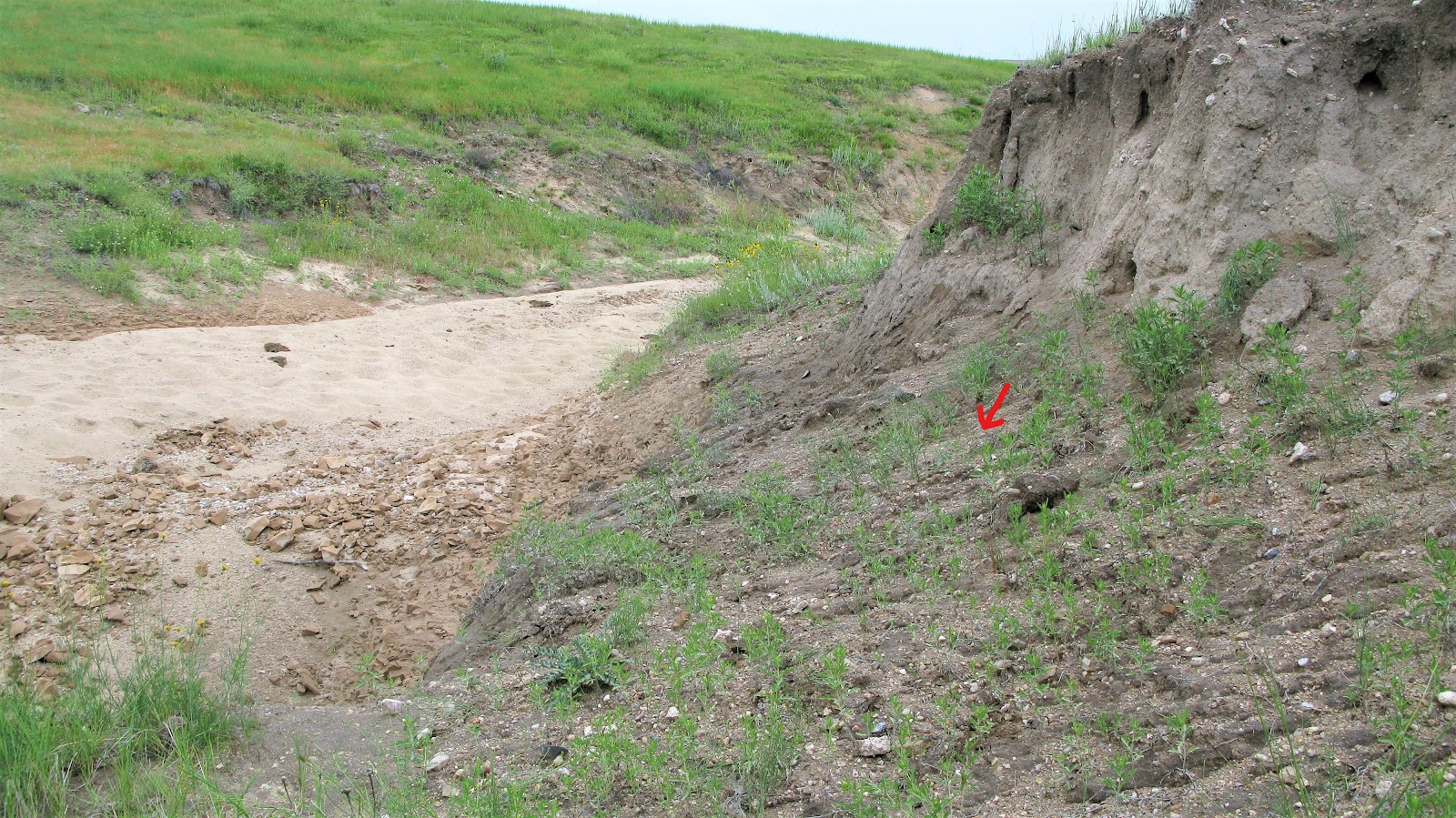
 
Figure Four - The cutbank where I found the 1.6-inch-long Lookingbill dart point
on July 9, 2015. Site in northern Colorado. The red arrow marks the spot. 

When I returned to SHADOWS on the TRAIL on July 9, 2015, the site did not disappoint me. One of the first artifacts that I found was the 1.6-inch-long Lookingbill dart point photographed in Figures one and five. Lookingbill dart points were made around 7,000 years ago. Dr. George C. Frison named Lookingbill points for a point type found in northwestern Wyoming (Frison 1983). Frison classified the Lookingbill points as Early Plains Archaic. Lookingbill points were one of the first point types on the High Plains of the Rocky Mountain states to be found in appreciable numbers associated with manos and metates.

Figure Five - 1.6-inch-long Lookingbill dart point as I found it on July 9, 2015. 


Lookingbill points were thin, small to medium-sized dart points with triangular blades and side notching. The shoulders were sharp and angular and the notches were rounded and sometimes close to the basal edge. The shapes of the bases ranged from straight to slightly concave. The Lookingbill point I found exhibited heavy grinding and polishing along the basal edge, accounting for a bit of its basal concavity.

On that July 9, 2015 artifact hunt, I found twenty-four prehistoric artifacts including the Lookingbill projectile point. 
 
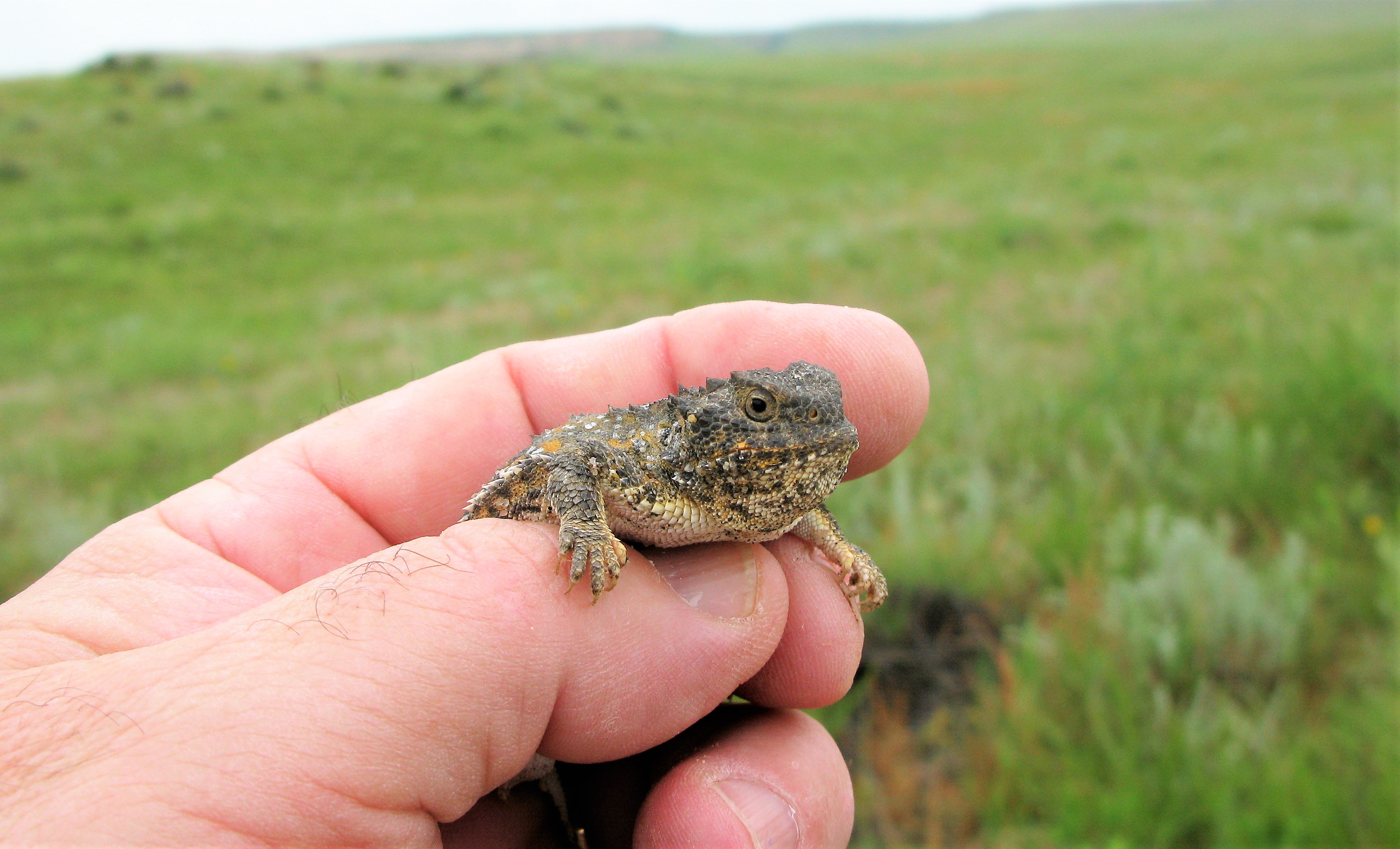
Figure Six - My hunting companion for about five feet or fifteen seconds on July 9, 2015. 
Horned toad claws are like sharp needles and that little guy was hanging on
to my thumb and finger for dear life.  

Several years before finding the Lookingbill point, on August 30, 2007, I found a 1
.36-inch-long Folsom dart point/knife form stuck in the clay-packed soil in an embankment on the ranch. When I spotted the tiny sliver of Flattop Chalcedony sticking out of the soil bank, I didn't have a clue it was an artifact. When I washed away the dirt clod surrounding it, I realized I found a Folsom point, the rarest of the rare! I was shocked, to say the least! (Figure seven).

That Folsom point was part of my inspiration behind writing my historical fiction book series about the Folsom People and that particular site titled SHADOWS on the TRAIL Pentalogy.   


Figure Seven - 1.36-inch-long semi-translucent Folsom point posing for a photograph after 
I washed the dirt off it. The embankment where it was found is behind the point.    

The true seed for my book series sprouted on a late Spring morning in 2010 at the ranch when I found a Paleoindian tool made from a red and gray striped rock from a prehistoric rock quarry in Texas (figure eight). As I stared down at a discoidal biface made by one of our First Americans, several questions raced through my mind. How did this tool end up in a prehistoric campsite in northern Colorado, five hundred miles north of its prehistoric rock quarry? Who made it? What was he or she like? What happened on its journey from Texas to northern Colorado? Since it was impossible to ask the Paleoindian who made that stone tool those questions, I wrote my own version of its journey from prehistoric Texas to Colorado.     

Figure Eight - 4.1-inch-long discoidal biface made from Alibates agatized dolomite and 
found on May 30, 2010. This artifact was the main inspiration for my book series 
SHADOWS on the TRAIL Pentalogy.  

Over the years I added more and more artifacts to my collection from the SHADOWS on the TRAIL Site, but artifact finds were becoming fewer and farther between. I was relying on erosion to keep up with my hunting pressure and it wasn't. On June 5, 2020, I surface recovered a 1.9-inch-long Scottsbluff dart point from the Cody Complex in a dry stream bed on the west side of the SHADOWS on the TRAIL Site (figure nine). That projectile point was the eighth Scottsbluff dart point/knife form that I have found on the site since 1986.   
 

Figure Nine - 1.9-inch-long Scottsbluff point that I found lying on top of
the sand in 2020. Of all the Paleoindian points I have found at the site, 
 Cody Complex and Goshen artifacts are the most common rarities.   


Rains ended a dry spell for Paleoindian artifacts from 2020 to 2023. On May 23, 2023, I discovered a 1.4-inch-long Midland or Goshen point eroding from an embankment (Figure ten). I am not sure whether that point is a Midland or a Goshen point. If it was a Midland point, it was the third diagnostic Midland artifact that I found at the site. I previously found two Midland projectile point bases on two separate occasions. If it was a Goshen point, it would be the tenth diagnostic Goshen artifact from the site.  


Figure Ten - 1.4-inch-long, very thin Midland point
found May 27, 2023. 

Goshen and Midland projectile points are very similar and when they are surface found out of their archaeological context, it is difficult to impossible to distinguish between them. The two projectile point types have more in common than they have differences. The criteria that I use to distinguish Goshen from Midland points found on the surface of the ground are 1). the aggressive basal thinning strikes on Goshen projectile points and 2). Midland points were flat and oftentimes bore fine pressure retouching around a good deal of the circumference of the point. Even those criteria are not conclusive. For example, the thin Midland projectile point in Figure ten has basal thinning strikes on one face. Is it a Goshen point or a Midland point, or does it really matter? For the answer to that last question, I refer you to Branney (2022). 

The Hell Gap site in eastern Wyoming is unparalleled in North America for its continuous record of Paleoindian deposits. Bruce Bradley (2009:259-262) in his analysis of bifacial technology at the Hell Gap site pondered the relationship between Goshen-Folsom-Midland.  Over the years, Bradley was involved in the Folsom-Midland debate and later in the Goshen-Plainview debate. At the Hell Gap site, Bradley was attempting to determine the cultural and technological relationship between Folsom and Midland, and Goshen and Plainview.   

Bradley struggled with determining tangible differences between Midland and Goshen and never came up with any definitive answers. He analyzed eight projectile points recovered from the Midland component at Hell Gap and identified one point as Folsom, two points as Goshen, one point as unclassified, and four points as Midland.

After that analysis, Bradley concluded, “As I look back at these classifications and reevaluate them in light of my confusion over the separation of the unfluted points, I am as unsure as ever that these categories are really meaningful. Nevertheless, I maintain my original classifications for those discussions.”


Figure Eleven - "G" was where I found the Midland point on May 27, 2023. "O" is an 
organic layer that runs through the site. I believe it represents the deposits during
the Paleoindian occupation at the site. 
 
Every artifact hunter or archaeologist needs a site like SHADOWS on the TRAIL. For me, it is a place where I can fulfill my artifact dreams, or at least try. The land is so beautiful and I am sure that was one of the reasons prehistoric people periodically occupied the site for over 13,000 years. When I am walking that land, I really don't need to find artifacts to enjoy myself. Finding the occasional artifact is an added bonus to the site. I have been 'skunked' on the site a few times, but what keeps me coming back is wondering what incredible artifact is lying there and waiting for me to return.  

References cited 

2009  Bradley, Bruce A.

"Bifacial Technology and Paleoindian Projectile Points" in Hell Gap, a Stratified Paleoindian Campsite at the Edge of the Rockies. The University of Utah Press. Salt Lake.  


2022  Branney, John Bradford
          "Unwinding a Twister-Goshen-Plainview/Midland". Academia.     

1983  Frison, George C. 

         "The Lookingbill Site, Wyoming 48FR308". Tibewa. 20:1-16.

1931  Renaud, E. B.
         Archaeological Survey of Eastern Colorado, First Report. Archaeological Survey,                  Department of Anthropology, University of Denver.   


About the Author


The historical fiction novels written by John Bradford Branney are known for their impeccable research and biting realism. In his latest blockbuster novel Beyond the Campfire, Branney catapults his readers back into Prehistoric America where they reunite with some familiar faces from Branney’s best-selling prehistoric adventure series the Shadows on the Trail Pentalogy.

John Bradford Branney holds a geology degree from the University of Wyoming and an MBA from the University of Colorado. John lives in the Colorado mountains with his family. Beyond the Campfire is the eleventh published book by Branney.


Tuesday, May 12, 2015

A Monster of Nature Comes to Ghosts of the Heart by John Bradford Branney


Follow Author John Bradford Branney on Facebook


Allow me to set the stage for this blog posting about Ghosts of the Heart, the second book in the Shadows on the Trail Trilogy by John Bradford Branney. Imagine that you are living almost 11,000 years ago in what would thousands of years later be called North America. You and your tribe of First American explorers are literally surviving hand to mouth. You have no possessions that you can not carry. You and your tribe follow the seasonal migration of the herds of Pleistocene mammals. You learned how to survive in this harsh and unforgiving land when you were just a child. You know nothing about science or weather or the physical phenomena of nature. Since you and your people are always one step away from annihilation, you do not have time to ponder anything except where your next meal is coming from and surviving for another sun. One day, you see the sun cloaked into darkness and after that, complete chaos. An unknown beast is coming alive!! You believe the gods are angry, but you don't know why. What is happening in front of your eyes is a horrific mystery that cannot be explained. 


The following text in blue is from my book Ghosts of the Heart, the second book in the Shadows on the Trail Trilogy. Nahuu was the leader of a hostile band of warriors who were tracking down the heroes of my prehistoric trilogy, the Folsom People. This was what happened.


Nahuu watched the billowing dark clouds to the north of the war party. The dangerous looking storm was crossing the trail the hunters had left to the north. Nahuu and the war party would wait the storm out before continuing their hunt. Iinii stood next to Nahuu, watching the black-tinged clouds swirling and bubbling in the sky. No one in the war party had ever seen a storm like this and the warriors stood there frozen, staring up into the clouds. On the west side of the storm, small swirling claw-shaped clouds descended out of the larger clouds. Each of the claws grasped the sky, like talons from a bird of prey. Then as quickly as the talons appeared, they disappeared back into the cloudbank.
While the large cloudbank slowly rotated through the sky, the talons lengthened and shortened, spiraling left and then right, until they disappeared into the clouds above. The warriors watched the dark clouds with both fear and awe.
While most of the warriors watched the talons in the northwest appear and disappear, Nahuu kept his eye on the furious thunderstorm to the north. The winds gusted when the two powerful storms collided. The sky erupted with lightning and thunder. Out of the storm clouds, five talons dropped down, swirling and twisting their way to the ground.

The five talons gently swayed in the sky, hypnotizing the warriors into believing there was less danger than there actually was. The five talons then touched each other and then quickly separated while ascending back up into the cloudbank. They suddenly reappeared as two larger talons. The two talons swirled and danced while a bolt of lightning struck a dead pine tree, showering the warriors with shards of wood. By the time the warriors looked back up in the sky, the two talons had become one.   

The pointed talon swirled in the sky, its shape weaving back and forth. The talon suddenly lunged towards the ground, colliding into the ground and the dead pine trees. The air erupted with the dust and dirt that climbed up the funnel cloud, turning its color from gray to brown. The Arid Plains lit up with lightning and shook from the thunder as the funnel cloud metamorphosed into a beast, a gigantic tornado that was ripping dead pine trees from the ground by the hundreds and tossing them across the Arid Plains. The war party stood there on the hill, too petrified to move as this monster of nature came towards them.
                                                                                                                                                   
Well, what do you think? What would you have done? Read Ghosts of the Heart to find out what Nahuu and his warriors did. Ghosts of the Heart is available at better booksellers everywhere. Click Here to Purchase John Bradford Branney Books.    


Monday, April 20, 2015

Bipointed Ultrathin Knife Forms

Figure One. 6.8-inch long bipointed knife form surface found in the 1950s on private
land near the town 
of Farson in the Eden Valley of Wyoming.
John Bradford Branney Collection.


My historical fiction book series titled the SHADOWS on the TRAIL Pentalogy is about the Folsom Paleoindian culture, a mysterious group of hunters and gatherers who lived over 12,000 years ago. In other articles, I have written about various components in the Folsom stone tool kit, but one tool I have not written about is the laurel leaf or bipointed knife form. That will be the focus of this article.  

What is a laurel leaf or bipointed knife form? In most cases, a descriptive name adds clarity to the description of something. In a few cases, a descriptive name causes confusion. In the case of laurel leaf or bipointed knife forms, the name adds clarity. Bipointed knife forms were named for prehistoric stone knives that have dual points, one on each end of the artifact. In the prehistoric record, bipointed knife forms have worldwide distribution and are currently the oldest continually made tool form in human prehistory. The oldest documented example of a bipointed knife form comes from Africa where investigators believe it is around 75,000 years old.

Figure Two. Cross-section of the bipointed ultrathin knife form in figure one.
John Bradford Branney Collection.

What does a bipointed knife form look like? Figure one is a photograph of an extremely rare bipointed knife form. This prehistoric knife form is not only a bipointed, it is an ultrathin bipointed knife form. This 6.8-inch-long, heavily patinated, bipointed knife form was found in the early 1950s on a private ranch near the town of Farson in the Eden Valley of Wyoming. The original material, before pedogenic carbonate took it over, appears to be a moderate brown jasper. You can barely see a touch of moderate brown jasper near the base of the knife form in the lower right-hand corner of the photograph. I told you; you can barely see it. 

How thin are ultrathin knife forms and how thin is the knife form in figure one? Very thin! Figure two is a photograph of the cross-section of the bipointed ultrathin knife form in Figure one.  The width of this bipointed ultrathin knife form is 58 millimeters and the thickness in the middle of the knife form is only 5 millimeters for a width to thickness ratio of 11.6, well within the ratio investigators use to define ultrathin knife forms.

Figure Three. CLICK for INFO

In my books from the SHADOWS on the TRAIL Pentalogy, the Folsom culture made some of the finest bipointed knife forms in existence. The ultrathin knife form in figure one exhibits another Paleoindian characteristic; thin, wide, and long flaking patterns resulting in overshot and over-the-face flaking patterns, I am confident that a Paleoindian made the knife form in figures one and since the Folsom culture specialized in ultrathin knife forms, it might have been a flintknapper from that culture who made the knife form sometime around 12,000 years ago. Since this bipointed ultrathin knife form was a surface find and not found in a dated and/or stratified archaeological context I will never know for sure who made it and when. 

What are some of the characteristics of bipointed knife forms? One of the best reference books on the subject of bipointed technology is titled Bipoints Before Clovis by William Jack Hranricky. This is the only book that I have found that explores bipointed technology in any detail. I encourage you to pick up this book if you are interested in A to Z on bipointed knife forms. I will be using the information from his book to go through the characteristics of bipointed knife forms below.  


Figure Four. CLICK to ORDER


Bipointed knife form technology has been in North America for a very long time and bipointed knife forms can be some of the oldest prehistoric tool forms in North America. A few investigators believe the technology arrived in North America via Europe around 20,000 years ago (evolved from Solutrean laurel leaf bifaces according to the book Across Atlantic Ice by Dennis Stanford and Bruce Bradley). That was a long time before the 13,000-year-old Clovis culture. The distribution of bipointed knife forms in North America appears to range from pre-Clovis sites to historical Indian sites. Therefore, it is virtually impossible to assign an age to a bipointed knife form with 100 percent assurance if the artifact was surface found and out of archaeological context.  

At the time Hranricky published Bipoints Before Clovis, there were no documented associations between bipointed technology and Clovis technology. Let me repeat that because I think it is an important observation. At the time Hranricky published his book, there were no known examples of bipointed technology found with Clovis cultural material. It appears that Clovis people preferred other knife forms, such as ovate or fluted knife forms. The Folsom culture was a different story. Investigators have tied some of the finest bipointed knife form examples in North America to the Folsom culture.

Figure Five. 4.6 inch long bipointed ultrathin knife form found by Keith Glasscock 
in Tom Green County, Texas in 1956. Ex Glasscock and Parrish Collections. 
John Bradford Branney Collection.     

How are bipointed knife forms made? They can start out as either a biface or a blade. 

What is a blade? A blade is a rock flake struck off the core rock. A blade is several times longer than its width. Prehistoric knappers produced bipointed knife forms from blades and finished them off as dual-pointed knife forms. Prehistoric people rarely used them as projectile points.   

Figure Six. 4.2-inch-long bipointed ultrathin knife form found by Bob Knowlton with
a grouping of other artifacts and bone material on a possible kill site in western Colorado. 
John Bradford Branney Collection 

Figure six is an example of how difficult it is to determine the age of a bipointed ultrathin knife form found on the surface of the ground and out of archaeological context. When I first saw this knife form my first opinion was that it was Paleoindian all the way. It has the wide, thin, and long flaking patterns that Paleoindians preferred, and the knife form was uber thin like an ultrathin knife form should be. I would have bet Paleoindian. 

Robert Knowlton surface found the bipointed ultrathin knife form in figure six on a private ranch in western Colorado near Grand Junction. Mr. Knowlton found this knife form with several other similar knife forms, two diagnostic projectile points, a pottery rim, and scattered and weathered deer bones. The finder believed he discovered a prehistoric deer kill site. As mentioned, Mr. Knowlton discovered a non-diagnostic pottery rim and two heavily serrated San Pedro dart points with the bipointed knife forms. He had no reason to believe they were unassociated. San Pedro projectile points were Late Archaic with an age somewhere between 2,500 and 1,800 years old, well after Paleoindian time. So much for my opinion that a Paleoindian made it.  

Unfortunately, Mr. Knowlton broke up the entire artifact suite and sold it piecemeal, artifact by artifact. It would have been much better if he had left all the artifacts together and sold them as the result of a single archaeological event.     

Bipointed knife forms have similar morphological characteristics (shape and form) that were consistent across a long span of prehistory. Therefore, unless the bipointed knife form is found within a dated context on an archaeological site or in a single cultural event such as figure six, it is difficult to tie a bipointed knife form with 100 percent certainty to any specific culture or chronology.

Figure Seven. CLICK to ORDER


One more example of a bipointed ultrathin knife form is shown in figure eight. This 7-inch long bipointed knife form was found on private land in Weston County, Wyoming. The knife form exhibits the wide, shallow percussion flakes favored by the Paleoindians, as well as fine pressure flaking along the edges. I would love to say this knife form was from the Folsom Paleoindian culture, but I cannot. It was not found with other Folsom materials and it was a surface find. Based on the prehistoric evidence of bipointed ultrathin knife forms, this bipointed knife form could have been made at any time during our country's prehistoric past.


Figure Eight. 7-inch long bipointed knife form was found on private land
in Weston County, Wyoming. John Bradford Branney Collection. 

    
I hope you enjoyed this article and learned something about bipointed knife form technology like I did when I researched the topic. If you get a chance please check out my SHADOWS on the TRAIL Pentalogy book series and join me on the adventure! Once you have read the series, please let me know what you think. 


John Bradford Branney holds a geology degree from the University of Wyoming and an MBA from the University of Colorado. He held various duties in the oil and gas industry for thirty-four years before taking up his writing. John has published eleven books and many magazine articles on prehistoric America and life in general. John lives in the Colorado mountains with his wife, Theresa, three German Shepherds, and a feral cat.