Saturday, May 25, 2013

High Anxiety in the SHADOWS ON THE TRAIL TRILOGY!


Some people contend that their individual personalities are molded from their past experiences. My three books in the SHADOWS ON THE TRAIL TRILOGY are a culmination of three things: my diligent research on prehistoric cultures, my well-oiled imagination, and my past experiences, both good and bad.  The climbing episodes in the first and second books of the TRILOGY came from a past experience. I used to rock climb. 

Figure Two.
I took the dialogue below (in blue) from Chapter 9 of SHADOWS ON THE TRAIL where a villainous tribe has forced their women and children slaves to scale a granite rock face in what they called the haunted Spirit Rock Canyon. Add in a death-defying waterfall right next to this rock face and a long fall into the river below should anything happen and it translates into compelling drama. I have been told by some readers that this particular section of the book makes their fingers tingle and their stomachs roll as they read it. That is EXACTLY what I wanted to happen when YOU read it!   
When I wrote Chapter 9, I envisioned a rock wall similar to the rock wall in Figure two, except below the climber in Figure two was a shear drop off. I would tell you how the story of the rock wall ends in the book, but I better let you read SHADOWS ON THE TRAIL to find out for yourself. Let me briefly introduce you to the characters in the dialogue below. Ayasha was a young orphan girl in the captured tribe and Namid was a strong young woman from the same tribe who was watching out for Ayasha.         
Ayasha was the next climber. She hesitated to take the first breathtaking step onto the rock wall, right above the vertical cliff. Ayasha looked down at the cloud of mist rising above the river. Namid gently placed her hands on Ayasha’s waist.
            “You will be all right!” Namid told her. “I will be right behind you!”         
            “I am scared!”
            “We are both scared, but we must do this!”
            The rope around Ayasha tightened as the prisoner climbing in front of her had reached the rope’s limit.
            “You must go, Ayasha!” Namid pleaded.
           Ayasha touched the rock wall with her fingers, searching for a finger hold. Finally, she stepped out onto the rock wall, her legs shaking. She took a step, hesitated, and then took another step. 
           “Good, Ayasha! See how easy it is!” Namid said, praising the small girl. “I am right behind you!”
          Ayasha took several more steps up the rock wall with Namid climbing closely behind her. Ayasha was almost to the top of the rock wall when she glanced over to her right and spied Chindi, the monstrous waterfall. Ayasha’s muscles froze on the rock wall, under the captivating spell of the waterfall. 
          This rock climbing event in the book came from my  personal experience of  rock climbing in college. Even though I was severely scared of high places in college and still do not like high places, I let a group of friends in college convince me to technical rock climb with them. That's one way of getting over your fear of something - a direct attack. Over the course of two years of climbing, I thought I had cured my fear of heights. 
         On one particular climb, my friend and I climbed up a vertical crack in the granite rock face to about one hundred feet above the ground. There, the vertical crack disappeared and directly above us the rock face overhung like a massive granite ceiling. We knew we were not skilled enough to climb the overhang and the only way out of the predicament was to find a way around the overhang. To our right was a steep featureless rock wall that wrapped around the side of the overhang. This was our only chance. Our dilemma was that this rock wall was as smooth as glass with only a few small rock crystals to put our boots or fingers on and there was no way to protect ourselves against a long fall (we did not bring any rock bolts on the climb). Climbing across the rock wall and slipping meant a very long free fall for one of us.  
Figure Three.
      We both tried to climb across the rock wall, but we lacked the intestinal fortitude or mental toughness to handle it. Neither of us had the guts to take a thirty or forty foot teeth-jarring fall before the climbing rope caught us. One hundred feet above the ground, we began panicking and making mental errors.  The rock wall defeated us and we rappelled back to the ground with our tails tucked between our legs. It was a very long time before I went rock climbing again and after that episode, climbing would never be the same.  
        Figure three above is what I envisioned the river looked like from the rock wall that Ayasha and Namid climbed in the above passage from SHADOWS ON THE TRAIL. This is not exactly a reassuring sight, even if you are not the one climbing it.  
        I hope you read SHADOWS ON THE TRAIL and share your thoughts and comments with me and others. SHADOWS ON THE TRAIL and the rest of the TRILOGY are available in paperback and e book at Amazon.com, Barnes and Noble.com, and many other booksellers. 


Safe climbing, now!


Click to enter the world of the Folsom People


Thursday, May 16, 2013

Dire Wolves or Gray Wolves - Pick Your Poison!


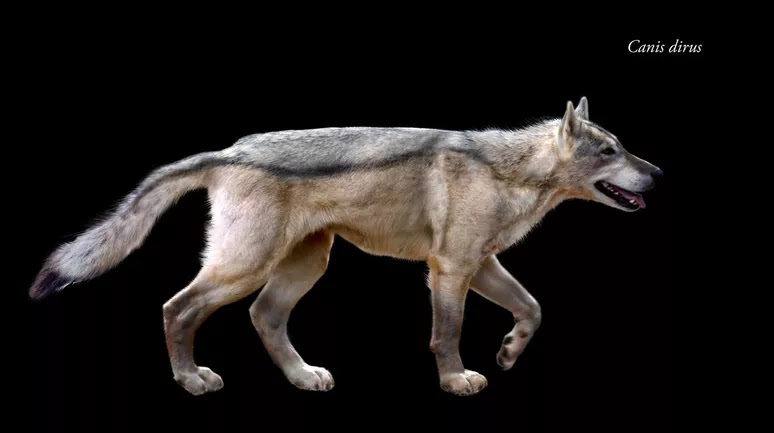
Figure One -- Artist's depiction of a dire wolf (from thoughtco.com). 


Let me take you on a short adventure in my time machine. The year is 10,700 B.C. and the place is what we would someday call the Panhandle of Texas. The scene is from my book SHADOWS on the TRAIL. Three hunters in a Paleoindian tribe called the Folsom People are returning to their tribe at night. They believe that they are not alone. At this time in North American prehistory, humans and wolves were at pretty much equal footing in the food chain; Wolves had been around a lot longer than humans, but humans were catching up. I am pretty sure that a few Paleoindians ended up as the main meal for packs of voracious wolves while wolves also served as a meal source for Paleoindians. While the prehistoric humans had fire and spears to defend themselves against these formidable predators, wolves roamed in packs of ten, twenty or, even more wolves. It does not take much of an imagination to see the situation humans found themselves in. Here is a short scene from SHADOWS on the TRAIL. 

Pahin stopped suddenly on the trail and not paying enough attention, Chayton ran right into the back of the big hunter. Chayton bounced off Pahin and then he collided with Kangi. The two boys untangled themselves and stood alongside Pahin. Both boys were completely out of breath and were wheezing. Their hands were on their hips. Pahin glared at them; he was trying to listen to the night.  

“Enila,” he told the boys to ‘be quiet’.

Chayton and Kangi held their breaths. Chayton heard the croaking of a bullfrog near the creek and a chirping cricket near the trail, but other than that, he heard nothing. Then, all three hunters heard it, a wolf howling somewhere in the canyon. The hunters held their breaths and listened some more, trying to pinpoint the distance and direction of the howl. One wolf howled while another answered.

“We must hurry,” Pahin declared, “they are behind us.”

The crescent moon was now high overhead. Its light reflected off the scattered clouds, making the trail barely visible. The three hunters ascended a knoll and from there they spotted the yellow lights of campfires.

“There is our camp!” Pahin yelled over his shoulder. “Run!”

Chayton managed to chuckle even through his stressed lungs. He had never been happier to see a camp in his life. He looked over his shoulder to make sure Kangi was still behind him. Adrenalin increased the speed and the urgency of the hunters. The campfires grew larger.

The black wolf galloped effortlessly along the trail like a demon of the night, invisible in the darkness. The wind in its face curled its lips upward into a sort of wolf-like sneer while exposing iridescent teeth. The monstrous animal no longer needed a scent to track the humans, it had spotted Kangi. The black wolf turned its head and snarled at the others, a warning for the pack to remain quiet. The lust of the kill flowed through the gaunt body of the black wolf as it picked up its pace to a full gallop.

CLICK to ORDER SHADOWS Book Series


What happened to the three hunters? You will have to read SHADOWS on the TRAIL 
to find out.


                               Figure Two - Size comparison between a dire wolf and a gray wolf.

When I wrote SHADOWS on the TRAIL, I thought about using the now extinct dire wolf in the plot of the book. I did my research on North American wolf species around 12,000 years ago and decided I would either go with dire wolves or gray wolves in my book. Dire wolves had an advantage in body size over gray wolves. Fossil specimens of dire wolves indicate that they were around twenty-five percent larger than gray wolves. Dire wolves also had a more powerful bite than gray wolves. Based on bone structure analysis, scientists concluded that a dire wolf's bite was around twenty-nine percent more powerful than a gray wolf's bite. Fossil evidence also indicates that dire wolves were not as fleet of foot as gray wolves. Dire Wolves had a bulkier build and based on a smaller brain cavity scientists believe that dire wolves were probably less intelligent than gray wolves. 

Figure Three - Comparison between gray wolf skull on the left and
extinct dire wolf skull on the right (courtesy Dire Wolf Project).

While gray wolves are social, highly intelligent, and efficient predators of both small and large game, it appears that dire wolves focused their hunting and scavenging on the large megafauna of the Pleistocene. When much of the larger megafauna went extinct in the Pleistocene, dire wolves followed in their footsteps and went extinct as well. 

Over sixteen hundred remains of dire wolves have been excavated from the Rancho La Brea tar pits in southern California while only eight gray wolves have been excavated from the same tar pits. Even if the population of dire wolves at the time was much greater than that of gray wolves, the disparity in the number of fossil remains between the two species is striking. The fossil evidence indicates that a large part of a dire wolf's existence was based on scavenging large mammals stuck in the tar, and ultimately, they became stuck in the tar themselves. The lack of gray wolves in the tar pits might attest to a different hunting strategy for gray wolves or that maybe the species was intelligent enough not to get stuck in the tar.  


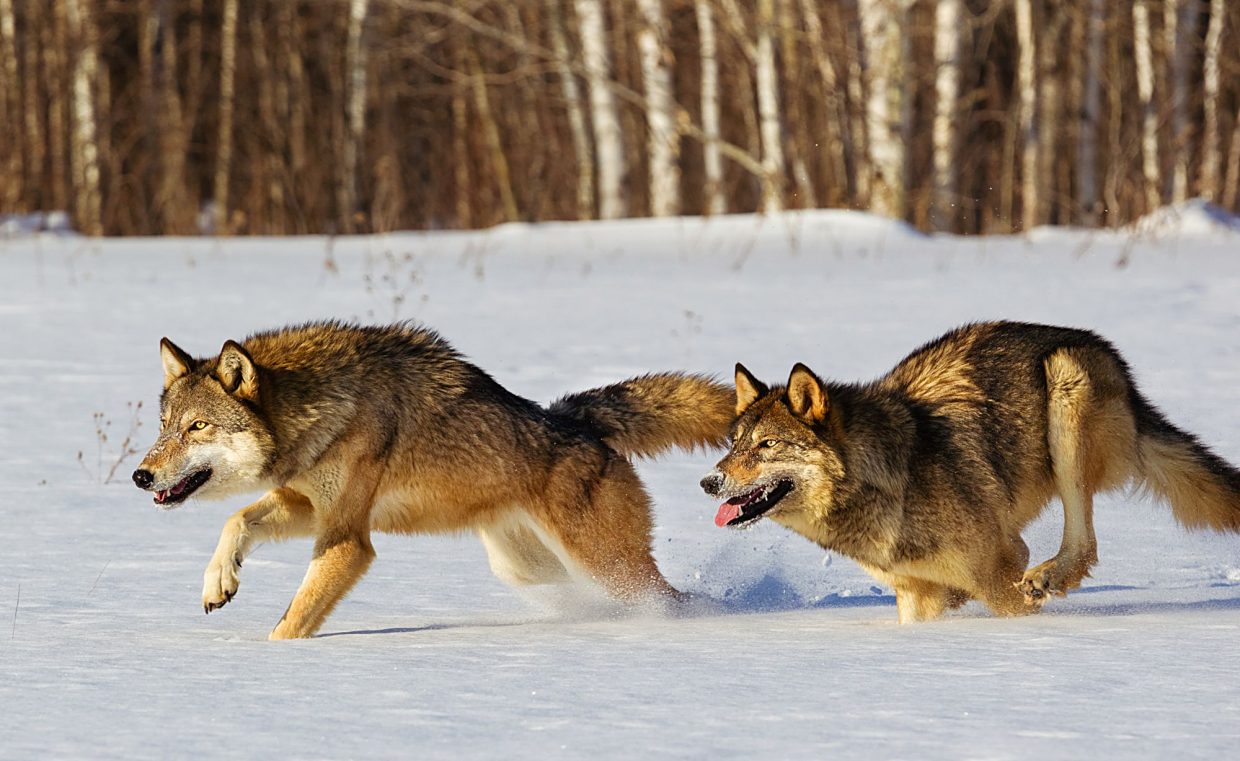
Gray wolves survived into modern times by being efficient and intelligent predators while dire wolves faded into extinction with mammoths, short-faced bears, camels, wild horses, ground sloths, and several other species.  

My final verdict was that gray wolves were more efficient predators than dire wolves, and therefore a more threatening species for my human characters in SHADOWS on the TRAIL. 


In the other books in the SHADOWS on the TRAIL Pentalogy,  one or both of these species returns for an encore performance. 
Check them out.    


Sunday, May 5, 2013

Part I -- The Atlatl Weapon System and the SHADOWS on the TRAIL


Figure One - Paleoindian using an atlatl or spear thrower.
Courtesy of the University of New Mexico    


Imagine, it is 12,600 years ago and you are armed with a spear thrower or atlatl, one spear, and three spear foreshafts. You are out hunting for big game with your typically empty belly…

You are literally hunting for your family’s survival, and something bigger on the food chain is hunting you as well!

… and today, we worry about cell phone coverage, Twitter, wearing a mask, and finding a parking space at the mall...
  

Figure Two - Shadows on the Trail - The 2nd Edition

Here is one such scene from my book Shadows on the Trail: 

Chayton stayed awake for a while but eventually dozed off again. He wondered what was keeping Hexaka and Wiyaka. Then, he heard the sound: hooves pounding the ground. He focused his eyes and spotted them: two beasts darting through the trees. He reached down and grabbed up a spear, briefly fumbling it. Chayton studied the tree line, looking for any movement. He flicked his thumb back and forth across the stone spear tip, checking its sharpness. Chayton felt a stab of pain in his thumb and looked down. The stone tip had sliced open his thumb. Mad at his own clumsiness, Chayton grabbed the spear by its shaft and waited for the beasts to reappear. He checked his breathing; it was too loud. He would startle the beasts. He slowed down his breathing and placed the butt end of the spear into the notch of his spear thrower. Then, he waited.

A young elk bull appeared out of the trees, trotting out onto the open field. Chayton was at full alert. The elk had yet to spot Chayton, and they were heading straight towards the hunter. The bull elk was leading the way with the cow elk following behind. They held their heads high as they sniffed the breeze for predators. Chayton was downwind, and he realized this was what Hexaka had planned the entire time. 

Chayton cocked his left throwing arm. He was ready to heave the spear. He needed the beasts closer. The bull was walking straight toward the hunter, but Chayton did not like the chances of this throw. The bull had no vital organs exposed to Chayton’s line of fire. Chayton could throw the spear perfectly and still not kill the beast. The last thing Chayton wanted to do was track down a wounded elk during the heat of the day across a country inhabited by wolves and mountain lions...


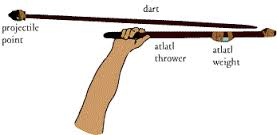
                                                  Figure Three. Basic components of a
                                                  spear thrower or atlatl weapon system
.


Shadows on the Trail was the first book in my prehistoric book series. I just rewrote the book's second edition. I am sure you will like it if you like Prehistoric America. The book series is about a group of Paleoindians called the Folsom people, a mystical tribe who actually roamed western North America around 12,600 years ago. The book series took place in what we now call Texas and Colorado. Several of the animal species that the Folsom people hunted were fast, large, and/or dangerous, so the weapon system they used made a big difference between surviving or not surviving. Since bow and arrow technology allegedly didn't show up on the High Plains of North America until 1,500 to 1,800 years ago, and horses did not show up until the Spaniards brought them to North America around 450 years ago, the Folsom people were limited in their weapon technology. 


Imagine hunting a one-ton bison with an atlatl and a spear.  

Figure Four - North American Paleoindians with atlatl weapon systems.


When Paleoindians entered North America around thirty thousand years ago (yes, I know that not everyone is convinced it was that early), they most likely brought with them an "Old World" technology called the spear thrower or atlatl weapon system. I wrote "most likely" because there is no conclusive evidence that North American Paleoindians had atlatl weapon systems. Since the key components of the atlatl weapon system were mostly perishable wood or bone (figure three), an atlatl system has yet to be discovered in any Paleoindian site in North America. Although it is common sense to assume Paleoindians had the atlatl, the archaeological evidence remains circumstantial. One bit of circumstantial evidence is the 11,000-year-old bannerstones. Some people believe that bannerstones were used as atlatl weights. Another bit of evidence is atlatl hooks in a 9,000 to 10,000-year-old sinkhole called Warm Springs in Florida.

An atlatl weapon system consists of a two-foot or so long wooden shaft with a handle or finger grips on one end and an attached hook made from antler, rock, or bone on the opposite end (figure three). Near the center of the atlatl's wooden shaft was oftentimes a rock weight used for balance or improving the whipping action during throwing. Figure one shows the launching process for an atlatl. The purpose of an atlatl weapon system is to artificially increase the length of the hunter's throwing arm. Why is that important? 
 
Figure Five. Elements of baseball pitching are not much different than atlatl throwing.

While a strung bow acts as a spring, the atlatl acts as a lever. The best way to explain the basic physics of an atlatl is by comparing it to a major league baseball pitcher (figure five). For baseball pitchers, the force used to throw a baseball multiplied by the distance that the ball is released from the point of rotation is what creates the speed of a baseball. In both baseball pitching and atlatl heaving, the point of rotation is the thrower's shoulder. If a pitcher's long arm is moving at the same rate of speed as another pitcher's short arm, the baseball at the point of release is moving faster with the long-armed pitcher. 

An atlatl artificially creates a longer arm or better lever, therefore, potentially creating more speed from the airborne spear when it leaves the atlatl hook or spear. 

The atlatl was a truly innovative idea. 


However, there is something else noteworthy about the physics of the atlatl weapon system; it not only artificially increases the radius of the throwing arm, but also increases the radius by wrist rotation. When major league baseball pitchers throw a baseball, they flick their wrist to gain more speed from their fastball. The same goes for atlatl throwing. In atlatl heaving, there is a big wheel rotating around the shoulder at a long radius (the arm rotating the atlatl handle around), AND a smaller wheel rotating with a flick of a wrist (the wrist rotating the end of the atlatl handle). Throwing without an atlatl, the wrist rotates around the length of a hand. With an atlatl, the wrist rotates around the length of the atlatl, a significant difference.      


Figure Six. Practical modern application of the atlatl.  

Another modern-day example with the same physics applied as the atlatl weapon system is the tennis ball thrower used around the world to throw tennis balls for our furry friends to fetch. Figure six shows a tennis ball thrower used by a dog owner with her attentive pooch bouncing alongside her, waiting for the chance to chase down that fuzzy yellow ball. Replace the tennis ball with a spear, and this dog owner becomes a Paleoindian hunter using an atlatl.

Stay tuned! 
For Part Two of the Atlatl I will write 
about the 'spear in flight' and what impacts 
the performance of the atlatl weapon system.
In the meantime, browse my books and 
read about how the Paleoindians used 
this marvelous weapon system.        


Meltzer, D.J. (2009)  First People in the New World. University Of California Press. Berkeley.


 Follow me on this blog and on Facebook - Shadows on the Trail Pentalogy by John Bradford Branney


Friday, May 3, 2013

Shadows on the Trail and Making Folsom Projectile Points


Click to Order John Bradford Branney Books


Another great video by paleomanjim on YouTube. This guy is truly the modern master of flintknapping as his scarred and beat up fingers demonstrate.

In this video he used indirect percussion with a moose antler punch and rock hammer to flute the Folsom point. This is the same method I used for the Folsom People in Shadows on the Trail. As stated in the video by paleomanjim, this method is more accurate than direct percussion.

He did pressure flaking with a deer antler and the finer pressure flaking detail with a deer tine.


Click to Watch the Video    

Wednesday, May 1, 2013

Shadows on the Trail Trilogy and the Making of a Folsom Point

Click to Enter the Pleistocene
An excellent YouTube video done by a modern day flint knapping master, +paleomanjim, demonstrating his effective technique for fluting Folsom points, just like the heroes in Shadows on the Trail had to do. Click the video and enjoy!

The Making of a Folsom Point --


Click to order Ghosts of the Heart

Wednesday, April 24, 2013

Native American Languages in the Shadows on the Trail Trilogy

Click to order Shadows on the Trail
As the author of Shadows on the Trail Trilogy, one of my most frequent questions is 'what are the languages used for the three Paleoindian tribes in the books?' Since it is impossible for anyone to know the languages Paleoindians spoke 11,000 years ago, I decided that I would use three historical Native American languages for the Shadows on the Trail Trilogy.

The first tribe I introduced in the book was the Folsom People. I interlaced the language of the Lakota Sioux with English for their personal names, places, and common phrases. For example, the name of our main character, Chayton, means Falcon in the language of the Lakota Sioux.

For the River People, I employed the language of the Cheyenne Indians for personal names, places, and some common phrases. For example, the name of the heroine of the River People, Namid, means Star Dancer in the language of the Cheyenne Indians.    

Finally, for the aggressive and hostile Mountain People I employed the language of the Comanche Indians for their personal names and places. For example, the warrior Tosarre's name in Comanche means Dog.

Click to Order Ghosts of the Heart
Do I believe any of these historical Native American languages existed 11,000 years ago when Paleoindians roamed the plains and mountains and these books took place? My answer is no! During an 11,000 year span of time, there is a high probability that the languages used by the Paleoindians were significantly different than the languages spoken by the historical Native American tribes of the Lakota Sioux, Cheyenne, and Comanche. But, I am sure there are linguists out there who have a much better answer to that question than me.  

One of the more memorable scenes in Chapter 10 of the first book Shadows on the Trail was when Keya of the Folsom People tribe (designated boy in the dialogue) finds Honiahaka from the River People tribe spying on the Folsom People's camp along the river. In the dialogue below, Keya only speaks the Lakota Sioux tongue while Honiahaka only understands the Cheyenne tongue. What happened with the conversation was a perfect example of a 'failure to communicate'.

Hidden behind scrub oak bushes along the river, Honiahaka watched the camp. It had been two suns since he had nearly drowned in the river. He smelled the roasting meat coming from the camp and his shrinking stomach growled in protest. Since he had eaten the frog legs at the marsh, his diet had consisted of grasshoppers, a small fish, and several more frog legs. He was famished.  
            Honiahaka wondered if these people were the same enemies who burned the village and killed his mother. Before he walked into this camp, he had to know it was safe. He needed to move closer to see who these people were. He carefully crept forward to another bush and then plopped down behind it. Honiahaka watched the people’s movements, but to him, they looked the same as any other people. He would have to get even closer to see if he recognized any of their faces from his village. He snuck forward, crouching down behind yet another bush.          
      
            Honiahaka now had a much better view of the village. He could now see the people’s faces. SMACK! An object whacked Honiahaka in the back of the head, knocking him flat. Before he could react, someone jumped on his back and shoved his face into the dirt. The attacker then grabbed one of
Click for Adventure
Honiahaka’s shoulders and flipped him over onto his back, plopping down in the middle of his chest. Before Honiahaka could even twitch a muscle, a stone knife blade was at his throat. Honiahaka looked up and the attacker was young and much bigger. Honiahaka laid still, a knife blade creasing the skin on his throat.  


"Nitúktetanhan hwo?–Where are you from?” the boy asked Honiahaka.
            Honiahaka did not understand.

"Táku eníciyapi hwo?–What is your name?” the boy asked, pushing the knife blade into Honiahaka’s neck.
            Honiahaka stared in bewilderment at the boy.   

“Oh ya lay hey?-Who are you looking for?” 
            Again, Honiahaka did not understand this strange language.

"Waniyetu nitóna hwo?–How old are you?”       
            “Noxa'e!–Wait!” screamed Honiahaka.    

"Táku eníciyapi hwo?–What is your name?” the boy asked again.
             Honiahaka had no idea what the boy was saying, but he started screaming out his own name anyway, “Honiahaka! Honiahaka!”

“What kind of name is that?” the boy asked and then punched Honiahaka in the jaw. Before Honiahaka could recover, the boy was standing over him with a fluted spear point brushing up against Honiahaka’s chest.
            “Inánjinyo!-Stand up!” the boy screamed, motioning him to stand with his spear. Honiahaka crawled slowly to his feet.

“Walk!” the boy ordered, pointing his spear in the direction of the camp.

My primary reason for using Native American languages in the Shadows on the Trail Trilogy was to make the dialogue between characters appear more authentic than merely speaking English or even using broken English. I wanted to present the Paleoindian characters as intelligent and insightful without resorting to the stereotype of  'dull witted cavemen who grunt and groan'. Based on skeletal remains and archeaological evidence, we can assume that the Paleoindians were intelligent hunters and gatherers with the same brain capacity as modern day humans.They could plan, create, and solve problems, as well as we can. A Paleoindian would probably not survive very well in our modern world, but I can guarantee that most modern humans could not survive in the Pleistocene filled with predatory animals and no cell phone to dial 911.

So far, I have received mostly positive reviews for using authentic Native American languages in the Shadows on the Trail Trilogy. Some readers have to told me that the use of these languages brings a higher level of authenticity to the book while other readers have found it a distraction. You be the judge! Read the Shadows on the Trail Trilogy and then give me your opinion!         

                               
                                Click to Join the Adventure


Sunday, April 14, 2013

Shadows on the Trail - A Prehistoric Adventure Novel


Shadows on the Trail takes place at the end of the last Ice Age on the plains and mountains of Texas and Colorado. The end of the Ice Age was a dramatic time of global warming, rising air temperatures and melting ice caps and glaciers. It was a time when many large mammal species went extinct and small bands of humans roamed the land attempting to survive in an unforgiving and violent world.  This is a tale of three prehistoric tribes whose paths collide, culminating into an emotional thriller filled with predatory animals, natural disasters, good and evil people.        
Chayton, our hero, is an orphan and hunter in a tribe called the Folsom People. Forced to deal with a catastrophic drought, Chayton and the Folsom People abandon their peaceful canyon home and make their way north to an idyllic land called the North Country. While the Folsom People make their way across a desolate prairie, a barbaric tribe called the Mountain People brutally attack a peaceful tribe called the River People. A fortunate encounter between a young boy from the River People and the Folsom People, pull the three tribes into the same whirlwind conflict.

The plot of the book takes a surprising turn when the surviving members of the River People convince the Folsom People to help them free part of their tribe from the fortified mountain village of the Mountain People. Together, the two good tribes devise an intricate plan to trap the lethal Mountain People and rescue the River People captives.        
Chayton’s lonely life takes a joyous turn when he rescues a beautiful young woman named Namid. While the independence of both Chayton and Namid keep their relationship at arm’s length in the near term, their attraction for each other break down their independence and true love blossoms.

Just when the reader is lulled into believing that ‘good will triumph over evil’ in this book, an unexpected and diabolical twist causes the River People and the Folsom People to scramble for survival against one of the deadliest forces of nature. 

Shadows on the Trail by John Bradford Branney is available at www.Amazon.com, www.barnesandnoble.com, and  www.blackrosewriting.com. 

Thursday, April 4, 2013

Folsom Points and Adventures About Them!

Figure One - 1.8 inch long Folsom dart point surface found on private 
land on 7/1/1999 in Albany County, Wyoming. 
John Branney Collection.  


Second Edition

The short scene below took place in the first chapter of my first prehistoric adventure entitled SHADOWS on the TRAIL.  The hero and main character in my book series was a Folsom hunter called Chayton, and in this passage he visited the tribal healer called Tarca Sapa. Chayton needed assistance in fluting projectile points required for the tribe’s journey to the North Country. Chayton was nervous for two reasons: Fluting projectile points was a difficult process with a high probability of failure and he was performing the activity in front of Tarca Sapa's granddaughter, Tonkala, who just happened to be Chayton’s heartthrob.        
With his hands shaking, Chayton opened up his leather pouch and pulled out two thick pads made from buffalo hide and two elk antler hammers. He
Figure Two - Click to Order
sat down on a nearby rock and covered his legs with the thick pads. He placed a spear point, tip down, along the inside of his left thigh and then placed an elk antler hammer horizontally on top of the platform at the base of the projectile point. He braced the other end of the elk antler hammer against the inside of his right thigh. When Chayton had the hammer precisely lined up with the small square platform, he took the second elk antler hammer in his right hand and swung down hard on top of the first elk hammer. Nothing happened. 

Flustered, Chayton looked over at Tonkala hoping that she was not watching him. Chayton then looked at Tarca Sapa hoping for some words of encouragement, but Tarca Sapa only stared straight ahead at the spear point still resting in Chayton’s lap. Chayton nervously realigned the spear point, this time swinging the hammer even harder, striking the spear point with much more force. A solid cracking sound came from the spear point and Chayton looked down and saw the long thin flake that had detached from the spear point. To Chayton’s delight, the spear point had a beautiful flute channel running its entire length. 
Bravo! Let’s give Chayton a round of applause! For a Folsom flintknapper, creating flutes on a projectile point was an extra and risky step in the knapping process. Evidence from archaeological sites indicates that the fluting process for Folsom points had a high probability of failure. There are various theories as to why Folsom knappers fluted their projectile points, but I speculate it had something to do with a hunting ritual. In my opinion, Folsom hunters believed that by making these exquisite projectile points, it gave them an "edge" in successfully hunting their prey. Otherwise, why did they do it? Did it work? We may never know. I am unaware of any research study that concludes that fluted Folsom projectile points were any more effective than other projectile points in killing bison or deer.  
Figure Three - 1.36 inch long Folsom dart point 
surface found on private land on 8/30/2007 in 
Weld County, Colorado. John Branney Collection.  
SHADOWS on the TRAIL is a historical-based, fictional adventure about a mystical group of people called Folsom who really lived in North America between 10,900 to 10,200 years ago. How do we know the Folsom People existed? They left behind a calling card, an exquisitely crafted fluted projectile point that was discovered in situ with extinct bison at an archaeological site near Folsom, New Mexico in 1926. The longitudinal flutes and the breathtaking workmanship differentiated the Folsom point from other types of projectile points used around the same time-period.
Figure Four - CLICK TO ORDER
Figure three is a 1.36 inch long Folsom projectile point surface found by the author in northern Colorado. The  Folsom point was made from a localized rock called Flattop Chalcedony. I found this Folsom point on the same site that gave up the Alibates Chert discoidal biface that inspired my blockbuster book series entitled the SHADOWS on the TRAIL Quadrilogy (Figure four).   
Creating longitudinal flutes from the base of the projectile point to its tip is an extremely difficult process as any modern-day flintknapper can attest. For the projectile point to survive the fluting process, the knapper and the rock had to be in tune with the process. Even using modern day mechanical gizmos, fluting Folsom points is a difficult and tedious process, resulting in many failures. Today, no one agrees on the process that the Folsom people used to flute their projectile points, but everyone agrees it was a remarkable achievement for 10,000 plus years ago.

The chipping debris discovered while excavating Lindenmeier, the Folsom super site in northern Colorado, demonstrates a high failure rate in making fluted projectile points (Wilmsen and Roberts 1978). Even when the projectile point somehow survived the fluting process, the Folsom hunter was left with a Folsom projectile point that was thin and fragile. The difficulty in making Folsom points and their fragility translates into very few surviving to modern day. For someone like me who religiously tromps the hills in search of prehistoric artifacts, finding a Folsom point is a rare and exceptional accomplishment.
Figure Five - 2.4 inch long Folsom preform. Red arrow 
points at the fluting nipple or striking platform. 
John Branney Collection. 

Figure five is a photograph of a 2.4 inch long Folsom preform prior to fluting. The striking platform or fluting nipple juts out from the middle of the base. Whether by pressure or percussion, indirect or direct, the knapper would strike the fluting nipple in such a manner as to create a longitudinal flute running from the base to the tip of the projectile points. The knapper would then create another fluting nipple and flute the other side. 

Figure Six - Folsom projectile points exhibiting fluting nipples.
John Branney Collection.    
Figure six is a photograph of two 1.65 inch long Folsom points from the author’s collection. The top point was completed and used. The bottom point was a preform that was fluted, but never finished or used. Both Folsom points exhibit evidence of the fluting nipple or striking platform at their bases (see mechanical pencil tip). The striking platform was used as a place to direct a blow for driving flutes longitudinally from the base to the tip of the projectile point.   
Figure Seven - One of many proposed theories on 
mechanism for fluting Folsom points. 


So, why did Folsom knappers go through the painstaking process of fluting projectile points? No one knows the answer. Perhaps, they believed that the flutes allowed more blood flow from animal wounds or that the fluting made it easier to haft the projectile points on to their spear or dart shafts. Maybe, both of these are true. As mentioned earlier, I believe it became ritualistic and spiritual. Not everybody in the tribe had the skill to make Folsom points so perhaps there was a specialist or shaman who made the points for the tribe, and his or her creations were considered powerful medicine. What are your thoughts? Then, read my books for the rest of the story.   
Wilmsen, Edwin N. and Frank H. H. Roberts, Jr.

1978    Lindenmeier, 1934-1974 – Concluding Report on Investigations. Smithsonian Institute Press. Washington D.C.  
CLICK for SHADOWS ON THE TRAIL