Showing posts with label atlatl. Show all posts

Thursday, November 8, 2018

Part III -- An Atlatl Spur and the SHADOWS on the TRAIL


Figure One - 2.2-inch-long granite atlatl spur surface found on private land
in Kings County, California, by Connie Hudson before 1970.
John Bradford Branney Collection.  

The purpose of the atlatl weapon system is to extend the arm of the thrower, much like a lever. When thrown properly, the atlatl handle increases the velocity of the spear. 

The finger bone's connected to the hand bone,
The hand bone's connected to the arm bone,
The arm bone's connected to the shoulder bone,
Now shake dem skeleton bones!

Dem bones, dem bones gonna walk around
Dem bones, dem bones, gonna walk around
Now shake dem skeleton bones!
When I think about the process of flinging a spear with an atlatl weapon system, the above tune comes to mind. Many of us remember this song from our childhoods. The various muscles and bones in the human body work together in unison and harmony to make us move. To make a successful atlatl throw, various components in the atlatl weapon system and the human body must work together in unison and harmony. One difference between the atlatl weapon system and the human body is that, in the throwing process, one of the components detaches from the rest of the components: the atlatl spear or dart. We'd better hope that we don't have any detaching components from the human body!


Figure Two - Atlatl mechanics. 

Most experts believe that prehistoric humans had access to the atlatl weapons system in North America as far back as the Clovis Paleoindians. Archaeological evidence for this is circumstantial. However, we do have clear evidence that the atlatl was in play in North America as early as the Middle Archaic. One of the reasons that atlatls might not be found in older Paleoindian sites is that atlatls or throwing handles were mostly made of perishable material. 
Based on archaeological evidence, bow and arrow technology replaced most atlatl technology in North America sometime around A.D. 200 to A.D. 500. There were some atlatl holdouts. When Spanish explorer Hernán Cortés landed in Mexico around A.D. 1519, he found the atlatl weapon system in use within the Aztec population. Cortés also discovered that Spanish chain mail armor wasn't always effective against the penetration of an atlatl-thrown spear. 


Figure Three - Close-up of the tail end of a spear, which connects to a spur
on the atlatl or throwing handle. 

An atlatl or throwing handle is a piece of wood, bone, or antler, two feet or so long. One end of the atlatl was for the thrower's hand, while the other end connected to the spear via a peg, hook, or spur (figure three). A cup or indentation at the tail end of the spear fits onto the spur of the atlatl handle. 

Figure Four - Rounded and
polished tip of the hummingbird atlatl spur. 
I will refer to the peg, hook, or spur at the tail end of the atlatl or throwing handle as simply the spur. The spur's purpose is to connect the tail end of the spear to the atlatl. The spur and the tail end of the spear work on the same principle as a ball and socket. A ball and socket is a mechanical device where the ball (in that case, the spur) rotates in a socket (in that case, the indented end of the spear) and allows rotating motion within the limits of the design. In other words, the cupped or indented end of the spear rotates on the spur until the spear is on its way, and disengages from the spur and the throwing handle. The spear remains engaged at the spur during the throw because the atlatl is traveling at a faster velocity than the spear. When the spear's velocity exceeds the velocity of the atlatl, the spear disengages from the spur on its way to the target.  

Written another way, when the thrower starts the spear toss, his or her arm pulls the atlatl forward and upward, and the cupped end of the spear rotates on the tip of the spur until the spear disengages from the atlatl and heads towards the target. 

Users of prehistoric atlatl weapon systems made spurs out of bone, rock, antler, and wood. There is one case in prehistoric Colorado where investigators proposed that a bison tooth was used as an atlatl spur. I already mentioned that we suspect that prehistoric humans made their atlatls out of perishable materials, so spurs might be the only things that survived time in the atlatl weapon system. 

Investigators and collectors have found evidence for the use of the atlatl in prehistoric California in almost every region of the state in the form of atlatl spurs. In fact, California has enough prehistoric atlatl spur examples to classify them into categories. (Ralston and Fitzgerald 2014).

Figures one and four show an example of a prehistoric atlatl spur surface found in Kings County, California, by Connie Hudson before 1970. Most of the people I have spoken to about this prehistoric artifact believe this atlatl spur represented a bird's head, specifically a hummingbird's head. 

A bird's head would be an ideal symbol for an atlatl. If we think about a spear launched from an atlatl, flying effortlessly through the sky, what better symbol for a flight than a bird or hummingbird? 
Figure Five - A mock-up of how I believe the birdhead's spur  
was used within the atlatl weapon system.   

Figure five is a drawing showing how I believe the prehistoric human had the hummingbird spur set up. The maker of this atlatl weapon system gouged out a hole in the back end of the wooden handle and attached the spur there. The butt end of the spear or dart was then placed on the rounded knob of the spear. When the prehistoric human flung the wooden handle forward, the spear led the way until it flew on its own.         


Check out my books and links on atlatls at the end of this article!  


Thursday, September 27, 2018

Part II- Atlatl Weapons and the SHADOWS on the TRAIL

Figure One - Photo of a painting called Pre-Columbian Indian with Atlatl
by the well-known Western artist James Bama. 

In Part One of my series on the Atlatl and the SHADOWS on the TRAIL Hexalogy, I discussed the overall concept of the atlatl weapon system and the advantages the thrower gained by lengthening their throwing arm with an atlatl. With everything else being equal, lengthening the throwing arm with a spear thrower or an atlatl increases the velocity and distance of an airborne spear or dart. Higher velocity means better penetration, which translates to more tissue and organ damage in the prey. Of course, there is always too much of a good thing, and increasing the length of an atlatl past its optimal limit will significantly decrease the spear's accuracy.  

Before we go any further with atlatls, I want to take you on a little elk hunt from my first book, SHADOWS on the TRAIL. Are you ready for that? In this particular scene, my main character, Chayton, is hunting with an atlatl. I assume that the atlatl weapon system was available to North American Paleoindians some 12,500 years ago. Circumstantial archaeological evidence indicates it was. Now, back to the hunt.

A young elk bull and cow appeared out of the trees, trotting out onto the open field. Chayton was at full alert. The elk had yet to spot Chayton, and they were heading straight towards the hunter. The bull elk was leading the way with the cow elk following behind. They held their heads high as they sniffed the breeze for predators. Chayton was downwind, and he realized this was what Hexaka had planned the entire time.   

Chayton’s cocked his left throwing arm. He was ready to heave the spear. He needed the beasts closer. The bull was walking straight toward the hunter, but Chayton did not like the chances of this throw. The bull had no vital organs exposed to Chayton’s line of fire. Chayton could throw the spear perfectly and still not kill the beast. The last thing Chayton wanted to do was track down a wounded elk during the heat of the day across country inhabited by wolves and mountain lions. He needed the elk to turn and expose its side to his spear. Chayton thought about moving his spot, but one sound and both elk would be off and running in the opposite direction. If the elk got any closer, they were bound to pick up Chayton’s scent.

Chayton searched the ground with his off hand and found a rock. While his left arm kept the spear ready, he hurled the rock off to his right. The rock bounced off a tree and rolled across the ground. The bull elk turned to investigate the sound and in doing so, exposed his side to the hunter. Chayton did not wait for any grass to grow; he hurled the spear. The razor-sharp fluted spear tip popped loudly when it penetrated the bull’s rib cage. The bull ran off as if nothing had happened. Chayton watched the bull elk plowing through the trees and vanishing from sight. 

What happened with the elk? You will have to read the SHADOWS on the TRAIL to find out. Don't worry, the journey I take you on will be worth your time.

In part two, I am exploring the flight of the atlatl-launched spear or dart, but first, a little housekeeping. In the following paragraphs, I will refer to the weapon that leaves the atlatl as a spear, even though some literature might refer to the weapon as a dart. In part two, the atlatl spear and dart are synonymous.  
The mechanics of an atlatl system depend on the flexibility of the spear. When the atlatl pushes the spear forward (figure three), energy is transferred from the atlatl and stored in the spear, much like a spring. When the spear 'lifts off' from the atlatl, the stored energy is released and converted to additional velocity as it flies toward the target.
  
Figure Three - The ingenuity of the mechanics behind the atlatl
is the stored energy within a flexed spear. 

Two concepts from physics help us to better understand the flight of an atlatl-launched spear. The first concept is momentum. Most of us have used the term momentum and generally understand how it works. Perhaps, we were talking about the momentum of our favorite sports team or a political candidate's campaign. In physics, momentum is defined as the tendency of an object to continue moving in its original direction. Momentum is an object’s resistance to stopping. An example of momentum is a rolling freight train that suddenly needs to stop. A loaded freight train's momentum takes the train longer to stop because of its momentum.    
How is momentum calculated? Momentum (P) is equal to the object's mass (M) multiplied by the object's velocity (V). As an example, if a lighter atlatl spear is flying through the air at the same velocity as a heavier atlatl spear, the lighter spear has less momentum than the heavier spear. Also, less resistance is required to stop a lighter spear if traveling at the same velocity as the heavier spear. If one changes the mass or velocity of the object, momentum changes.

Momentum = P = M x V

As the equation above indicates, mass and velocity carry the same weight in calculating momentum. A slower-moving heavy spear can have the same momentum as a faster-moving light spear.   

Figure Four - Middle Archaic atlatl dart points from the high plains
showing size ranges. The longest point is 1.9 inches long.
John Bradford Branney Collection 
The second physics concept is kinetic energy, which is defined as the energy of an object in motion. The more kinetic energy a spear has, the more available energy it has to penetrate the prey's hide, break any bones in its path, and push the projectile point and spear shaft further into the prey's body cavity.    

Just like momentum, kinetic energy is defined using an object’s mass and velocity, but mass and velocity affect kinetic energy differently than momentum. While mass and velocity carry equal weight in momentum, velocity is more important than mass in kinetic energy

Kinetic energy (KE) is equal to one-half times mass (½ M) multiplied by (x) velocity squared (V²). 

Kinetic Energy = KE = ½M x V²

To calculate kinetic energy, we divide the mass in half and square the velocity!  
I mentioned earlier that a slower-moving heavy spear can have the same momentum as a faster-moving light spear. However, the faster-moving light spear has more kinetic energy than the slower-moving heavy spear. Velocity has a much stronger influence on kinetic energy than it does momentum. If the heavy spear and light spear are flying at the same velocity, the heavy spear has more kinetic energy because it has more mass.  Although mass is important when it comes to spears, velocity has a bigger influence on distance, kinetic energy, and accuracy. The atlatl or the spear thrower portion of the weapon system has little influence on the size or mass of the spear, but it does have a huge influence on increasing a given spear's velocity.

Figure Five - Paleoindians carrying atlatls and spears. 


Is a heavy or a light spear more lethal when it comes to hunting with an atlatl? Whittaker, Pettigrew, and Grohsmeyer (2017) explored the relationship between heavy and light spears and suggested that Paleoindians who hunted large mammals such as mammoths or bison required heavier spears and projectile points. The spear had to be able to cut a hole through the animal's hide with enough momentum to reach its vital organs and/or cause lethal hemorrhaging. Close your eyes and imagine hunting a gigantic mammoth with a light spear and a small projectile point. I would say that would be like “hunting a bear with a willow switch”. Although it is not prudent to hunt mammoths with undersized equipment, that same equipment might be suitable for hunting wary antelope on the plains, where adding velocity improves both distance and accuracy.  

It is logical to assume that Paleoindians customized their atlatl weapon systems for the type of prey they were hunting. If the targeted prey were mammoth or bison, the spears and projectile points might be heavier. If the targeted prey were deer, antelope, or mountain sheep, the spears and projectile points might be lighter and take advantage of increased velocity and distance. This is not any different from what modern game hunters do. You don’t see experienced hunters using rifles and cartridges designed for elephants on antelope or vice versa. That just doesn't make sense, and Paleoindians had to make sense if they wanted to survive.

Happy Hunting! 

2017    Whittaker, John C., Devin B. Pettigrew, and Ryan J. Grohsmeyer
Atlatl Dart Velocity: Accurate Measurements and Implications for Paleoindian and Archaic Archaeology in Paleoamerica, Vol. 3, No. 2, pp. 161-181. College Station.     


CLICK here if you MISSED Part ONE of my ATLATL Article   


Hey, check out my books, won't ya? 


Tuesday, January 14, 2014

Paleoindian Wounds in Ghosts of the Heart!


Second Edition 


Click for Book Review of Ghosts of the Heart


One thing I wanted to convey and dramatise in the SHADOWS on the TRAIL Hexalogy and in the second book in the series, GHOSTS of the HEART, was what happened when Paleoindians were wounded or injured 12,000 years ago. While researching GHOSTS of the HEART, I sought archaeological evidence and information on how wounds and injuries were treated in the prehistoric world. Since that type of perishable evidence was not usually found in archaeological sites, I assumed that a few Native American treatments and cures had been passed down from generation to generation, perhaps from Archaic and Paleoindian times.


Modern experimentation demonstrated that a well-thrown spear from
an atlatl can be propelled at a speed of around 70 miles per hour
 
 
After my research in concert with my own good old common sense, I concluded that during Paleoindian times, serious wounds and injuries oftentimes led to death or at least a debilitating life, and a debilitating life led to a low life expectancy. Based on the age and condition of the few Paleoindian / Early Archaic human skeletons that scientists have found and studied, this was a reasonable conclusion.  

Below is a short scene I took from GHOSTS of the HEART. In this particular scene, my main character, named Chayton, was seriously wounded by a stone-tipped spear. Chayton and his companion Wiyaka found themselves in a life-or-death situation. They were far away from their tribe, so the only thing they could do was escape their enemies and find their tribe so that Chayton's serious wound could be treated by the healer.        

                                             Folsom dart point used by the Folsom People and an
                                              Agate Basin dart point used by the Mountain People.  
                                                        
Before the sun set in the west, Chayton and Wiyaka made it out of the mountains and onto the foothills. Wiyaka found a safe place for them to camp near a small spring-fed pond. Chayton collapsed on the ground, sick and exhausted. Wiyaka went to the pond and filled up their water pouches. When he returned, Wiyaka woke Chayton up, telling him, “Sit up! I want to look at your shoulder.”

Wiyaka knelt down behind Chayton and said, “It is getting dark, turn your back to the sun.”

“Where is Namid?” Chayton asked.

Slol wa yea shnee, – I do not know.”

“Avonaco?”

Slol wa yea shnee, – I do not know.”

Chayton slowly twisted his body, letting the rays of the setting sun reach his wounded shoulder. Chayton’s hide shirt was stuck to the wound with dried blood. When Wiyaka peeled the shirt away, the air exploded with hundreds of flies escaping from the festering wound. Wiyaka swatted at the dense cloud of flies, but they were not going to give up their feast easily. Wiyaka leaned closer, attempting to block the flight of the flies while he examined the wound. Wiyaka took a whiff and quickly turned his nose away. The smell of rotting flesh overcame his senses. Holding his breath, Wiyaka steadied his stomach and inspected the wound. Blood was still trickling down Chayton’s back and a whitish-yellow mass covered the wound. When Wiyaka stuck his face even closer to inspect the whitish-yellow mass, he caught another whiff of the rancid smell and turned his head away. Wiyaka’s eyes watered from the strong stench and his stomach began to heave. He held his breath once again and inspected the wound. This was too much for Wiyaka and he turned his head to the side, vomiting the contents of his almost empty stomach on the ground. When he had purged his stomach of everything in it and more, Wiyaka again tried to inspect the whitish-yellow glob that completely enveloped the wound and the surrounding area. He found that it consisted of fly eggs and when he looked closer, he saw that many of the eggs had already hatched and white maggots had taken over.

Waglulas, – Maggots,” Wiyaka declared. “Ayabeya. – Everywhere.”

Without antibiotics, infection would be a deadly killer for Paleoindians, just as it is today. Chayton was fortunate that they extracted the stone spear point out of his shoulder quickly. Stone spear points were attached to the spear foreshaft with animal sinew or tendon. When sinew comes into contact with blood and bodily fluids, it stretches and swells. Waiting too long to extract the spear point could result in separating the spear point from the sinew and shaft, leaving the stone projectile point in the shoulder muscle. The shoulder muscles would then contract around the spear point making it difficult or impossible to remove it.


Deadly two-inch plus 
Colorado Folsom.
Chayton was lucky that the spear penetrated his shoulder and not somewhere more lethal, such as his chest or abdomen. The seriousness of a chest wound is self-explanatory. A wound to the abdomen or stomach can be just as serious. Vital organs and blood vessels are concentrated in the abdomen of a human. If an intestine is pierced, a fatal infection is almost ensured. As an analogy from historical times, Mexican soldiers wrapped heavy blankets around their midsections when fighting the Apache Indians. The Mexican soldiers were protecting their midsections from deadly arrow wounds to the abdomen. We also know that some historical Native American tribes draped thick animal hides around their torsos to protect themselves from arrow and bullet wounds to the abdomen. 

Paleoindians had other wounds they had to contend with besides those inflicted by other humans. Paleoindians had to deal with nature and its ruggedness. They had to deal with hiking injuries and campfire burns, and predator attacks. In all of those cases, Paleoindians treated their injuries, mild to serious, with what was available at the time, which was probably not much. Think about that the next time you have a sunburn, a pulled muscle or a contusion. You could always go to the medical clinic or doctor. Paleoindians never had that option!           

Well...
Does Chayton survive his wound or not? You will just have to read my book series to find out. 


Tuesday, August 6, 2013

SHADOWS ON THE TRAIL Book Review

Click to Order Books by John Bradford Branney


For those of you who have not read the Shadows on the Trail Trilogy, beginning with book one entitled Shadows on the Trail, here is what Elmer Guerri, the book reviewer for Prehistoric American, wrote about Shadows on the Trail.

The entire Shadows on the Trail Trilogy is now available for purchase in paperback and e book so if you have not joined the journey of the Folsom People, you might want to jump on the train and order Shadows on the Trail or the entire Shadows on the Trail Trilogy. You will be glad you did and thanks in advance for your support!  


Sunday, May 5, 2013

Part I -- The Atlatl Weapon System and the SHADOWS on the TRAIL


Figure One - Paleoindian using an atlatl or spear thrower.
Courtesy of the University of New Mexico    


Imagine, it is 12,600 years ago and you are armed with a spear thrower or atlatl, one spear, and three spear foreshafts. You are out hunting for big game with your typically empty belly…

You are literally hunting for your family’s survival, and something bigger on the food chain is hunting you as well!

… and today, we worry about cell phone coverage, Twitter, wearing a mask, and finding a parking space at the mall...
  

Figure Two - Shadows on the Trail - The 2nd Edition

Here is one such scene from my book Shadows on the Trail: 

Chayton stayed awake for a while but eventually dozed off again. He wondered what was keeping Hexaka and Wiyaka. Then, he heard the sound: hooves pounding the ground. He focused his eyes and spotted them: two beasts darting through the trees. He reached down and grabbed up a spear, briefly fumbling it. Chayton studied the tree line, looking for any movement. He flicked his thumb back and forth across the stone spear tip, checking its sharpness. Chayton felt a stab of pain in his thumb and looked down. The stone tip had sliced open his thumb. Mad at his own clumsiness, Chayton grabbed the spear by its shaft and waited for the beasts to reappear. He checked his breathing; it was too loud. He would startle the beasts. He slowed down his breathing and placed the butt end of the spear into the notch of his spear thrower. Then, he waited.

A young elk bull appeared out of the trees, trotting out onto the open field. Chayton was at full alert. The elk had yet to spot Chayton, and they were heading straight towards the hunter. The bull elk was leading the way with the cow elk following behind. They held their heads high as they sniffed the breeze for predators. Chayton was downwind, and he realized this was what Hexaka had planned the entire time. 

Chayton cocked his left throwing arm. He was ready to heave the spear. He needed the beasts closer. The bull was walking straight toward the hunter, but Chayton did not like the chances of this throw. The bull had no vital organs exposed to Chayton’s line of fire. Chayton could throw the spear perfectly and still not kill the beast. The last thing Chayton wanted to do was track down a wounded elk during the heat of the day across a country inhabited by wolves and mountain lions...


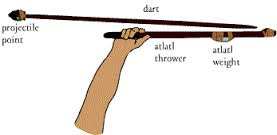
                                                  Figure Three. Basic components of a
                                                  spear thrower or atlatl weapon system
.


Shadows on the Trail was the first book in my prehistoric book series. I just rewrote the book's second edition. I am sure you will like it if you like Prehistoric America. The book series is about a group of Paleoindians called the Folsom people, a mystical tribe who actually roamed western North America around 12,600 years ago. The book series took place in what we now call Texas and Colorado. Several of the animal species that the Folsom people hunted were fast, large, and/or dangerous, so the weapon system they used made a big difference between surviving or not surviving. Since bow and arrow technology allegedly didn't show up on the High Plains of North America until 1,500 to 1,800 years ago, and horses did not show up until the Spaniards brought them to North America around 450 years ago, the Folsom people were limited in their weapon technology. 


Imagine hunting a one-ton bison with an atlatl and a spear.  

Figure Four - North American Paleoindians with atlatl weapon systems.


When Paleoindians entered North America around thirty thousand years ago (yes, I know that not everyone is convinced it was that early), they most likely brought with them an "Old World" technology called the spear thrower or atlatl weapon system. I wrote "most likely" because there is no conclusive evidence that North American Paleoindians had atlatl weapon systems. Since the key components of the atlatl weapon system were mostly perishable wood or bone (figure three), an atlatl system has yet to be discovered in any Paleoindian site in North America. Although it is common sense to assume Paleoindians had the atlatl, the archaeological evidence remains circumstantial. One bit of circumstantial evidence is the 11,000-year-old bannerstones. Some people believe that bannerstones were used as atlatl weights. Another bit of evidence is atlatl hooks in a 9,000 to 10,000-year-old sinkhole called Warm Springs in Florida.

An atlatl weapon system consists of a two-foot or so long wooden shaft with a handle or finger grips on one end and an attached hook made from antler, rock, or bone on the opposite end (figure three). Near the center of the atlatl's wooden shaft was oftentimes a rock weight used for balance or improving the whipping action during throwing. Figure one shows the launching process for an atlatl. The purpose of an atlatl weapon system is to artificially increase the length of the hunter's throwing arm. Why is that important? 
 
Figure Five. Elements of baseball pitching are not much different than atlatl throwing.

While a strung bow acts as a spring, the atlatl acts as a lever. The best way to explain the basic physics of an atlatl is by comparing it to a major league baseball pitcher (figure five). For baseball pitchers, the force used to throw a baseball multiplied by the distance that the ball is released from the point of rotation is what creates the speed of a baseball. In both baseball pitching and atlatl heaving, the point of rotation is the thrower's shoulder. If a pitcher's long arm is moving at the same rate of speed as another pitcher's short arm, the baseball at the point of release is moving faster with the long-armed pitcher. 

An atlatl artificially creates a longer arm or better lever, therefore, potentially creating more speed from the airborne spear when it leaves the atlatl hook or spear. 

The atlatl was a truly innovative idea. 


However, there is something else noteworthy about the physics of the atlatl weapon system; it not only artificially increases the radius of the throwing arm, but also increases the radius by wrist rotation. When major league baseball pitchers throw a baseball, they flick their wrist to gain more speed from their fastball. The same goes for atlatl throwing. In atlatl heaving, there is a big wheel rotating around the shoulder at a long radius (the arm rotating the atlatl handle around), AND a smaller wheel rotating with a flick of a wrist (the wrist rotating the end of the atlatl handle). Throwing without an atlatl, the wrist rotates around the length of a hand. With an atlatl, the wrist rotates around the length of the atlatl, a significant difference.      


Figure Six. Practical modern application of the atlatl.  

Another modern-day example with the same physics applied as the atlatl weapon system is the tennis ball thrower used around the world to throw tennis balls for our furry friends to fetch. Figure six shows a tennis ball thrower used by a dog owner with her attentive pooch bouncing alongside her, waiting for the chance to chase down that fuzzy yellow ball. Replace the tennis ball with a spear, and this dog owner becomes a Paleoindian hunter using an atlatl.

Stay tuned! 
For Part Two of the Atlatl I will write 
about the 'spear in flight' and what impacts 
the performance of the atlatl weapon system.
In the meantime, browse my books and 
read about how the Paleoindians used 
this marvelous weapon system.        


Meltzer, D.J. (2009)  First People in the New World. University Of California Press. Berkeley.


 Follow me on this blog and on Facebook - Shadows on the Trail Pentalogy by John Bradford Branney