Sunday, July 21, 2013

Walking a Mile for a Camel - SHADOWS on the TRAIL Hexalogy!


Figure One -  Camelops hesternus. 

    
One of the most enjoyable parts of writing the SHADOWS on the TRAIL Hexalogy was doing the archaeological and geological research required to make the novels as prehistorically accurate as possible while still maintaining the freedom to create dynamic characters and an intriguing storyline. One of the very first extinct Pleistocene mammals I used in my first book of the hexalogy, SHADOWS on the TRAIL, was Camelops hesternus, an ancestor to modern-day camels. 

I took a bit of literary license in SHADOWS on the TRAIL by using Camelops in a minor role within an intricate plot. My purpose in using the beast was to highlight the climate change occurring at the time. SHADOWS on the TRAIL took place around 12,700 years ago during the Folsom Complex and the Younger Dryas climate event. Currently, there is no archaeological evidence that Camelops survived until 12,700 years ago in North America. As of this writing, the only direct evidence of an encounter between humans and Camelops in North America occurred at an archaeological site 108 miles southwest of Calgary, Alberta, called Wally's Beach. Using radiocarbon dating, archaeologists determined that humans at a future Wally's Beach butchered the camel around 13,300 years ago (Waters et al. 2015), six hundred years before my story in SHADOWS on the TRAIL took place.

   
Figure Two - Butchered camel remains at Wally's Beach represent the only direct evidence
that prehistoric humans hunted the animals in North America.
 
(Photo: Brian Kooyman/University of Calgary)

The critical words in my last paragraph were the only direct evidence of an encounter between humans and Camelops in North America. There are several famous archaeological sites in the western United States where archaeologists found Camelops remains, but there was no evidence that humans caused the camels' demise. Some of the sites where archaeologists found Camelops remains were Agate Basin, Blackwater Draw, Casper, Colby, Lindenmeier, Murray Springs, and Lubbock Lake (Haynes 2009: p 48). 

So, I dealt with Camelops and the age discrepancy between current archaeological evidence in my book SHADOWS on the TRAIL. My philosophy toward the Pleistocene megafauna extinctions is simple. Just imagine how many Camelops remains are still buried out there on the land, undiscovered. How many Camelops' remains have urban sprawl destroyed, or sites where the remains weathered away on their own? Stone tools made by humans may have survived all those years, but the perishable bones of Camelops may not have. Fossilized camel remains are still out there in North America, buried and undiscovered, and they may or may not be associated with prehistoric human activity. If they are ultimately linked to humans, the evidence of the human-camel association might be younger or even older than the archaeological evidence found at Wally's Beach. 

When I write my historical fiction novels about Paleoindians in America, my usual tactic is to use extinct mammals with a disclaimer that scientists are never sure whether they have discovered the earliest or the latest survivor of any given extinct species. At Wally's Beach, humans butchered a Camelops sometime around 13,300 years ago, but that does not mean that there aren't younger Camelops remains still buried that met their demise at the hands of Paleoindians. Only time and erosion will bring the truth to bear!  
 
In the passage below from SHADOWS on the TRAIL, three hunters from the Folsom tribe encounter two Camelops.  
 
The larger of the two bull camels stopped at the edge of the mudhole and swiveled his large slender head around on an elongated neck. The camel’s eyes searched for movement while the disproportionately small ears fluttered back and forth, listening for danger. The smaller bull sniffed the edge of the mudhole with huge nostrils, searching for the scent from predators. Each camel took a long, ungainly step into the swampy muck. The camels gazed around, nervously chewing their cuds. Camels were not the savviest beasts around, but millions of years of evolution had taught them to survive. 

The larger bull stepped deeper into the gooey bog. His gangly front legs sank deeper into the muck. Not wanting to go any further, the larger camel stretched his long neck to reach the mud puddle. 

Hidden behind a small grove of cottonwood trees, three hunters waited for the two beasts to become mired in the sticky mess. Each hunter carried several smaller spear foreshafts, a main spear shaft, and a spear thrower or atlatl. A spear thrower or atlatl was an old-world invention that added length to the throwing arm, therefore increasing the velocity of a thrown spear. 
      
   Click to Order

The family Camelidae, comprising camels and llamas, originated in North America during the Eocene Epoch around 45 million years ago. The camel and llama lineages diverged about 17 million years ago, and then around 7 million years ago, camels crossed the Bering Strait into Asia (Buchholz 2021). 

The genus Camelops appeared in North America during the late Pliocene between 5.3 and 2.6 million years ago, and went extinct around 13,300 years ago (see my discussion above on Wally's Beach).  
Figure 3 - Artists' depiction of mother and 
baby Camelops. Image courtesy of 
naturalhistoryexplorer.com 
Camelops was one of six genera in the family Camelidae in North America and existed in the western part of North America, while llamas existed from coast to coast. Since soft tissue is not preserved in the fossil record, scientists are unsure whether Camelops had humps like modern-day camels or looked more like their distant relative: the llama.

Camelops was a physically imposing beast, standing seven feet tall at its shoulders and weighing around 1800 lbs. (800 kg.). Scientists believe it was both a browser and a grazer. Hunting them on foot with spears in the Pleistocene must have been quite a challenge. If anything like modern-day camels, Camelops could have easily outrun its human predators. Ambushing or trapping the beasts in some kind of natural or manmade enclosure would have been the only way for humans to stack the deck in their favor.        

Both camels and llamas were common in North America until the end of the Pleistocene, when they and other large mammals went extinct. In my opinion, there was no single reason for the extinction of camels, llamas, and other megafauna species at the end of the Pleistocene. Human predation and climate change appear to be the most cited reasons for the megafauna extinction. With long pregnancies and wide interbirth intervals, Paleoindians hunting the megafauna just aggravated an already tenuous survival situation.  


 Figure 4 - A paper-thin Folsom spear or dart point. This is 
projectile point type the Folsom People would have made
  and used in SHADOWS on the TRAIL
John Bradford Branney Collection.
                                     

2021    Buchholz, Pete
            The Last Camels of North America. Earth Archives. 

2009    Haynes, Gary      
            American Megafaunal Extinctions at the End of the Pleistocene. Vertebrate                            Paleobiology and Paleoanthropology Series. Springer Science. 

2015     Waters, Michael R., Thomas W. Stafford Jr., Brian Kooyman, and L.V. Hills   
             Late Pleistocene horse and camel hunting at the southern margin of the ice-free                    corridor: Reassessing the age of Wally’s Beach, Canada. PNAS, volume 114,                         number 14. 


The historical fiction novels written by John Bradford Branney are known for their impeccable research and biting realism. In his eleventh blockbuster novel, BEYOND the CAMPFIRE, Branney catapults his readers back to the Pleistocene.  


John Bradford Branney holds a geology degree from the University of Wyoming and MBA from the University of Colorado. 


Wednesday, June 19, 2013

Prehistoric America - Wonderful Pleistocene Mammals

Available at Amazon.com, Barnesandnoble.com,
and other booksellers in both print and e-book formats. 

The link below is a great little summary article about some of the wild mammals that lurked throughout the Pleistocene in North America (even with the numerous typos in the article it is still interesting).

I have discussed some of these mammals in previous posts and at least one of these mammals made an appearance in Shadows on the Trail.

In the sequel to Shadows on the Trail, at least two of these mammals will make an appearance.

  Prehistoric North America - Wonderful and Interesting Mammals


If you haven't yet had a chance to read Shadows on the Trail it is available on line from various booksellers including Amazon.com and BarnesandNoble.com. 


Monday, June 10, 2013

Saber-Toothed Cat or Mtn. Lion? Pick Your Poison


Figure One - Eyes of a hunter! 

She lay on a ledge overlooking the dying pond. From her vantage point, igmuwatogla, the mountain lioness was watching the pond for prey. The water in the pond would soon dry up, and the drought had killed off most of the deer. The lioness was hungry. Her small round ears perked up when she heard a sound. She listened and heard something coming her way in the shadows of the trees. She heard footsteps walking through the crackling dry leaves. Her keen eyes focused on the direction of the sound, but before she ever spotted the prey, she recognized the odor. The scent of deer blood teased her quivering nostrils. Igmuwatogla raised her twitching nose. She heard the snap of a tree branch. Her ears shot forward, and the pupils of her eyes readjusted to the light where the sound came from. The aroma of blood testing her patience. Her shrunken stomach growled in anticipation of a meal. The lioness spotted movement in the trees below. She slunk down the slope of the canyon, listening and watching for the prey. Her instincts told her to set up an ambush and wait for her prey. Igmuwatogla picked up her pace. Millions of years of evolution had made the lioness the perfect predator

The passage in blue above came from the book SHADOWS on the TRAIL, the first book in the SHADOWS on the TRAIL Pentalogy, a historical book series about Paleoindians 12,600 years ago. The book passage describes how a mountain lioness sizes up her next meal by using the extraordinary senses and instincts that millions of years of evolution had fine-tuned. Who is her next meal? Well, you will have to read SHADOWS on the TRAIL to find that out. If you like Prehistoric America, you won't be disappointed.  

Figure 2 - Smilodon fatalis or a Sabre-toothed
cat fights with a dire wolf over a mammoth carcass at the 
Rancho La Brea tar pits. The dire wolf is already
fatally stuck in the oozing tar. Photo
courtesy of www.50birds.com.

In one of my earlier blog articles titled Dire Wolves Versus Gray Wolves, I explored my decision-making for selecting gray wolves over dire wolves for costarring in my first book SHADOWS on the TRAIL. I used the same decision-making process to select my second predator for the book. My decision came down between the seemingly formidable and extinct saber-toothed cat, Smilodon fatalis, or the amazing evolutionary survivor, the American mountain lion. Below is some of my criteria I used in making my selection. 
 
Figure 3 - The saber-toothed cat reached a
height of 39 inches at the shoulder and a body
length of 69 inches. Photo courtesy of
www.arisonaskiesmeteorites.com.
Based on fossil evidence, one of the great predators of North America for over one million years was Smilodon fatalis, or the saber-toothed cat. It survived near the top of the food chain from about 1.6 million years ago to around 10,000 years ago. Based on analysis from skeletons, the saber-toothed cat weighed between 350 to 620 lbs. and was about the same size as a modern-day African lion. Analysis shows it was built more like a bear than the African lion with heavier forequarters and lighter hindquarters than an African Lion. Based on bone structure, the saber-toothed cat was not as fleet of foot as the African lion. Furthermore, DNA studies have confirmed that the saber-toothed cat is not related to any living feline species. 

Figure 4 - The fictional caveman cartoon The Flintstones
featured a saber-toothed cat named Baby Puss.  


The most distinguishing characteristic of the saber-toothed cat was its large serrated canine teeth which could reach a length of seven or eight inches. Although the teeth were ominous-looking, they were fragile and could not bite through bone. Mechanical analyses have shown that the narrow jaws of the saber-toothed cat only had about one-third to one-half of the biting power of an African lion.

Since saber-toothed cats are extinct so we must interpret their habits and lifestyle from fossil remains. The best place to do the interpretation is at the "gooey graveyard" at the Rancho La Brea tar pits in southern California where over two thousand well-preserved saber-toothed cat skeletons have been recovered and analyzed. Only the dire wolf has a greater concentration of skeletal material at the Rancho La Brea tar pits.

Figure 5 - Size comparison between a human and the saber-toothed cat 
that weighed as much as three to four men. Photo courtesy of

Based on the number of skeletons at the tar pits, scientists believe that saber-toothed cats were ambush predators that preyed on large, slow-moving herbivores such as bison, camels, ground sloths, horses, and mastodons. Its bone structure indicates that it was not suited for preying on quicker, smaller animals. It most likely inhabited forest or heavy brush environments where the cover provided an opportunity for ambushing its prey. The large sample of saber-toothed cat bone material recovered in the tar pits indicates that the animals were scavenging other trapped animals there. Scientists, analyzing the tar pit specimens, found a large number of broken teeth and fractured bones in saber-toothed cat skeletons, and concluded that the trauma causing the injuries came from preying on much larger prey animals. 

The bottom line is that the saber-toothed cat was unable to adapt to a new environment and went extinct with many of the large mammal species that it preyed upon...


What about the American mountain lion? 


Figure 6 - The American Mountain Lion 

The American mountain lion, also known as a cougar, puma, panther, or catamount; is a highly efficient stalk-and-ambush predator. The mountain lion's name is a misnomer since its habitat is quite diverse and not limited to mountains. They are found on the desert and plains, as well as the foothills and mountains. The American mountain lion has the widest habitat range of any large terrestrial mammal in the western hemisphere, spanning from the Canadian Yukon to the southern Andes of South America! It is the second heaviest cat in the western hemisphere, behind the jaguar. Adult lions stand 24 to 35 inches at the shoulders and from head to tail range from 4.9 to 9 feet. Adult males weigh between 115 to 220 lbs.                
The mountain lion is a solitary, nocturnal animal that pursues a wide range of prey from insects up to ungulates weighing over 1000 lbs. The mountain lion's lean and wiry physique gives it great leaping and short-sprint capabilities. The mountain lion can leap vertically eighteen feet in one bound and jump horizontally forty to forty-five feet. The mountain lion's top speed is between forty and fifty miles per hour. Evolution created this near-perfect predator. 
                      
Figure 7 - Photo courtesy of www.fineartamerica.com  

In addition to its physical strength and performance, the mountain lion has extraordinary senses.  The mountain lion uses its finely tuned sense of smell to locate prey within an area. Once the prey is located, the mountain lion moves its small rounded ears together or independently to isolate the direction of the sound. The mountain lion can open its eye pupils three times wider than a human, letting in much more light for nocturnal conditions. Mountain lions demonstrate a heightened sensitivity to movement and many biologists believe that movement triggers an attack. This theory answers the question as to why most of its natural prey freezes in the presence of a mountain lion. The prey is trying to prevent an attack.

By now you can pretty much guess which predator I picked for SHADOWS on the TRAIL. That does not mean you won't see a saber-toothed cat in my other books. Check out my books and see how I handled the storyline! LINK BELOW! 


                              CLICK to ORDER SHADOWS


Saturday, May 25, 2013

High Anxiety in the SHADOWS ON THE TRAIL TRILOGY!


Some people contend that their individual personalities are molded from their past experiences. My three books in the SHADOWS ON THE TRAIL TRILOGY are a culmination of three things: my diligent research on prehistoric cultures, my well-oiled imagination, and my past experiences, both good and bad.  The climbing episodes in the first and second books of the TRILOGY came from a past experience. I used to rock climb. 

Figure Two.
I took the dialogue below (in blue) from Chapter 9 of SHADOWS ON THE TRAIL where a villainous tribe has forced their women and children slaves to scale a granite rock face in what they called the haunted Spirit Rock Canyon. Add in a death-defying waterfall right next to this rock face and a long fall into the river below should anything happen and it translates into compelling drama. I have been told by some readers that this particular section of the book makes their fingers tingle and their stomachs roll as they read it. That is EXACTLY what I wanted to happen when YOU read it!   
When I wrote Chapter 9, I envisioned a rock wall similar to the rock wall in Figure two, except below the climber in Figure two was a shear drop off. I would tell you how the story of the rock wall ends in the book, but I better let you read SHADOWS ON THE TRAIL to find out for yourself. Let me briefly introduce you to the characters in the dialogue below. Ayasha was a young orphan girl in the captured tribe and Namid was a strong young woman from the same tribe who was watching out for Ayasha.         
Ayasha was the next climber. She hesitated to take the first breathtaking step onto the rock wall, right above the vertical cliff. Ayasha looked down at the cloud of mist rising above the river. Namid gently placed her hands on Ayasha’s waist.
            “You will be all right!” Namid told her. “I will be right behind you!”         
            “I am scared!”
            “We are both scared, but we must do this!”
            The rope around Ayasha tightened as the prisoner climbing in front of her had reached the rope’s limit.
            “You must go, Ayasha!” Namid pleaded.
           Ayasha touched the rock wall with her fingers, searching for a finger hold. Finally, she stepped out onto the rock wall, her legs shaking. She took a step, hesitated, and then took another step. 
           “Good, Ayasha! See how easy it is!” Namid said, praising the small girl. “I am right behind you!”
          Ayasha took several more steps up the rock wall with Namid climbing closely behind her. Ayasha was almost to the top of the rock wall when she glanced over to her right and spied Chindi, the monstrous waterfall. Ayasha’s muscles froze on the rock wall, under the captivating spell of the waterfall. 
          This rock climbing event in the book came from my  personal experience of  rock climbing in college. Even though I was severely scared of high places in college and still do not like high places, I let a group of friends in college convince me to technical rock climb with them. That's one way of getting over your fear of something - a direct attack. Over the course of two years of climbing, I thought I had cured my fear of heights. 
         On one particular climb, my friend and I climbed up a vertical crack in the granite rock face to about one hundred feet above the ground. There, the vertical crack disappeared and directly above us the rock face overhung like a massive granite ceiling. We knew we were not skilled enough to climb the overhang and the only way out of the predicament was to find a way around the overhang. To our right was a steep featureless rock wall that wrapped around the side of the overhang. This was our only chance. Our dilemma was that this rock wall was as smooth as glass with only a few small rock crystals to put our boots or fingers on and there was no way to protect ourselves against a long fall (we did not bring any rock bolts on the climb). Climbing across the rock wall and slipping meant a very long free fall for one of us.  
Figure Three.
      We both tried to climb across the rock wall, but we lacked the intestinal fortitude or mental toughness to handle it. Neither of us had the guts to take a thirty or forty foot teeth-jarring fall before the climbing rope caught us. One hundred feet above the ground, we began panicking and making mental errors.  The rock wall defeated us and we rappelled back to the ground with our tails tucked between our legs. It was a very long time before I went rock climbing again and after that episode, climbing would never be the same.  
        Figure three above is what I envisioned the river looked like from the rock wall that Ayasha and Namid climbed in the above passage from SHADOWS ON THE TRAIL. This is not exactly a reassuring sight, even if you are not the one climbing it.  
        I hope you read SHADOWS ON THE TRAIL and share your thoughts and comments with me and others. SHADOWS ON THE TRAIL and the rest of the TRILOGY are available in paperback and e book at Amazon.com, Barnes and Noble.com, and many other booksellers. 


Safe climbing, now!


Click to enter the world of the Folsom People


Thursday, May 16, 2013

Dire Wolves or Gray Wolves - Pick Your Poison!


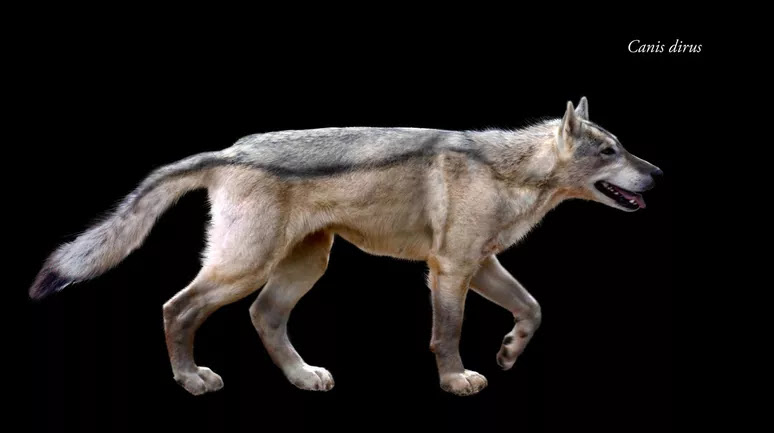
Figure One -- Artist's depiction of a dire wolf (from thoughtco.com). 


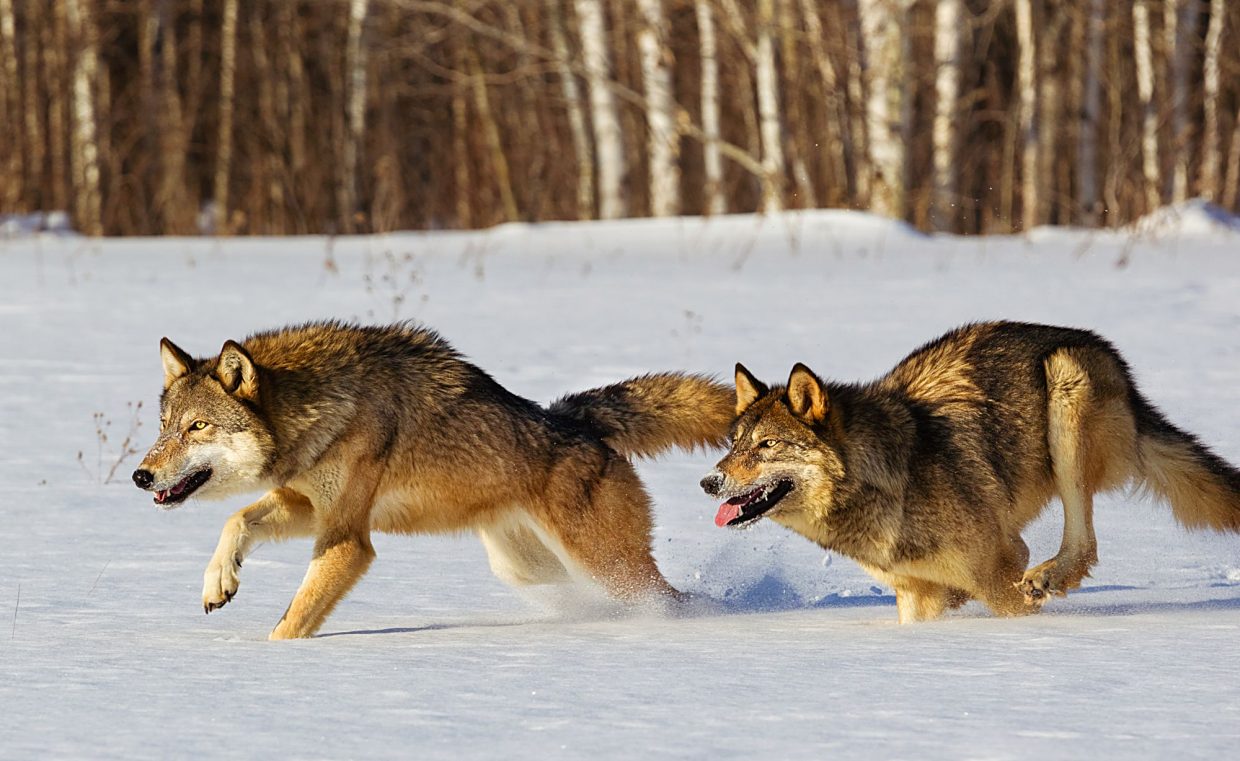
Let me take you on a short adventure in my time machine. The year is 10,700 B.C. and the place is what we would someday call the Panhandle of Texas. The scene is from my book SHADOWS on the TRAILThree hunters in a Paleoindian tribe called the Folsom People are returning to their tribe at night. They believe that they are not alone. At this time in North American prehistory, humans and wolves were at pretty much equal footing in the food chain; Wolves had been around a lot longer than humans, but humans were catching up. I am pretty sure that a few Paleoindians ended up as the main meal for packs of voracious wolves while wolves also served as a meal source for Paleoindians. While the prehistoric humans had fire and spears to defend themselves against these formidable predators, wolves roamed in packs of ten, twenty or, even more wolves. It does not take much of an imagination to see the situation humans found themselves in. Here is a short scene from SHADOWS on the TRAIL. 

Pahin stopped suddenly on the trail and not paying enough attention, Chayton ran right into the back of the big hunter. Chayton bounced off Pahin and then he collided with Kangi. The two boys untangled themselves and stood alongside Pahin. Both boys were completely out of breath and were wheezing. Their hands were on their hips. Pahin glared at them; he was trying to listen to the night.  

“Enila,” he told the boys to ‘be quiet’.

Chayton and Kangi held their breaths. Chayton heard the croaking of a bullfrog near the creek and a chirping cricket near the trail, but other than that, he heard nothing. Then, all three hunters heard it, a wolf howling somewhere in the canyon. The hunters held their breaths and listened some more, trying to pinpoint the distance and direction of the howl. One wolf howled while another answered.

“We must hurry,” Pahin declared, “they are behind us.”

The crescent moon was now high overhead. Its light reflected off the scattered clouds, making the trail barely visible. The three hunters ascended a knoll and from there they spotted the yellow lights of campfires.

“There is our camp!” Pahin yelled over his shoulder. “Run!”

Chayton managed to chuckle even through his stressed lungs. He had never been happier to see a camp in his life. He looked over his shoulder to make sure Kangi was still behind him. Adrenalin increased the speed and the urgency of the hunters. The campfires grew larger.

The black wolf galloped effortlessly along the trail like a demon of the night, invisible in the darkness. The wind in its face curled its lips upward into a sort of wolf-like sneer while exposing iridescent teeth. The monstrous animal no longer needed a scent to track the humans, it had spotted Kangi. The black wolf turned its head and snarled at the others, a warning for the pack to remain quiet. The lust of the kill flowed through the gaunt body of the black wolf as it picked up its pace to a full gallop.

CLICK to ORDER SHADOWS Book Series


What happened to the three hunters? You will have to read SHADOWS on the TRAIL 
to find out.


                               Figure Two - Size comparison between a dire wolf and a gray wolf.

When I wrote SHADOWS on the TRAIL, I thought about using the now extinct dire wolf in the plot of the book. I did my research on North American wolf species around 12,000 years ago and decided I would either go with dire wolves or gray wolves in my book. Dire wolves had an advantage in body size over gray wolves. Fossil specimens of dire wolves indicate that they were around twenty-five percent larger than gray wolves. Dire wolves also had a more powerful bite than gray wolves. Based on bone structure analysis, scientists concluded that a dire wolf's bite was around twenty-nine percent more powerful than a gray wolf's bite. Fossil evidence also indicates that dire wolves were not as fleet of foot as gray wolves. Dire Wolves had a bulkier build and based on a smaller brain cavity scientists believe that dire wolves were probably less intelligent than gray wolves. 

Figure Three - Comparison between gray wolf skull on the left and
extinct dire wolf skull on the right (courtesy Dire Wolf Project).

While gray wolves are social, highly intelligent, and efficient predators of both small and large game, it appears that dire wolves focused their hunting and scavenging on the large megafauna of the Pleistocene. When much of the larger megafauna went extinct in the Pleistocene, dire wolves followed in their footsteps and went extinct as well. 

Over sixteen hundred remains of dire wolves have been excavated from the Rancho La Brea tar pits in southern California while only eight gray wolves have been excavated from the same tar pits. Even if the population of dire wolves at the time was much greater than that of gray wolves, the disparity in the number of fossil remains between the two species is striking. The fossil evidence indicates that a large part of a dire wolf's existence was based on scavenging large mammals stuck in the tar, and ultimately, they became stuck in the tar themselves. The lack of gray wolves in the tar pits might attest to a different hunting strategy for gray wolves or that maybe the species was intelligent enough not to get stuck in the tar.  


Gray wolves survived into modern times by being efficient and intelligent predators while dire wolves faded into extinction with mammoths, short-faced bears, camels, wild horses, ground sloths, and several other species.  

My final verdict was that gray wolves were more efficient predators than dire wolves, and therefore a more threatening species for my human characters in SHADOWS on the TRAIL


In the other books in the SHADOWS on the TRAIL Pentalogy,  one or both of these species returns for an encore performance. 
Check them out.    


Sunday, May 5, 2013

Part I -- The Atlatl Weapon System and the SHADOWS on the TRAIL


Figure One - Paleoindian using an atlatl or spear thrower.
Courtesy of the University of New Mexico    


Imagine, it is 12,600 years ago and you are armed with a spear thrower or atlatl, one spear, and three spear foreshafts. You are out hunting for big game with your typically empty belly…

You are literally hunting for your family’s survival, and something bigger on the food chain is hunting you as well!

… and today, we worry about cell phone coverage, Twitter, wearing a mask, and finding a parking space at the mall...
  

Figure Two - Shadows on the Trail - The 2nd Edition

Here is one such scene from my book Shadows on the Trail: 

Chayton stayed awake for a while but eventually dozed off again. He wondered what was keeping Hexaka and Wiyaka. Then, he heard the sound: hooves pounding the ground. He focused his eyes and spotted them: two beasts darting through the trees. He reached down and grabbed up a spear, briefly fumbling it. Chayton studied the tree line, looking for any movement. He flicked his thumb back and forth across the stone spear tip, checking its sharpness. Chayton felt a stab of pain in his thumb and looked down. The stone tip had sliced open his thumb. Mad at his own clumsiness, Chayton grabbed the spear by its shaft and waited for the beasts to reappear. He checked his breathing; it was too loud. He would startle the beasts. He slowed down his breathing and placed the butt end of the spear into the notch of his spear thrower. Then, he waited.

A young elk bull appeared out of the trees, trotting out onto the open field. Chayton was at full alert. The elk had yet to spot Chayton, and they were heading straight towards the hunter. The bull elk was leading the way with the cow elk following behind. They held their heads high as they sniffed the breeze for predators. Chayton was downwind, and he realized this was what Hexaka had planned the entire time. 

Chayton cocked his left throwing arm. He was ready to heave the spear. He needed the beasts closer. The bull was walking straight toward the hunter, but Chayton did not like the chances of this throw. The bull had no vital organs exposed to Chayton’s line of fire. Chayton could throw the spear perfectly and still not kill the beast. The last thing Chayton wanted to do was track down a wounded elk during the heat of the day across a country inhabited by wolves and mountain lions...


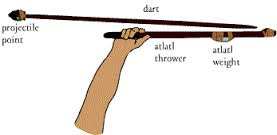
                                                  Figure Three. Basic components of a
                                                  spear thrower or atlatl weapon system
.


Shadows on the Trail was the first book in my prehistoric book series. I just rewrote the book's second edition. I am sure you will like it if you like Prehistoric America. The book series is about a group of Paleoindians called the Folsom people, a mystical tribe who actually roamed western North America around 12,600 years ago. The book series took place in what we now call Texas and Colorado. Several of the animal species that the Folsom people hunted were fast, large, and/or dangerous, so the weapon system they used made a big difference between surviving or not surviving. Since bow and arrow technology allegedly didn't show up on the High Plains of North America until 1,500 to 1,800 years ago, and horses did not show up until the Spaniards brought them to North America around 450 years ago, the Folsom people were limited in their weapon technology. 


Imagine hunting a one-ton bison with an atlatl and a spear.  

Figure Four - North American Paleoindians with atlatl weapon systems.


When Paleoindians entered North America around thirty thousand years ago (yes, I know that not everyone is convinced it was that early), they most likely brought with them an "Old World" technology called the spear thrower or atlatl weapon system. I wrote "most likely" because there is no conclusive evidence that North American Paleoindians had atlatl weapon systems. Since the key components of the atlatl weapon system were mostly perishable wood or bone (figure three), an atlatl system has yet to be discovered in any Paleoindian site in North America. Although it is common sense to assume Paleoindians had the atlatl, the archaeological evidence remains circumstantial. One bit of circumstantial evidence is the 11,000-year-old bannerstones. Some people believe that bannerstones were used as atlatl weights. Another bit of evidence is atlatl hooks in a 9,000 to 10,000-year-old sinkhole called Warm Springs in Florida.

An atlatl weapon system consists of a two-foot or so long wooden shaft with a handle or finger grips on one end and an attached hook made from antler, rock, or bone on the opposite end (figure three). Near the center of the atlatl's wooden shaft was oftentimes a rock weight used for balance or improving the whipping action during throwing. Figure one shows the launching process for an atlatl. The purpose of an atlatl weapon system is to artificially increase the length of the hunter's throwing arm. Why is that important? 
 
Figure Five. Elements of baseball pitching are not much different than atlatl throwing.

While a strung bow acts as a spring, the atlatl acts as a lever. The best way to explain the basic physics of an atlatl is by comparing it to a major league baseball pitcher (figure five). For baseball pitchers, the force used to throw a baseball multiplied by the distance that the ball is released from the point of rotation is what creates the speed of a baseball. In both baseball pitching and atlatl heaving, the point of rotation is the thrower's shoulder. If a pitcher's long arm is moving at the same rate of speed as another pitcher's short arm, the baseball at the point of release is moving faster with the long-armed pitcher. 

An atlatl artificially creates a longer arm or better lever, therefore, potentially creating more speed from the airborne spear when it leaves the atlatl hook or spear. 

The atlatl was a truly innovative idea. 


However, there is something else noteworthy about the physics of the atlatl weapon system; it not only artificially increases the radius of the throwing arm, but also increases the radius by wrist rotation. When major league baseball pitchers throw a baseball, they flick their wrist to gain more speed from their fastball. The same goes for atlatl throwing. In atlatl heaving, there is a big wheel rotating around the shoulder at a long radius (the arm rotating the atlatl handle around), AND a smaller wheel rotating with a flick of a wrist (the wrist rotating the end of the atlatl handle). Throwing without an atlatl, the wrist rotates around the length of a hand. With an atlatl, the wrist rotates around the length of the atlatl, a significant difference.      


Figure Six. Practical modern application of the atlatl.  

Another modern-day example with the same physics applied as the atlatl weapon system is the tennis ball thrower used around the world to throw tennis balls for our furry friends to fetch. Figure six shows a tennis ball thrower used by a dog owner with her attentive pooch bouncing alongside her, waiting for the chance to chase down that fuzzy yellow ball. Replace the tennis ball with a spear, and this dog owner becomes a Paleoindian hunter using an atlatl.

Stay tuned! 
For Part Two of the Atlatl I will write 
about the 'spear in flight' and what impacts 
the performance of the atlatl weapon system.
In the meantime, browse my books and 
read about how the Paleoindians used 
this marvelous weapon system.        


Meltzer, D.J. (2009)  First People in the New World. University Of California Press. Berkeley.


 Follow me on this blog and on Facebook - Shadows on the Trail Pentalogy by John Bradford Branney