Tuesday, October 28, 2014

The American Lion in Winds of Eden


Figure One - Based on fossil remains, a reconstruction of the 
American Lion (Panthera leo atrox).

Have you ever heard of the American Lion? 
No, not the 'African' Lion, the 'American' Lion. 
Well, hang on to your seats, you are just about to learn 
about the American Lion. 

When I did my research for Winds of Eden, the third book in my five-book prehistoric adventure series titled SHADOWS on the TRAIL PENTALOGY, I was looking for storylines around the biggest and baddest animal predators living around 12,000 plus years ago. I wanted the human protagonists in my book to face the same challenges that the real-life Paleoindians faced back in time, armed only with primitive weapons. If you have read any of my books in the SHADOWS on the TRAIL PENTALOGY, you know I like to put my main characters in lots of precarious and unpredictable situations, and some of these situations were with the wilder side of Pleistocene animal predators.

One of the most intriguing North American Pleistocene predators was the American Lion or Panthera leo Atrox. The American Lion's most distinguishing features were its size and long, slender limbs. Based on the studies from skeletal remains, researchers estimated the weight of Panthera leo Atrox somewhere between 390 to 520 pounds, with a few specimens estimated at over 700 pounds. The American Lion's length ranged from 5.3 to 8.2 feet long. That was one big cat! As far as large cats go, only European cave lions rivaled the American Lion’s size and no cat ever rivaled the American Lion's size on the North American continent (figure two).

Figure Two - Size comparison of North America's large cats during the Pleistocene. 
Note that the American Lion was the King of the Beasts on the continent.
Photograph courtesy of  Pinterest and Chris Urena.    

A passage introducing the American Lion in my prehistoric adventure book titled Winds of Eden 

In the starlight, her body looked gray and ghostlike as she crept quietly through the tall grass. She was the perfect predator, the top of the food chain. As she stepped, she lifted her legs high, careful not to brush up against the stalks of tall grass. The soft pads on the bottom of her feet made little sound as she glided over the rugged terrain. She had always been exceptionally careful, but tonight she was ravenous and impatient to find food. Even though she had nothing to fear, surprise was her element.  

Her nocturnal eyes picked up the tiny twinkle of light near the edge of the forest. She cautiously advanced. Her instincts made her mindful of danger. She meandered across the area, staying downwind from the light and studying the lay of the land as she quietly advanced towards her target. Occasionally, she stopped and lifted her snout high in the air, searching for smells. She had yet to pick up the scent of prey. Then a sound drew her attention. It came from the direction of the light. With her belly dragging the grass-covered ground, she slowly crept towards the source of the sound. As she moved closer, the brilliant light blinded her sensitive eyes. She smelled something new, a scent locked somewhere in her memory. Out of her throat came a low–pitched rumble. 


Figure Three - Available at Amazon.com.
Search Winds of Eden by John Bradford Branney 


It appears that the American Lion preferred living in open country based on the locations where paleontologists have found skeletal remains. According to KurtĂ©n and Anderson in their book Pleistocene Mammals of North America, there is some evidence that Paleoindians hunted American Lions. Bones from Panthera leo atrox were found in a human garbage pile in Jaguar Cave in Idaho. Associated charcoal in the cave deposit was radiocarbon-dated to 10,370 ± 350 years BP (uncorrected radiocarbon years). Correcting this radiocarbon date would put the skeletal remains and garbage dump at around 12,000 calendar years, well within the timing in the SHADOWS on the TRAIL PENTALOGY and Winds of Eden.

Figure Four - Skeleton of  an American Lion at the
George C. Page Museum at La Brea Tar Pits.   
The genetic lineage of the American Lion or Panthera leo atrox is not without controversy. Based on skeletal remains, paleontologists still debate whether Panthera leo atrox was lion-like or jaguar-like. In the first half of the last century, French paleontologist Marcellin Boule and German paleontologist Max Hilzheimer stated that Panthera leo atrox possessed a mixture of features from both lions and jaguars. The consolidation of the American Lion's features does not match any living species. Later in the century, John Merriam and Chester Stock proposed that after studying skulls from Panthera leo atrox, the mammal more closely resembled a jaguar than a lion. In the latest study, John M. Harris and Per Christianson focused on the cranium and jaws of Panthera leo atrox and proposed them to be more jaguar-like. I am sure the debates will continue.

The bottom line is that the American Lion or Panthera leo atrox was appreciably larger and genetically different than both the living species of the African lion and the South American jaguar. Since skeletal remains cannot directly tell us what the behavior and hunting habits of Panthera leo atrox were, In Winds of Eden, I assumed the behaviors and habits of a modern-day African Lion, an open country predator. 

Figure Five - Comparison in size between an extinct American Lion and a modern African Lion.
Courtesy of Jun's Anatomy.    


An adult male African lion stands three feet high at the shoulders and weighs between 350 to 440 pounds. The African lion is a massive beast, but it is small in comparison to the extinct American Lion. The African Lion is twenty–five percent smaller than the skeletal remains of the American Lion. African lion males have manes that vary in color and fullness. There is no physical evidence whether American Lion males had manes, and if so what color the manes were. The fur coats on African lions blend well in a semi-desert environment and their belly fur oftentimes is paler to neutralize the shadows from the sun. In the starlight, African lions are gray. People have described them as ghostlike.

African lions are agile and graceful. The African lion’s spine is supple enough to allow it to press its belly against the ground while arching its back like a bow in anticipation of leaping at its prey. The African lion’s legs are powerful and they are able to leap over fences as tall as twelve feet. African lions can leap distances of over forty feet and they can run at over forty miles per hour for short bursts. It is hard to imagine what the much larger Panthera leo atrox could do. Once the lion catches its prey, it uses its claws and forelimbs like grappling hooks to seize and drag the prey to their mouths. Like most carnivores, the African lion has two pairs of blade-like carnassial teeth located about halfway between the front of the jaw and the jaw joint. The carnassial teeth work together like scissors, allowing lions and other carnivores to slice off strips of flesh. Surprise is a key element in the African Lion's attack.

An African lion lives and hunts in a pride which is a lion's social unit. A pride typically consists of five females, two males, and the young. While females do most of the hunting, the male lions protect the pride and patrol the territory, always marking their territory and on the lookout for other males.

Sight is the primary sense that African lions use. African lions are very opportunistic and  hunt at any time of the night or day,
Figure Six - African Lion, the King of the Beasts. 
although they prefer darkness. When the lion pride hunts, the members oftentimes spread out along a front or in a semi-circle so the prey does not allude them. Lions have a reflective layer at the back of their eye that amplifies light into the eyeballs, making the lion's eyes shine at night. An African lion’s pupil is oval to round, just like ours. Smell and hearing are the next most widely used senses for African lions. African lions obtain most of their water requirements by eating other animals. They can survive in desert climates as long as there are animals to eat.  

Did the American Lion or Panthera leo atrox live and hunt in prides? We cannot be sure. Just imagine if you were a Paleoindian hunter and you were armed only with a spear. Imagine that you bump into a solitary American Lion or maybe even the pride. 
That would be a truly terrifying experience.

You don't have to imagine it. READ Winds of Eden and find out 
if you could have survived.


CLICK to ORDER


Thursday, September 18, 2014

Ultrathin Knife Forms along the SHADOWS on the TRAIL


Figure one. Four-inch long ultrathin knife form surface found on private land
in central Wyoming
and exhibiting thinness, bi-concave x-section,
great width, 
and long, flat flaking. Age is indeterminate. 
John Bradford Branney Collection.


Introduction.

If you have read my prehistoric adventure series the SHADOWS on the TRAIL Pentalogy, you know that my mythical adventures are about a Paleoindian culture called Folsom that existed in western North America around 12,500 years ago. One of the archaeological calling cards left behind by the Folsom Paleoindians was their beautifully crafted fluted projectile points. I have dedicated several articles to these wonderfully made projectile points so I will not cover them in this article.  


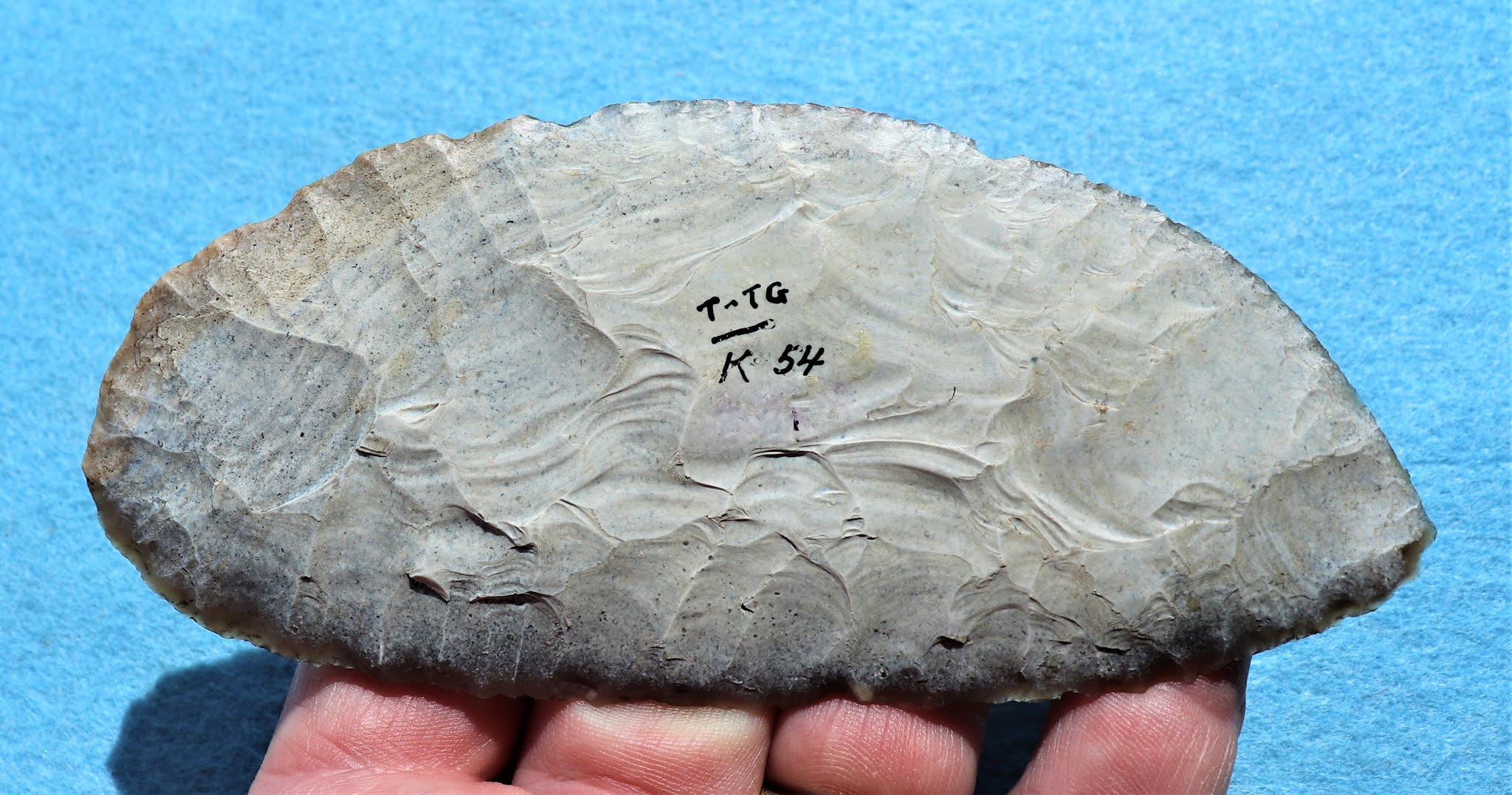
Another artifact that archaeologists often attribute to Folsom Paleoindians is the ultrathin knife form. Ultrathin knife forms were specialized stone tools made with sophisticated knapping technology by highly skilled knappers (figure one). Archeologists and collectors have defined the specifications for ultrathin knife forms by their thinness, bi-concave cross-section, width to thickness ratio, well-controlled marginal pressure flaking, and specialized flaking technique. A finished ultrathin knife form can be ovate, pointed, or bi-point in shape. I have examples from my collection below. Width to thickness ratios for ultrathin knife forms, measured in millimeters, often exceed values of ten or greater. 


Figure Two.  3.8-inch long ultrathin knife form made from Georgetown chert
and found in Coryell County, Texas 
by Hervey McGregor.
Note diving flakes near the middle of the biface.
Age is indeterminate. 
John Bradford Branney Collection.   

Figure Three. Cross-section of the ultrathin knife form in figure two with 
a width to thickness ratio approaching ten. Age is indeterminate. 
John Bradford Branney Collection.   
  

Uses of Ultrathin Knife Forms.        

Jodry (1998) noted that ultrathin knife forms were associated with Folsom camps and lithic workshops, but not kill sites and initial meat processing sites. Her conclusion was that ultrathin knife forms were used in the downstream meat processing sites, and not at the initial kill and rough butchering sites. Based on the use-wear, production technology, and archaeological context of ultrathin knife forms, Jodry proposed that Folsom people used ultrathin knife forms as knives for filleting meat. Based on archaeological evidence, we know that processing meat was one of the major activities in Paleoindians' lives. Since "true" ultrathin knife forms were so thin and delicate, it is hard to imagine that Paleoindians did not use them for slicing meat into thin strips or cutting meat away from the bones of their prey during the butchering process.

Jodry suggested further the possibility that ultrathin knife forms were women’s knives. She claimed this possibility based on the behaviors of historical Indian tribes where meat filleting was mostly a woman's task. From this observation, Jodry assumed that Paleoindian women may have acted the same was as historical Indian women and did much of the meat filleting. Her conclusion could be possible, but I find it a bridge to far to project activity from Paleoindians some twelve thousand years ago to historical Indian tribes some two hundred years ago. Therefore, I do not concur with her assumption that ultrathin knife forms were women's knives. As an outdoor enthusiast and past hunter, I envision these sharp ultrathin knife forms serving multiple purposes in the lives of Paleoindians, and my evidence is several ultrathin knife forms in my collection that have other uses such as engraving and burination (figure four).  


Figure Four - 4.6-inch long ultrathin knife form surface found on private land in 
Sweetwater County, Wyoming. This knife form has a graver (G) on one end
and a burin tip (B) on the other end. Neither gravers nor burins
were unusual on ultrathin knife forms. Age indeterminate.
John Bradford Branney Collection.    

Over the years, I have picked up many artifact pieces that I suspected started out as ultrathin knife forms. Since ultrathin knife forms by definition were thin and brittle, many did not survive long enough for me or others to find them intact thousands of years later, and just like modern-day hunters who sharpen their hunting knives when they get dull, Paleoindians did the same thing with their knife forms. Many ultrathin knife forms that started out much larger and wider were resharpened down to smaller sizes, masking their original form. When found, these suspected pieces or smaller knife forms are oftentimes not conclusive enough to categorize them as originally ultrathin knife forms.      


Figure Five. 3.5-inch long ultrathin knife form surface found in Wyoming and exhibiting fine marginal pressure flaking around the perimeter of the biface. Age indeterminate. 
John Bradford Branney Collection.
  
Below, I captured a passage from my book GHOSTS of the HEART, the second book in the SHADOWS on the TRAIL Pentalogy series. This scene took place right after the Folsom People trapped and killed a small herd of bison in an arroyo trap. The scene described the butchering and harvesting of the meat from the bison carcasses. 

When it was all over, the tribe had killed twenty-two tatanka – bison. The meat from the herd would help the tribe through wani yetu – winter. One of the hunters ran to the camp to tell the people of the tribe. Before long, the entire tribe had returned to help butcher and carry the meat back to the camp. First, everyone in the tribe helped lay all of the carcasses on their bellies with legs sprawled. Then a team of two or three butchers worked on each carcass; while one person held and positioned the carcass, the other person chopped, sawed, and cut. The team of butchers then cut the hide lengthwise down the back. They then pulled the hide to the ground on both sides of the carcass, creating a mat that would protect the butchered meat from the ground. The team of butchers extracted the tender cuts of meat under the skin of the back first, followed by the forelegs, shoulders, hump meat, rib cage, and body cavity. They would not waste anything. The team of butchers opened up each body cavity and removed the heart, liver, and gall bladder. 
With hammer stones, choppers, and stone knives, the butchers then harvested the hindquarters, hind legs, neck, and skull. As the team of butchers systematically stripped the meat from the carcasses, others carried the meat back to the camp where they cut it into strips and hung it from sagebrush and tree branches to dry. The Folsom People would make pemmican from the meat that was too tough to eat. They then extracted two more delicacies from the skull, the tongue, and the brain. 

By the time the sun was in the west, the tribe had stripped the tatanka carcasses clean. They would leave any remaining meat for the scavengers of the night. That evening in the camp, there was a grand celebration as the Folsom People celebrated the great hunt.

Origin of Ultrathin Knife Forms.
Figure Six. From Bradley (1982) 


There is evidence that the production of ultrathin knife forms by the Folsom prehistoric culture was an outgrowth of the Clovis prehistoric culture's biface reduction process. The use of overshot flakes and the intentional use of hinge and step terminations along the midline of an ultrathin knife form was very close to the process that Clovis knappers used for biface reduction (Bradley 1982: 203-208).

Bradley described two different thinning methods for biface reduction that both Clovis and Folsom flintknappers used. He called the first of these biface thinning methods alternating opposed biface thinning. This method is shown on the left-hand side of figure six. In this method, initial shaping and thinning of the biface involved the removal of large percussion flakes using a patterned sequence. The knapper removed the first large percussion flake from a margin near either end of the biface. The knapper then removed another large percussion flake from the same side but on the opposite end of the biface. Next, the knapper removed two large percussion flakes next to the first two percussion flakes, but on opposite edges. If the biface needed further thinning, the knapper removed one or more percussion flakes near the middle of the biface. These large, wide percussion flakes oftentimes traveled across much of the biface and in some cases took off a portion of the opposite edge in what we call an outre passe or overshot flake. 

Figure Seven. 3.32 inches long, paper-thin ultrathin knife form
surface found in east-central Colorado. Probable meat filleting knife.
Note overshot flaking. 
John Bradford Branney Collection.
Bradley called the second biface thinning method used by Clovis and Folsom flintknappers o
pposed diving biface thinning. This method is shown on the right-hand side of figure six. As thinning on a biface progressed and the biface became routinely flaked, the knapper switched to a different style of thinning flake. This new thinning flake style allowed for maximum thinning with less risk of overshot flakes. The knapper accomplished this by removing a sequence of flakes from one edge of the same face with intentional hinge-fracture terminations at or near the midline of the biface. The flake scars were then met by a series of thin flakes from the opposite edge which 
removed most of the hinge-fracture terminations from the flaking from the initial edge. This flaking method created a biface that was oftentimes thinner in the middle than along the edges. The cross-section of a biface successfully executing the opposed diving biface thinning method was biconcave, meaning that the biface was thinner in the middle than along its edges. 
 
Figure Eight. Cross-section of ultrathin knife form
from 
figure six. John Bradford Branney Collection.


Once the knapper thinned the ultrathin knife form to the desired state through percussion flaking, he or she finished the ultrathin knife form by removing small pressure flakes around the edges of the biface. I often refer to these tiny marginal retouch flakes on the edgework of ultrathin knife forms and Folsom projectile points as "flea bites".

Figure Nine. Ultrathin knife form surface found by Keith Glasscock in 1954 in Tom Green County, Texas. It is 137 millimeters long, 58.5 millimeters wide, and 
6.9 millimeters thick. Note the "diving flakes" near the center.   
John Bradford Branney Collection.    
        
Cautionary Note.

You will note that in my first paragraph I did not state that ultrathin knife forms were a diagnostic artifact for just the Folsom Paleoindian culture because they are not. Other prehistoric cultures occasionally made ultrathin knife forms using similar technology with similar results. Paleo and ultrathin knife forms are some of the most overidentified and over-claimed artifacts in the collecting world. Every artifact collector wants one or thinks they have one in their collection because "true" ultrathin knife forms are both rare and valuable. But just because I or any other collector say it is so, doesn't make it so. 

Based on archaeological evidence from Paleoindian sites, Paleoindians seldom went through the time and effort to create these delicate ultrathin knife forms. Evidence indicates that Paleoindians to a large extent just used large flakes or unifacial blades with retouched edges for their cutting and butchering needs.

If an ultrathin knife form is found on the surface of the ground on a prairie, river, creek, lake, plowed field, mountain, or wherever, it is impossible to determine with one hundred percent certainty that Paleoindians made that particular ultrathin knife form. For that ultrathin knife form to be attributed to Folsom or any other prehistoric culture, the artifact has to be found in dated stratigraphic and archaeological context or in clear association with other diagnostic Folsom or other culturally diagnostic artifacts. Don’t let anyone fool you into believing otherwise. There are all kinds of claims when it comes to surface found artifacts, but the proof is in the technology used and the context of where it was found. Although the Folsom prehistoric culture appeared to prefer ultrathin knife forms, that is not enough proof to conclusively assign surface found ultrathin knife forms to that culture.

Figure Ten. Ultrathin knife form surface found by Keith Glasscock in 1954 in Tom Green County, Texas. It is 137 millimeters long, 58.5 millimeters wide,
and 6.9 millimeters thick. John Bradford Branney Collection.    
        
Bradley, Bruce
            1982    Flaked Stone Technology and Typology. In The Agate Basin Site: A Record of the Paleoindian Occupation of the Northwestern High Plains, edited by G. C. Frison and D. J. Stanford, pp. 181 – 208. Academic Press, New York.  

Jodry, M.A.
            1998    The Possible Design of Folsom Ultrathin Knife Bifaces as Fillet Knives for Jerky Production. Current Studies in the Pleistocene 15: 75-77.    

Thursday, August 21, 2014

Good News for Future Readers of Shadows on the Trail!!!

Good news if you have not read my prehistoric thriller Shadows on the Trail!

The publisher has lowered the price for the Shadows on the Trail e book down to $6.99 each!

Order your copy of Shadows on the Trail today and you can be readin...
g it tonight! You can order both Shadows on the Trail and the second book in the Trilogy, Ghosts of the Heart in e book for $11.98 for both books! Then, the real adventure begins.

Join the adventure today! 

Tuesday, August 19, 2014

Prairie Ghosts Along the Shadows on the Trail!

Figure One - Speed Demon! Pronghorn buck watching me across
his prairie kingdom. 
Photograph by John Bradford Branney.

Antilocapra americana or the American pronghorn is the fastest mammal in North America. It has a distribution from southern Canada to northern Mexico.

I was driving down a bumpy gravel road in Wyoming on an early morning jaunt to one of my favorite artifact-hunting ranches. A sea of sagebrush and beige prairie surrounded the road. Out of the corner of my right eye, I caught movement out on the prairie. I glanced over and spotted a pronghorn buck racing my vehicle. I peered down at my speedometer and noted that I was plugging along at a tad more than thirty miles per hour. I looked over at the pronghorn buck and he was not even laboring to keep up. I gandered at the stretch of road in front of me and saw that the road was pretty straight. I decided to put that pronghorn buck to the test. I stepped on the accelerator just to see how fast Mr. Pronghorn could go. You have to watch out for pronghorns paralleling your vehicle. They have a nasty habit of accelerating and crossing the road in front of you. I do not understand why they do that. Maybe they are showing off or maybe it is just a deadly game they like to play or maybe they are not that bright. I do know that sometimes that does not end well for them.      


Figure Two - The first book in my Paleoindian adventure series is SHADOWS on the TRAIL.


My vehicle picked up speed at around thirty-five miles per hour and the pronghorn buck matched it. I again checked the road out in front of me for curves and ruts. I sped up to forty miles per hour. The vehicle chattered and yawed down the washboard road. Forty miles per hour was my limit, otherwise, I might be the one that ends up out on the prairie. I thought that might be the limit of the pronghorn buck, as well. I looked over at my pronghorn friend and saw that at forty miles per hour, the buck was not done with me yet. He lowered his head and found another gear. His legs chewed up the prairie sand as he accelerated across the road right in front of my vehicle. I pumped the brakes and slowed down. That was enough for me. I let the adrenalin subside in my body. The last time I saw that pronghorn buck his white rump was waving goodbye to me. The pronghorn buck was adios, amigos, disappearing in a sea of tall Wyoming sagebrush. The pronghorn buck just demonstrated to me who the fastest dude on the prairie was, and it sure was not me.  

Pronghorn are the second fastest land animal in the world, right behind cheetahs. At thirty miles per hour, pronghorns are loping along. At forty-five miles per hour, they are cruising along. Beyond that, they are simply hauling!   

High Plains archaeological sites are well represented with the remains of pronghorn antelope. The archaeological record of the Folsom People, my main characters in Shadows on the Trail, demonstrates that pronghorn antelope were an important component of their Pleistocene diet. Investigators have found the remains of pronghorn antelope in Folsom-aged strata at two major archaeological sites: the Lindenmeier Site in northern Colorado and the Agate Basin Site in eastern Wyoming. Figure three shows fluted projectile points from my collection that are diagnostic of the Folsom Paleoindian Complex. 

Figure Three - Folsom projectile points from the author's collection.  

It is now time to climb into our time machine and set it for the late Pleistocene, sometime around 10,600 B.C. We join three young hunters from my prehistoric odyssey called Shadows on the Trail on a difficult trek across the Arid Plains of North Texas and southern Colorado. The three young hunters named Chayton, Wiyaka, and Keya are almost out of food and water. From that book passage, it appears things have gone from bad to worse. 

      The hunters were in the direct path of the dirt and dust blowing in the wind. Whatever was creating the dust, was heading towards the hunters. Chayton was nervous and peered around for something to hide behind. His eyes teared up from the dust and dirt in the air. The empty prairie offered nothing but sage and greasewood. The rumbling sound grew louder, and the dust cloud was practically on top of the hunters. They could barely see each other. Wiyaka suddenly stood up. His face lit up into a broad smile and then instantly became a worried frown. He waved his spear over his head and screamed his lungs out. Still hunkered down, Chayton and Keya peered at Wiyaka as if they were sure he had gone crazy.   

The lead animals spotted Wiyaka and his waving spear. The herd veered off to the right of the three hunters. Chayton stood up and Keya followed suit. The three hunters watched as hundreds, if not thousands of pronghorn antelope galloped past them. The herd was so large that the dust cloud it created brought temporary darkness to the prairie. By the time the thundering hooves died out, the dust cloud had drifted off to the southeast and the blazing sun reappeared.  

“Ha! Ha! Ha!” Keya laughed and pointed a finger at Chayton.

“What are you laughing at?” Chayton demanded. 

Wiyaka turned around and looked at Chayton. He laughed. Keya and Wiyaka were having a good laugh at Chayton’s expense. Dirt covered Chayton from head to toes. When he opened his mouth, the only thing on his body not covered in dirt and dust were his teeth. Chayton reminded the hunters about the herd.

“Are we going to stand here and laugh at me or go after the herd?” Chayton demanded.

“I would like to stand here and laugh at you,” Wiyaka ribbed Chayton.

“I am leaving!” Chayton announced. 

Wiyaka and Keya ran after Chayton. In their exuberance, the hunters had all but forgotten about the heat and the wind and their thirst and sore feet. The hunters reached a small knoll quite gassed from their run. They slogged up the hill, having to stop several times for a breather. When they reached the top, all three hunters collapsed on the ground, completely exhausted. Chayton peeked over the top of the knoll and his eyes could not believe the sight. He did a double take. In the near distance, a massive river meandered across the Arid Plains. On both sides of the river, large herds of tatoke or pronghorn antelope grazed on the short grass growing along the floodplain.

The three hunters had found paradise.          


Figure Four - Pronghorn buck cruising along on the prairie.
Author photograph. 
I imagine that back 12,600 years ago, pronghorn herds were plentiful. Pronghorn antelope are survivors, and their herds are prolific even today. While deer have short-crowned, browsing teeth, pronghorn have high-crowned teeth which enables them to browse on grit-covered shrubs and forbs. Pronghorn can survive on a diet of sagebrush, something a deer cannot do. 

In a wide-open environment like the Arid Plains in the story above, pronghorn antelope are nearly unapproachable. Pronghorns have phenomenal eyesight and they don't miss much, even at very long distances. George Frison reported in his book Survival of Hunting that pronghorns' bulging eyes allow the beasts a nearly 360-degree field of vision and that study showed that a pronghorn's eyesight is akin to a human peering through eight power binoculars. Pronghorn, bison, and caribou are hypersensitive to movement. If you are a spear-toting hunter in the Folsom tribe without a mode of transportation other than your two legs, you can imagine how difficult it was to get close enough to hunt pronghorn antelope on the open plains. 

However, for prehistoric hunters, there was a bit of hope. Pronghorn antelope have a couple of weaknesses. Even though pronghorns are mostly unapproachable for a spear-tossing hunter on a wide-open prairie, the animals become confused when dealing with physical barriers or when surrounded by humans. Trap them in some kind of dead-end arroyo or with a manmade or natural barricade, and pronghorn antelope tend to run around in circles until they literally fall over from exhaustion, instead of attempting to escape the enclosure. Prehistoric hunters took advantage of that behavior by building brush, stone, or wooden fences that funneled the pronghorn herds into more confined areas. There, the prehistoric hunters dispatched the pronghorns with spears and stone mauls. 

In the book Architecture of Hunting by Ashley Lemke, the author reported there are over one hundred large-scale hunting structures dated from Early Archaic to historical Indian times in the Great Basin of the United States. Early hunters trapped pronghorn, mule deer, big-horn sheep, and elk in those structures. Communal pronghorn hunters used lines of brush, rocks, and wooden poles to trap the beasts. Corrals were eighteen inches to seven feet tall and made up of juniper trees, pine, sagebrush, and stone. Fences did not need to be high for pronghorns because they are just like caribou; both beasts prefer to go under, not over obstacles. I have found a few pronghorn carcasses hung up on barb wire fences. Attempting to leap over the fence did not end well for them.  

Figure Five - A buck and three does that I "lured" closer by waving my walking stick in the air 
while artifact hunting in Wyoming in September 2014. My game began when the
foursome was at least a quarter of a mile away. John Bradford Branney Photograph.   
   
Pronghorn antelope possess another weakness; their curiosity compromises them. When pronghorn antelope spot something of interest on the prairie, they oftentimes move in for a closer look. They need to see what it is, even though it might be a dangerous predator. Since they can outrun all breathing predators, they can use a burst of speed to rocket away. I have tested their curiosity many times while hunting for prehistoric artifacts on the wide-open prairie (figure five). When I see a pronghorn in the distance, I wave my walking stick in the air to get its attention. Once it locks onto me, I can usually hold its attention for a while. Occasionally, I can draw them in closer, or at least hold them in place standing there and staring at me. The game usually ends when either the pronghorn or I become bored and lose interest.    

Figure Six - I took this photograph in September 2020 while prehistoric artifact
hunting in Wyoming. The pronghorns initially scampered away but stopped to 
check me out one last time. "Curiosity kills the cat".   


Read the Shadows on the Trail Pentalogy for 
more adventures about pronghorn antelope!  


CLICK for THESE BOOKS


The historical fiction novels written by John Bradford Branney are known for their impeccable research and biting realism. In his latest blockbuster novel Beyond the Campfire, Branney catapults his readers back into Prehistoric America where they reunite with some familiar faces from Branney’s best-selling prehistoric adventure series the Shadows on the Trail Pentalogy.

John Bradford Branney holds a geology degree from the University of Wyoming and an MBA from the University of Colorado. John lives in the Colorado mountains with his wife, Theresa. Beyond the Campfire is the eleventh published book by Branney.


Saturday, August 2, 2014

Ghosts of the Heart and Catastrophic Storms!


Click the Link - Ghosts of the Heart by John Bradford Branney
               The Scene: 10, 700 years ago, in a place one day  
                                would be called Colorado.

Wanbli Cikala and He Wonjetah stood on the bank of the creek, bracing themselves against the gale-force winds and onslaught of flying sand and gravel. The black dust blizzard was directly in front of them, carrying silt and sand high into the air. “It will miss us!” Wanbli Cikala screamed, more of a hope than a fact.


Slol wa yea shnee! – I do not know!” He Wonjetah screamed into the wind.


The sand and gravel pelted their faces while their dust-filled eyes streamed tears into the wind. In a wasted effort, both men held their arms in front of their noses and mouths, attempting to protect their faces from sand and gravel. Tree limbs from the dead pine forest flew past the two men like
spears thrown by the gods. With one arm, He Wonjetah grabbed Wanbli Cikala by the arm and literally pulled him down into the creek bottom. The sky was as black as the darkest night when the front edge of the black dust blizzard exploded on the Arid Plains on top of the tribe. He Wonjetah and Wanbli Cikala stumbled around in the creek bottom, looking for a place that shielded them from the abrasive sand.


Finally, He Wonjetah just shoved Wanbli Cikala to the ground, falling on top of him. The winds roared over them as sand and silt poured into the deeper depression of the creek bottom. He Wonjetah could not breathe as he searched for air to fill his lungs while choking on the thick dust. He heard Wanbli Cikala underneath him, wheezing and coughing as silt and sand poured into the creek bottom, filling it up. The drifting sand and silt would soon bury the tribe unless they kept moving. He Wonjetah stood up and the cyclonic winds knocked him back down.

What would you think if this suddenly appeared
and you had never seen or heard of a tornado?


The passage above is from Ghosts of the Heart, the second book in my Shadows on the Trail Trilogy. In this passage, the Folsom People were traveling through a once-upon-a-time pine forest, a pine forest that no longer existed because of climate change near the end of the Pleistocene. On this once-forest, now-desert location, the Folsom People encountered a frightful sight, a black blizzard or dust storm of epic proportion. The Folsom People were stuck in the middle of this desert with no place to run or hide, except to the bottom of a dry creek bed. The passage showed how two of the tribal elders named Wanbli Cikala and He Wonjetah dealt with this hair-raising experience.  


Now, I am going to ask you to close your eyes and imagine yourself witnessing either a gigantic tornado, a massive dust storm or a devastating hailstorm for the very first time. But, before you close your eyes, imagine you have a time machine and can go back in time to 10,700 years ago in the Pleistocene Epoch, before the science even existed that could adequately explain the causes of these forces of nature. Now, imagine that when you step into the time machine, you leave your knowledge and memories in the 21st Century. You are now living in the Pleistocene Epoch without any kind of knowledge or memories on what causes tornados or dust storms. Okay, now that I have set the stage, close your eyes and unharness your vivid imagination.

Photograph of a dust storm in central United States in the 1930s.


Are your eyes open yet? Good. Wipe your memory of everything you know about weather and storms. I know this is darn near impossible to do. Once we have learned something it is very difficult, if not impossible, to unlearn it. I want you to imagine you are a member of the Folsom People tribe and you are roaming the plains and prairies of Texas and Colorado in search of food. You would have no knowledge of what makes weather change or storms appear. How do you think you would explain storms? Remember, we have wiped out your modern-day memory. Perhaps, you and the other Folsom People would blame these phenomena on an all-powerful being, creating these mysteries of nature. This is not too far off. Our early ancestors did this as well. 


The Pleistocene was no place for wimps. The Folsom People not only had to deal with the predatory animals that wanted to put them on their menu (yes, humans were part of the food chain, not the top of the food chain), but they also had to deal with the ravages of storms associated with climate change. 


Now, as a Folsom person, how would you explain that dust storm? Without the knowledge to understand the science behind a dust storm, well, I don't have to explain the problem the Folsom People had.


         Read Ghosts of the Heart and experience life as one of our First     Americans. Click the Link!

Click to Order Shadows on the Trail
Click to Order Ghosts of the Heart


Sunday, July 27, 2014

Prehistoric Mammals Excavated from Wyoming Cave!

Shadows on the Trail is available at Amazon.com, Barnes and Noble.com
and better booksellers.


Now this is an interesting link!  Fossils in Wyoming