Showing posts with label Folsom archaeological complex. Show all posts

Monday, May 9, 2022

Author John Bradford Branney Captures Readers’ Minds!


 Author John Bradford Branney once again captures readers’ minds with vibrant characters and breathtaking landscapes in his latest prehistoric adventure!

In Beyond the Campfire, John Bradford Branney set the time machine for 10,600 B.C., returning his readers to the Rocky Mountains of North America. Beyond the Campfire is the fifth book in his prehistoric saga titled the Shadows on the Trail Pentalogy.

Beyond the Campfire realistically portrays Prehistoric America at the end of the Pleistocene and unites a riveting storyline and diverse characters with clues taken from the archaeological record and oral traditions of early Americans. Critics have hailed John Bradford Branney’s books for their accurate and vivid depictions of Prehistoric America. Author Branney guides his readers through the plains and mountains of the Rocky Mountains accompanied by a colorful band of adventurers including a cheh^pi warrior named Tonwan and a folsom hunter named Cansha. The author also reacquaints readers with a favorite character or two from previous Shadow on the Trail Pentalogy books!  

“The original book in the series titled Shadows on the Trail started out as a one-off book. It told the story of how a twelve-thousand-year-old stone artifact from a prehistoric rock quarry in Texas ended up in northern Colorado where I discovered it thousands of years later,” Author Branney pointed out. “Due to the popularity of the first book, I expanded the book series to a trilogy…and then a quadrilogy…and now Beyond the Campfire makes it a pentalogy. The five-book series follows the lives of three generations of a Paleoindian family. Will there be more books in the series? Only time will tell.”

Beyond the Campfire picks up where the first four adventures left off; climate change, hostile humans, dangerous beasts, and survival remain the concerns for the small band of Paleoindians surviving on the mountains and plains of a violent and untamed world. Author Branney’s story captures the tumultuous changes and disasters that plagued early Americans and highlights the difficulties these tough people faced.

Isn’t it time for you to join the adventure?

Tuesday, May 7, 2019

Radiocarbon Dating - Part Two - Reporting


Figure One - A handful of Folsom dart points, surface found on private land in the high plains. 
Age is around 10,900 to 10,200 BP. John Branney Collection.    

Welcome to Part Two of my article on Radiocarbon Dating. In Part One, I discussed how the radiocarbon date process worked. In Part Two, I explore how radiocarbon dates are reported in archaeological papers and journals. If you missed Part One, click the link to that article; Radiocarbon Dating - Part One - Process, and don't forget to return and read Part Two! 
         
“Radiocarbon dates indicate that Folsom may have had a relatively long residence in the Rocky Mountains and adjacent Plains from about 10,900 to 10,200 BP.

“At the Hell Gap site the investigators defined a Midland level with dates estimated between 10,700 and 10,400 RCYBP (Irwin-Williams et al. 1973).”
                                 -   Marcel Kornfeld, The First Rocky Mountaineers, page 46

When you read the above passage from Dr. Kornfeld’s archaeological book The First Rocky Mountaineers, do you get the impression that both Folsom and Midland are a tad north of 10,000 years old? I did. In fact, the first book I wrote I used 10,500 years ago for the age of the Folsom Complex (figure two). I was wrong. I was using an uncalibrated radiocarbon date. The calibrated radiocarbon date for Folsom is much older. After calibrating the raw radiocarbon date, we find that Folsom occurred around 12,500 years ago during the Younger Dryas climate event! 

Do you know what the BP refers to in the above passage from Dr. Kornfeld? Do you know what RCYBP stands for? By the time you read this article, you will be able to answer these questions.   

Figure Two - The second edition of 
Shadows on the Trail. 
In Part One of my article on Radiocarbon Dating, I mentioned certain “gotchas” that archaeologists and scientists must be aware of when using the radiocarbon dating process. One of the bigger assumptions scientists must account for is that the amount of carbon-14 isotope in the atmosphere has not been constant throughout prehistoric time. At different times during Earth's prehistory, plants absorbed different amounts of the carbon-14 isotope and since the carbon-14 isotope is the basis for measuring in the radiocarbon dating process, this became a major challenge. To determine age, the radiocarbon model must know how much carbon-14 isotope was available in the atmosphere at a specific time so it can calculate how much radioactive carbon-14 isotope has decayed.  

Scientists recognized this problem early on in the radiocarbon process and went about solving it. They used dendrochronology, or the study of tree rings, to tie tree rings to levels of carbon-14 isotope levels. For example, using 4,500-year-old bristlecone pines in the Sierra Mountains, scientists determined carbon-14 isotope levels at the time the tree rings were formed. The scientists then correlated the tree rings from living bristlecone pines to dead stumps,  allowing the scientists to calibrate carbon-14 isotope levels back to around 8,200 years ago. With this information, scientists created the first pass at “calibrating" raw radiocarbon ages to corrected calendar ages.   
Figure Three - Paleoindians waiting
their turn at the cafeteria. 
 
To accommodate the lack of certainty in radiocarbon measurements, scientists added an error factor to the measured radiocarbon age. For example, an archaeological report might read that the age of a site is 10,000 ± 160 B.P. This means that there is a 67 percent chance (one standard deviation) that the real age of the site is 160 years plus or minus the 10,000 years before present (B.P.). Whenever you see Before Present or B.P. or BP or bp, it means the age is measured from the baseline year of 1950. For the above example, if we want 95 percent accuracy, we must use two standard deviations, so we add two times 160 years, or 320 years to either side of 10,000 years before present (B.P.).         

Archaeologists and scientists oftentimes publish uncalibrated or uncorrected radiocarbon dates instead of calibrated radiocarbon dates. Knowing the difference between calibrated and uncalibrated radiocarbon dates can be misleading and confusing for those who don't know the difference. Raw radiocarbon dates do not tie up well to calendar years. For example, an uncalibrated date of 9,000 radiocarbon years is approximately 10,200 calendar years old. That is a 1,200-year swing! See and play around with the correction curve in figure four. The error between uncorrected and corrected grows substantially as the age of the samples increase! As an example, 11,000 uncalibrated radiocarbon years correct to approximately 13,000 calendar years. That is a 2,000-year difference! So when you read a report where the author quotes the Clovis Complex at 11,000 RCYBP, remember that the author is referring to an uncalibrated date. Most scientists currently believe that Clovis was around 13,000 years old. 

Most of us think in calendar years, not radiocarbon years. We want to know how old a site or an artifact is based on our day-to-day paradigm of calendar years, not something as esoteric as radiocarbon years. 
Figure Four - One representation of radiocarbon age conversion to calendar age. 
Enter the vertical axis with an uncalibrated radiocarbon age 
and read the calibrated calendar age on the horizontal axis.   


Why do archaeologists and scientists report uncalibrated radiocarbon dates instead of calibrated and/or corrected dates? I asked that same question to a practicing archaeologist and he told me, "Because archaeologists write reports for other scientists and archaeologists, not for laypeople."

Okay...I thought his answer was a tad bit snobbish, but pretty much what I expected. I mentioned to him that most of the sites he and other archaeologists excavate came from "laypeople" and that many of us "laypeople" are just as interested in prehistoric cultures as archaeologists. I saw his response as more evidence for the broad chasm and lack of respect that exists between professional archaeologists and us "laypeople".     
Another reason that archaeologists and scientists might report uncalibrated radiocarbon age is that they might not trust the calibration or correction model. After all, models are only representations, not reality. And in this case, the models assume a certain amount of carbon-14 isotope in the atmosphere at different times in prehistory. That is a big assumption. I remember working on my undergraduate degree in geology and a professor told us that models were only as good as the assumptions behind them, i.e., "garbage in, garbage out."  

I became interested in archaeology over fifty years ago and since then I have seen the proposed ages of certain prehistoric cultures change over time. I remember when Clovis technology was reported at around 11,000 years old and now scientists are reporting the more precise age of 13,000 years for Clovis. I am sure these reporting discrepancies come from improvements in technology, modeling, sampling methodology, and computer power.   

When you read archaeological reports, be sure to note the radiocarbon dating nomenclature the authors use. It is not always clear. Uncalibrated radiocarbon dates are reported as bp, RCYBP, C14 ka BP, 14C ka BP, 14C ka BP, radiocarbon years, c14 years before the present, rcbp, carbon-14 years before the present, and CYBP. In all cases, BP and bp is referenced from the baseline year of 1950. Again, if you see this nomenclature it means the estimated radiocarbon date is from uncalibrated data. It is my experience that most authors of archaeological site reports don’t explain whether they are using calibrated or uncalibrated radiocarbon dates, they assume the readers will figure it out. Beware! The difference between uncalibrated and calibrated radiocarbon dates can be huge, especially when the samples get older.  

Calibrated radiocarbon dates are reported as cal B.P., cal yr. BP, B.P., BP or the one I like the most; Site XYZ is blankety-blank-blank years old (even though George Frison's fantastic books often used 'years old' but used uncalibrated radiocarbon dates much of the time). 


Figure Five - A handful of Midland dart points surface found on private land in the high plains. According to the radiocarbon age nomenclature used by Marcel Kornfeld, Midland is close to two thousand years older than Folsom. We know better, Folsom and Midland technologies were contemporaries. John Bradford Branney Collection.      

Let me now return to the original passage at the top of this article from The First Rocky Mountaineers by archaeologist Marcel Kornfeld. 

"Radiocarbon dates indicate that Folsom may have had a relatively long residence in the Rocky Mountains and adjacent Plains from about 10,900 to 10,200 BP.
"At the Hell Gap site the investigators defined a Midland level with dates estimated between 10,700 and 10,400 RCYBP (Irwin-Williams et al. 1973)."

                                 -   Marcel Kornfeld, The First Rocky Mountaineers, page 46

On page 46, Dr. Kornfeld discussed the ages of the Folsom and Midland prehistoric cultures. Most knowledgeable people contend that the Folsom and Midland prehistoric cultures were contemporaneous, or nearly so. Many people, including me, believe that the people who made Folsom points also made Midland points.    

If we use the appropriate nomenclature I presented earlier in the article, the 10,900 to 10,200 BP in Dr. Kornfeld's upper passage referred to a calibrated radiocarbon date, but this is not the case. Folsom is much older than 10,900 to 10,200 years ago. The author used common calibrated radiocarbon nomenclature for an uncalibrated radiocarbon date!  
The lower passage, 10,700 and 10,400 RCYBP, uses uncalibrated radiocarbon date nomenclature. This is perfectly fine but is in direct conflict with the nomenclature in the upper passage. Dr. Kornfeld mixed uncalibrated radiocarbon age nomenclature with RCYBP with calibrated radiocarbon age nomenclature with BP. By doing this, he is stating that the Midland culture was around 12,620 calendar years old while the Folsom culture was only around 10,500 calendar years old. We know better than that, both cultures were pretty much the same age. Dr. Kornfeld should have used bp instead of BP in the first passage to indicate an uncalibrated radiocarbon date. This just shows that even the experts get confused.   


Be careful when you read radiocarbon dates in archaeological journals and articles, even if written by experts! The dates are not always what they seem. I hoped you learned something from this article. I did when I did the research.   


CLICK to ORDER SAND and SAGE 


Thursday, January 24, 2019

Clovis First? Second? Third? Fourth?


Figure One - Five High Plains Clovis spear points/knife forms surface found on private land.
Note that each of these points has a flute starting at the proximal end and terminating midway
or less than midway into the body of the point. The longest point is 3.85 inches long.
John Bradford Branney Collection.  

Close your eyes and imagine the emptiness of North America thirteen thousand years ago. No cities, towns, highways, or planes. Not much of anything except a few bands of roaming Paleoindians spread across the expanse of an entire continent, living amongst countless herds of animals.
After its discovery in 1929 by Ridgely Whiteman in New Mexico, North American archaeology coronated the Clovis Paleoindian culture as royalty. Scientists proclaimed that the mammoth hunters who made the Clovis artifacts were the First Americans, i.e. the first humans to ever walk on North American soil. Since its discovery, Clovis technology has taken the breath away from artifact hunters and scientists alike. Books and magazine articles have filled our insatiable appetites for everything Clovis, including speculating about the lifestyles of those Paleoindians. No other prehistoric culture in North America has captured more attention than Clovis.
Figure Two - Edward Howard in 1933 at the
Clovis-type site in New Mexico.
We know from current archaeological evidence that Clovis flintknapping technology started showing up in North American sites around 13,500 years ago. But where did the Paleoindians who made that technology come from? That's the million-dollar question. The first and longest-held belief was the Clovis First Theory which in broad strokes stated that ancestral Clovis people originating in Siberia, crossed the Bering Strait from Siberia into Alaska during the last ice age when ocean levels were low. The theory proposed that the ancestral Clovis people holed up in Beringia until the Laurentide and Cordilleran ice sheets began melting and growing apart. The melting allowed the Clovis people access between the ice sheets to migrate south across Canada into the United States and Mexico. Since archaeologists contended that the Clovis people were the First Americans, they proposed that those people brought their flintknapping technology with them from Beringia, or they invented it once they arrived in the interior of  North America.  

The Clovis First Theory held water for decades and there are still a few scientists who hold onto that premise even though we have not seen any evidence, or smoking gun, proving that Clovis Paleoindians crossed the Bering Strait and brought their technology with them. In other words, if Clovis people and their technology came to North America through Siberia, why can't we trace Clovis technology back to Beringia or Siberia?

Figure Three - A painting called Cautious Killers depicting Clovis hunters trapping a
mammoth at what would one day be called the Colby Mammoth Site in northern
Wyoming. Courtesy National Geographic. Artist Roy Anderson.   


When I reference a smoking gun with Clovis technology, what exactly am I writing about? Clovis technology is represented in the archaeological record by stone projectile points, prismatic blades, blade cores, and unifacial tools made from blades. Clovis technology was heavy into blade technology. Clovis technology also included projectile points and foreshafts made from bone and ivory. Red ocher was also tied to the Clovis people. They covered the hematite-rich powder indiscriminately over artifacts and their burials. Unfortunately, other Paleoindian cultures besides Clovis dabbled in some of the above technologies and practices so we cannot attribute the technologies and practices exclusively to Clovis. The one technological innovation or smoking gun that distinguished Clovis from other Paleoindian cultures was a fluted projectile point! Clovis or Clovis-like projectile points are one of the most recognizable projectile point types in North America.  

Clovis projectile points are quite distinctive. They are one of a kind. Beyond their general outline and preferred biface reduction method, Clovis projectile points possessed a recognizable feature; Clovis flintknappers fluted most of their projectile points. The flutes or grooves started at the middle of the proximal end or base of the projectile point and terminated midway or less from the tip (see examples in figures one and four). Artifact hunters and scientists have discovered fluted Clovis or Clovis-like projectile points across the lower 48 states from coast to coast and from Canada to northern Mexico. That was an amazing dispersion of technology over a relatively short period of time. Some scientists estimate that the Clovis culture was only around for approximately three hundred years. Adaptation of Clovis technology by the populace must have been quick and decisive. But, where did the process for fluting originate, and by whom?

Figure Four - 3.85 inch long Clovis spear/knife form surface
found on private land in Colfax County, New Mexico. Note the
extraordinary flute. John Bradford Branney Collection. 
A master flintknapper named Bob Patten once wrote in his book Peoples of the Flute, "If, as it appears, the Clovis tradition [fluting] was invented here [North America], someone must have already been here to invent it."

An old saying stated that hindsight is 20-20, meaning that it is always easier to second guess the past than to forecast the future. To believe that there were no humans in North America prior to Clovis has always seemed naïve and unrealistic to me. Most other continents on the planets have evidence of humans dating back thousands and thousands of years before Clovis, even going back millions of years in Africa. Why would North America be the exception and remain human free right up until 13,500 years ago? What prevented humans from finding North America prior to Clovis? How did North America remain isolated while the cradle of humanity was happening all over the world? That makes no sense to me. 

The second edition of SHADOWS on the TRAIL. New scenes and different outcomes.
CLICK to ORDER SHADOWS on the TRAIL - 2nd Edition  

Ninety years after scientists first documented Clovis in New Mexico, there is now undeniable archaeological evidence that the Clovis people were not the First Americans. Sites with names such as Cooper's Ferry, Cactus Hill, Friedkin, Gault, Meadowcroft, and Topper have exposed the weakness in the Clovis First Theory. But why did it take so long? Perhaps, scientists were initially so locked onto the Clovis First Theory that egos got in the way and they poo-pooed anyone who disputed Clovis First. I have read that on some earlier archaeological sites digging stopped once Clovis was discovered because the investigators assumed there was nothing older than Clovis. 

In the past two decades, the Clovis First Theory has taken some hefty body shots and as far as I am concerned it is down for the eight count. The Clovis First Theory has been dead in my mind for some time. Archaeological discoveries older than Clovis are now aplenty, pushing human entrance into North America to 14,500, 15,000, 16,000 years ago, and beyond. It would not surprise me one bit if someday archaeological evidence discovers humans in North America as early as 25,000 years ago or maybe earlier. That just makes sense!
As far as the origin of Clovis technology, the mystery remains unsolved. In 2011, scientists excavated Clovis-like fluted projectile points at a site called Serpentine Hot Springs in northwestern Alaska (figure five). Could that be the smoking gun everyone was looking for?  Unfortunately, charcoal from that site dated to around 12,000 years, a thousand years younger than Clovis technology in the lower 48 states. If the people who made and used Clovis technology originated in Siberia and Beringia as the Clovis First Theory contended, and Serpentine Hot Springs was the smoking gun, wouldn't Serpentine Hot Springs fluted projectile points be older than Clovis fluted projectile points in the lower 48 states?  Serpentine Hot Springs indicates that perhaps Clovis technology migrated northward from the lower 48 states to Alaska, and not vice versa. 

The mystery remains as to the origins of Clovis technology.    

 
Figure Five -  Fluted points found buried in 
northwest Alaska. Charcoal dated the site
younger than Clovis in the lower 48 states. 


The historical fiction novels written by John Bradford Branney are known for their impeccable research and biting realism. In his latest blockbuster novel Beyond the Campfire, Branney catapults his readers back into Prehistoric America where they reunite with some familiar faces from Branney’s best-selling prehistoric adventure series the Shadows on the Trail Pentalogy.

John Bradford Branney holds a geology degree from the University of Wyoming and an MBA from the University of Colorado. John lives in the Colorado mountains with his wife, Theresa. Beyond the Campfire is the eleventh published book by Branney.  


Monday, March 12, 2018

Historical Fiction Novel by John Bradford Branney breathes life into Prehistoric America


CLICK to BUY CROW and the CAVE
Fans of the popular Shadows on the Trail book series by bestselling author John Bradford Branney are gobbling up copies of his latest adventure, Crow and the Cave.  

The historical fiction novels written by John Bradford Branney are known for their impeccable research and biting realism. In his latest blockbuster novel Crow and the Cave, Author Branney catapults his readers into Prehistoric America where they reunite with some familiar faces from Branney’s best-selling prehistoric adventure series the Shadows on the Trail Trilogy.

Hailed for its accurate depiction of life in Prehistoric America, Crow and the Cave is a fast-paced read that accurately builds on clues from the archaeological record and oral traditions practiced by early Americans. What makes Crow and the Cave even more compelling is the inspiration for the story. Crow and the Cave rose from a life-threatening accident that left Author Branney and his German Shepherd Madd Maxx crippled and bleeding on a remote ranch.  Not one to miss an opportunity to tell a story, Branney recounted this incident in the context of a Paleoindian named Hoka in Prehistoric America. This catastrophic event burst forth on the pages of Crow and the Cave.

Hogan and Cansha
John Bradford Branney has shown meticulous attention to detail and a consummate familiarity with the high plains of Prehistoric America in Crow and the Cave. Branney has again shown why he is one of the preeminent, authoritative, and technically-superb writers of this genre. Readers will relish every page of Crow and the Cave.    

John Bradford Branney holds a geology degree from the University of Wyoming and MBA from the the University of Colorado. John lives in the Colorado mountains with his wife, Theresa. Crow and the Cave is the eighth published book by Branney.
Copies of Crow and the Cave are available at all major booksellers, including Black Rose Writing, Amazon, and Barnes & Noble.
CLICK for CROW and the CAVE


Tuesday, July 14, 2015

A Return to the SHADOWS on the TRAIL Site


Figure one - The 1.6-inch-long Lookingbill dart point I found on July 9, 2015
at the SHADOWS on the TRAIL Site.   


On an overcast and rainy July 9, 2015, I returned to the SHADOWS on the TRAIL Site in northern Colorado for a visit. At the time we were living in Houston, Texas. A building contractor was constructing our new home in the Colorado mountains and we were in town to check on his progress. I took the day off and instead of bugging the building contractor, I went artifact hunting at one of my favorite sites. Following is my story about the SHADOWS on the TRAIL Site.   
In the early 1980s, I discovered a copy of a master's thesis written in the 1960s about northeastern Colorado archaeology. The anthropology student visited several dozen archaeological sites in northern Colorado and then wrote about them. If I remember right, the grad student never discovered any of the sites himself but relied on information from old documents from archaeologists like E.B. Renaud (1931) or from word of mouth with local collectors or landowners. The master's candidate mostly surface-hunted the sites, although I do remember that he dug a couple of test trenches on a site or two. I studied that thesis from beginning to end and based on the locations described, I investigated most of the sites myself. 
I was mostly disappointed with the results of my master's thesis project. Local collectors knew about most of the sites and were hunting them for decades. However, there was one site, a possible jewel off the beaten path. The thesis barely mentioned that site, devoting less than one page to it. Thirty years and some change later I named that site SHADOWS on the TRAIL.   
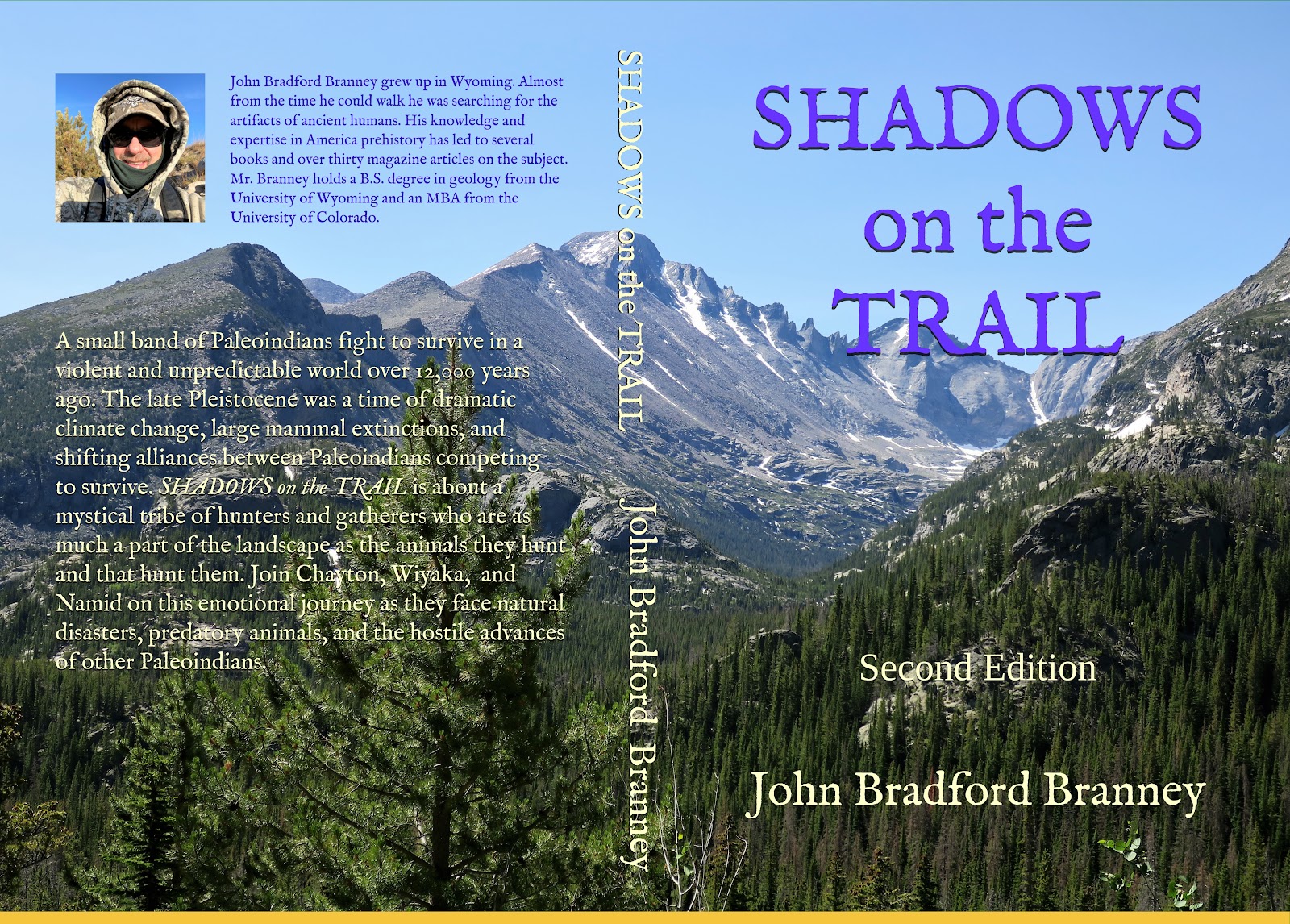
Figure Two - The first book in my historical fiction series 
about the Folsom People.  

On December 20, 1986, I made my first trip to the ranch where the site was. The road was not much better than a rutted Jeep trail. Back then, I was driving a front-wheel drive car with little ground clearance. I slowly drove on that glorified cow trail for about five miles never knowing when or where I might hit something hard enough to rip my car's oil pan off.  About two hundred yards away from the tiny ranch house, the road crossed a dry creek bed filled with sand. I punched the accelerator and the vehicle slid across the top of that sand like a toboggan on snow. I felt very fortunate that I made it through the sandy creek bottom without high-centering my low-slung vehicle in the sand. I concluded from the condition of the road that the ranchers didn't make it to town too often.
When I reached the ranch house, another surprise awaited me. The ranchers owned a humongous St. Bernard dog, and when it saw my car coming, it bolted off the front porch to greet me and my vehicle. The dog was tall enough to stand there on all fours and peer right into my driver's side window. Anyone who has ever been around St. Bernard dogs knows that they are world-class slobberers. That gigantic beast 'slimed' my car window from one end to the other with a mixture of gooey dog slobber and mud. 

Needless to say, I did not even try to get out of the car. Remember, the year was 1986, a few years after the horror book and movie titled Cujo came out. In the book, Cujo was a St. Bernard dog that was crazy nuts with rabies and trapped a young boy in a car. I won't tell you how the book ended, but it didn't end well for the boy or the beast. I wondered if that St. Bernard at my car window happened to be a relative of Cujo.  

The rancher's wife heard Cujo carrying on and she called the dog off. I was relieved that the beast did not eat my entire car for breakfast. Once I received permission to hunt artifacts, I headed off to the hills with Cujo tagging along behind. The dog stayed with me for about half the day and then became bored and headed back to the ranch house. On that first hunt, I didn't do that great, finding only three broken artifacts. However, there was a positive note to the hunt; I did find a bunch of chipping debris. Early humans were definitely there! I left the ranch thinking that the site deserved another look. 

Figure Three - Prehistoric fire hearth eroding from an embankment at the SHADOWS on the
TRAIL
Site. The photograph was taken by the author on July 9, 2015. 

 
Since that first visit to the ranch, I have watched the ranch change hands four times. My artifact hunting has somehow survived five different ranch owners, which is a modern miracle in itself knowing how getting access to large ranches has plummeted in recent years. Over that same period, I have found hundreds of artifacts on the site from early Paleoindian to the historical Indian tribes. I have found a dozen or so different diagnostic projectile point types representing different archaeological complexes. The site was occupied by various prehistoric cultures from over 13,000 years ago until the European settlers showed up in the 1800s. 
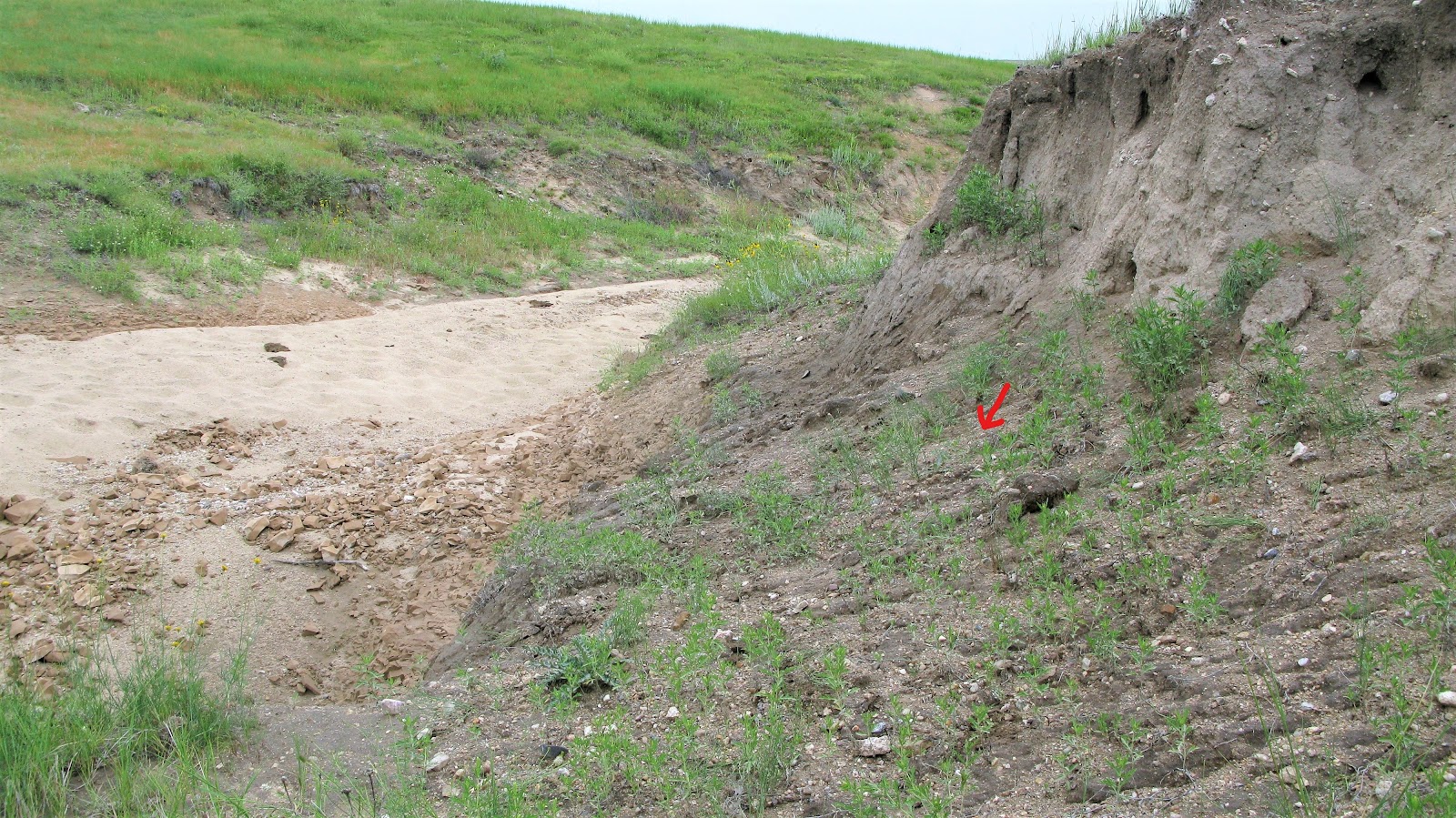
 
Figure Four - The cutbank where I found the 1.6-inch-long Lookingbill dart point
on July 9, 2015. Site in northern Colorado. The red arrow marks the spot. 

When I returned to SHADOWS on the TRAIL on July 9, 2015, the site did not disappoint me. One of the first artifacts that I found was the 1.6-inch-long Lookingbill dart point photographed in Figures one and five. Lookingbill dart points were made around 7,000 years ago. Dr. George C. Frison named Lookingbill points for a point type found in northwestern Wyoming (Frison 1983). Frison classified the Lookingbill points as Early Plains Archaic. Lookingbill points were one of the first point types on the High Plains of the Rocky Mountain states to be found in appreciable numbers associated with manos and metates.

Figure Five - 1.6-inch-long Lookingbill dart point as I found it on July 9, 2015. 


Lookingbill points were thin, small to medium-sized dart points with triangular blades and side notching. The shoulders were sharp and angular and the notches were rounded and sometimes close to the basal edge. The shapes of the bases ranged from straight to slightly concave. The Lookingbill point I found exhibited heavy grinding and polishing along the basal edge, accounting for a bit of its basal concavity.

On that July 9, 2015 artifact hunt, I found twenty-four prehistoric artifacts including the Lookingbill projectile point. 
 
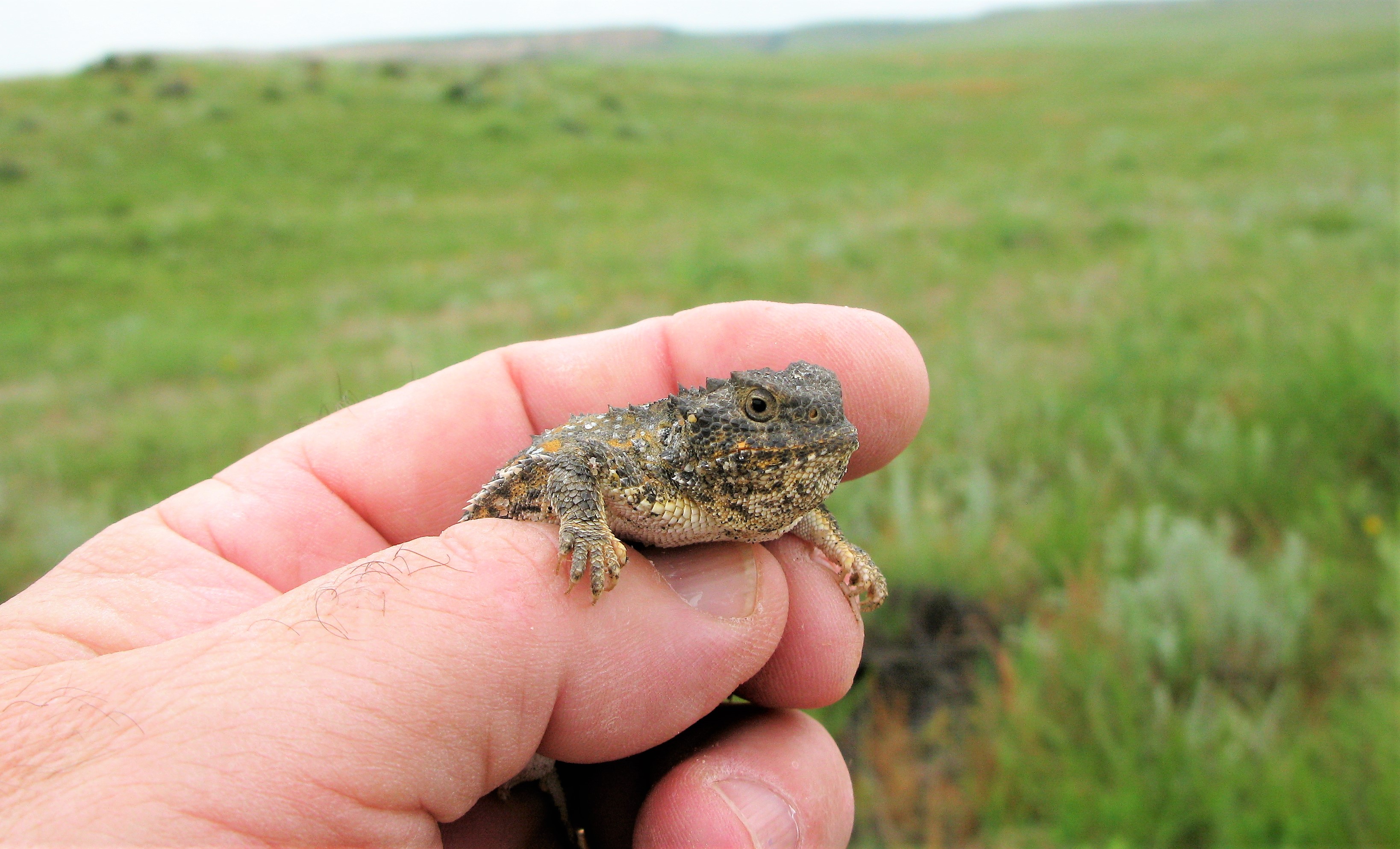
Figure Six - My hunting companion for about five feet or fifteen seconds on July 9, 2015. 
Horned toad claws are like sharp needles and that little guy was hanging on
to my thumb and finger for dear life.  

Several years before finding the Lookingbill point, on August 30, 2007, I found a 1
.36-inch-long Folsom dart point/knife form stuck in the clay-packed soil in an embankment on the ranch. When I spotted the tiny sliver of Flattop Chalcedony sticking out of the soil bank, I didn't have a clue it was an artifact. When I washed away the dirt clod surrounding it, I realized I found a Folsom point, the rarest of the rare! I was shocked, to say the least! (Figure seven).

That Folsom point was part of my inspiration behind writing my historical fiction book series about the Folsom People and that particular site titled SHADOWS on the TRAIL Pentalogy.   


Figure Seven - 1.36-inch-long semi-translucent Folsom point posing for a photograph after 
I washed the dirt off it. The embankment where it was found is behind the point.    

The true seed for my book series sprouted on a late Spring morning in 2010 at the ranch when I found a Paleoindian tool made from a red and gray striped rock from a prehistoric rock quarry in Texas (figure eight). As I stared down at a discoidal biface made by one of our First Americans, several questions raced through my mind. How did this tool end up in a prehistoric campsite in northern Colorado, five hundred miles north of its prehistoric rock quarry? Who made it? What was he or she like? What happened on its journey from Texas to northern Colorado? Since it was impossible to ask the Paleoindian who made that stone tool those questions, I wrote my own version of its journey from prehistoric Texas to Colorado.     

Figure Eight - 4.1-inch-long discoidal biface made from Alibates agatized dolomite and 
found on May 30, 2010. This artifact was the main inspiration for my book series 
SHADOWS on the TRAIL Pentalogy.  

Over the years I added more and more artifacts to my collection from the SHADOWS on the TRAIL Site, but artifact finds were becoming fewer and farther between. I was relying on erosion to keep up with my hunting pressure and it wasn't. On June 5, 2020, I surface recovered a 1.9-inch-long Scottsbluff dart point from the Cody Complex in a dry stream bed on the west side of the SHADOWS on the TRAIL Site (figure nine). That projectile point was the eighth Scottsbluff dart point/knife form that I have found on the site since 1986.   
 

Figure Nine - 1.9-inch-long Scottsbluff point that I found lying on top of
the sand in 2020. Of all the Paleoindian points I have found at the site, 
 Cody Complex and Goshen artifacts are the most common rarities.   


Rains ended a dry spell for Paleoindian artifacts from 2020 to 2023. On May 23, 2023, I discovered a 1.4-inch-long Midland or Goshen point eroding from an embankment (Figure ten). I am not sure whether that point is a Midland or a Goshen point. If it was a Midland point, it was the third diagnostic Midland artifact that I found at the site. I previously found two Midland projectile point bases on two separate occasions. If it was a Goshen point, it would be the tenth diagnostic Goshen artifact from the site.  


Figure Ten - 1.4-inch-long, very thin Midland point
found May 27, 2023. 

Goshen and Midland projectile points are very similar and when they are surface found out of their archaeological context, it is difficult to impossible to distinguish between them. The two projectile point types have more in common than they have differences. The criteria that I use to distinguish Goshen from Midland points found on the surface of the ground are 1). the aggressive basal thinning strikes on Goshen projectile points and 2). Midland points were flat and oftentimes bore fine pressure retouching around a good deal of the circumference of the point. Even those criteria are not conclusive. For example, the thin Midland projectile point in Figure ten has basal thinning strikes on one face. Is it a Goshen point or a Midland point, or does it really matter? For the answer to that last question, I refer you to Branney (2022). 

The Hell Gap site in eastern Wyoming is unparalleled in North America for its continuous record of Paleoindian deposits. Bruce Bradley (2009:259-262) in his analysis of bifacial technology at the Hell Gap site pondered the relationship between Goshen-Folsom-Midland.  Over the years, Bradley was involved in the Folsom-Midland debate and later in the Goshen-Plainview debate. At the Hell Gap site, Bradley was attempting to determine the cultural and technological relationship between Folsom and Midland, and Goshen and Plainview.   

Bradley struggled with determining tangible differences between Midland and Goshen and never came up with any definitive answers. He analyzed eight projectile points recovered from the Midland component at Hell Gap and identified one point as Folsom, two points as Goshen, one point as unclassified, and four points as Midland.

After that analysis, Bradley concluded, “As I look back at these classifications and reevaluate them in light of my confusion over the separation of the unfluted points, I am as unsure as ever that these categories are really meaningful. Nevertheless, I maintain my original classifications for those discussions.”


Figure Eleven - "G" was where I found the Midland point on May 27, 2023. "O" is an 
organic layer that runs through the site. I believe it represents the deposits during
the Paleoindian occupation at the site. 
 
Every artifact hunter or archaeologist needs a site like SHADOWS on the TRAIL. For me, it is a place where I can fulfill my artifact dreams, or at least try. The land is so beautiful and I am sure that was one of the reasons prehistoric people periodically occupied the site for over 13,000 years. When I am walking that land, I really don't need to find artifacts to enjoy myself. Finding the occasional artifact is an added bonus to the site. I have been 'skunked' on the site a few times, but what keeps me coming back is wondering what incredible artifact is lying there and waiting for me to return.  

References cited 

2009  Bradley, Bruce A.

"Bifacial Technology and Paleoindian Projectile Points" in Hell Gap, a Stratified Paleoindian Campsite at the Edge of the Rockies. The University of Utah Press. Salt Lake.  


2022  Branney, John Bradford
          "Unwinding a Twister-Goshen-Plainview/Midland". Academia.     

1983  Frison, George C. 

         "The Lookingbill Site, Wyoming 48FR308". Tibewa. 20:1-16.

1931  Renaud, E. B.
         Archaeological Survey of Eastern Colorado, First Report. Archaeological Survey,                  Department of Anthropology, University of Denver.   


About the Author


The historical fiction novels written by John Bradford Branney are known for their impeccable research and biting realism. In his latest blockbuster novel Beyond the Campfire, Branney catapults his readers back into Prehistoric America where they reunite with some familiar faces from Branney’s best-selling prehistoric adventure series the Shadows on the Trail Pentalogy.

John Bradford Branney holds a geology degree from the University of Wyoming and an MBA from the University of Colorado. John lives in the Colorado mountains with his family. Beyond the Campfire is the eleventh published book by Branney.